2.40.1 Levelling Device, Lift Car — Any mechanism which either automatically or under the control of the operator, moves the car within the levelling zone towards the landing only, and automatically stops it at the landing.
2.40.2 Levelling Device, One Way Automatic — A device which corrects the car level only in case of under run of the car but will not maintain the level during loading and unloading.
2.40.3 Levelling Device, Two-Way Automatic Maintaining — A device which corrects the car level on both under run and over-run and maintains the level during loading and unloading.
2.40.4 Levelling Device, Two Way Automatic Non-Maintaining — A device which corrects the car level on both under run and over run but will not maintain the level during loading and unloading.
2.41 Levelling Zone — The limited distance above or below a lift landing within which the levelling device may cause movement of the car towards the landing.
2.42 Lift — An appliance designed to transport persons or materials between two or more levels in a vertical or substantially vertical direction by means of a guided car or platform. The word ‘elevator’ is also synonymously used for ‘lift’.
2.43 Lift Car — The load carrying unit with its floor or platform, car frame and enclosing bodywork.
2.44 Lift Landing — That portion of a building or structure used for discharge of passengers or goods or both into or from a lift car.
2.45 Lift Machine — The part of the lift equipment comprising the motor and the control gear therewith, reduction gear (if any), brake(s) and winding drum or sheave, by which the lift car is raised or lowered.
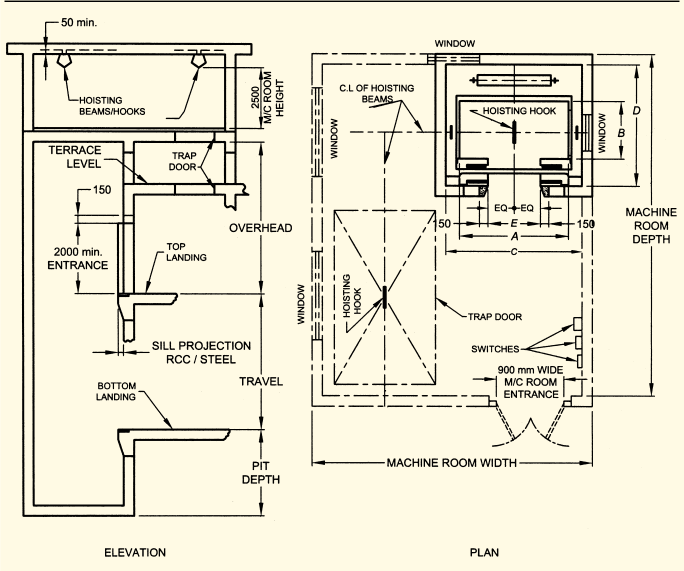
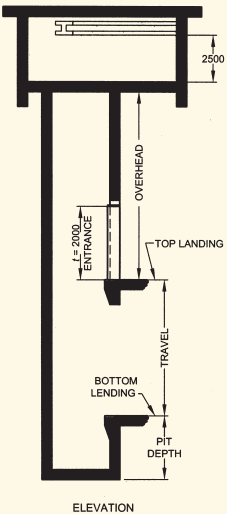
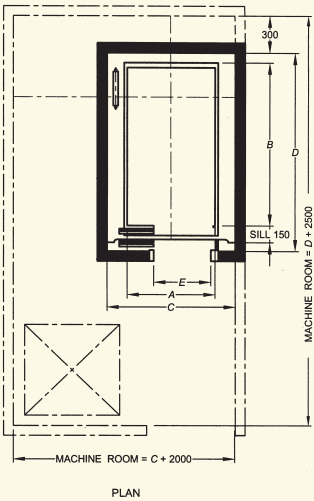
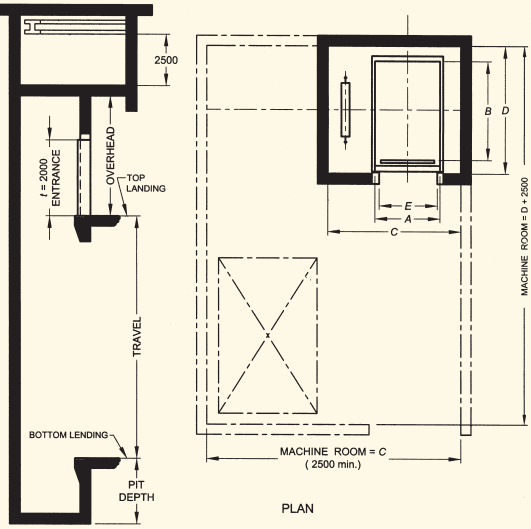
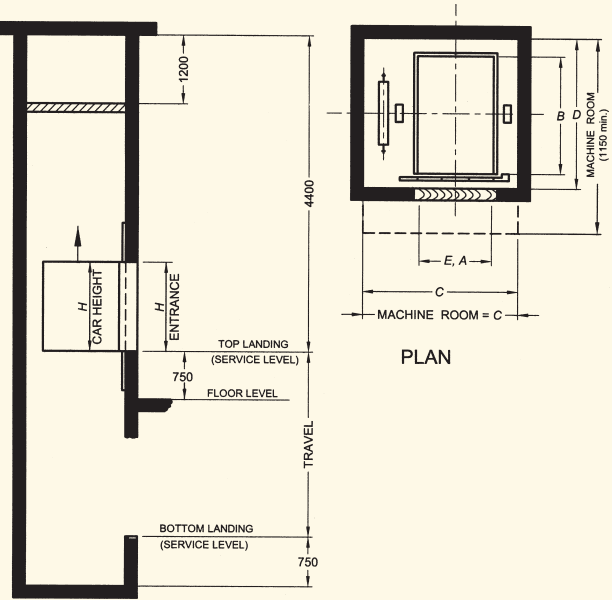
2.46 Lift Pit — The space in the lift well below the level of the lowest lift landing served.
2.47 Lift Well — The unobstructed space within an enclosure provided for the vertical movement of the
lift car(s) and any counterweight(s), including the lift pit and the space for top clearance.
2.48 Lift Well Enclosure — Any structure which separates the lift well from its surroundings.
2.49 Operation — The method of actuating the control of lift machine.
2.49.1 Automatic Operation — A method of operation in which by a momentary pressure of a button the lift car is set in motion and caused to stop automatically at any required lift landing.
2.49.2 Non-Selective Collective Automatic Operation — Automatic operation by means of one button in the car for each landing level served and one button at each landing, wherein all stops registered by the momentary actuation of landing or car buttons are made irrespective of the number of buttons actuated or of the sequence in which the buttons are actuated. With this type of operation, the car stops at all landings for which buttons have been actuated making the stops in the order in which the landings are reached after the buttons have been actuated but irrespective of its direction of travel.
2.49.3 Selective Collective Automatic Operation — Automatic operation by means of one button in the car for each landing level served and by up and down buttons at the landings, wherein all stops registered by the momentary actuation of the car made as defined under non-selective collective automatic operation, but wherein the stops registered by the momentary actuation of the landing buttons are made in the order in which the landings are reached in each direction of travel after the buttons have been actuated. With this type of operation, all ‘up’ landing calls are answered when the car is travelling in the up direction and all ‘down’ landing calls are answered when the car is travelling in the down direction, except in the case of the uppermost or lowermost calls which are answered as soon as they are reached irrespective of the direction of travel of the car.
2.49.4 Single Automatic Operation — Automatic operation by means of one button in the car for each landing level served and one button at each landing so arranged that if any car or landing button has been actuated, the actuation of any other car or landing operation button will have no effect on the movement of the car until the response to the first button has been completed.
2.49.5 Group Automatic Operation — Automatic operation of two or more non-attendant lifts equipped with power-operated car and landing doors. The operation of the cars is co-ordinated by a supervisory operation system including automatic dispatching means whereby selected cars at designated dispatching
points automatically close their doors and proceed on their trips in a regulated manner.
Typically, it includes one button in each car for each floor served and up and down buttons at each landing (single buttons at terminal landings). The stops set up by the momentary actuation of the car buttons are made automatically in succession as a car reaches the corresponding landings irrespective of its direction of travel or the sequence in which the buttons are actuated. The stops set up by the momentary actuation of the landing buttons may be accomplished by any lift in the group, and are made automatically by the first available car that approaches the landing in the corresponding direction.
2.49.6 Car Switch Operation — Method of operation by which the movement of lift car is directly under the operation of the attendant by means of a handle.
2.49.7 Signal Operation — Same as collective operation, except that the closing of the door is initiated by the attendant.
2.49.8 Double Button (Continuous Pressure) Operation — Operation by means of buttons or switches in the car and at the landings any of which may be used to control the movement of the car as long as the button or switch is manually pressed in the actuating position.
2.50 Operating Device — A car switch, push button or other device employed to actuate the control.
2.51 Overhead Beams — The members, usually of steel, which immediately support the lift equipment at the top of the lift well.
2.52 Over Speed Governor — An automatic device which brings the lift car and/or counter weight to rest by operating the safety gear in the event of the speed in a descending direction exceeding a predetermined limit.
2.53 Passenger Lift — A lift designed for the transport of passengers.
2.54 Position and/or Direction Indicator — A device which indicates on the lift landing or in the lift car or both, the position of the car in the lift well or the direction or both in which the lift car is travelling.
2.55 Rated Load (Lift) — The maximum load for which the lift car is designed and installed to carry safely at its rated speed.
2.56 Rated Load (Escalator) — The load which the escalator is designed and installed to lift at the rated speed.
2.57 Rated Speed (Lift) — The mean of the maximum speed attained by the lift car in the upward and downward direction with rated load in the lift car.
2.58 Rated Speed (Escalator) — The speed at which the escalator is designed to operate. It is the rate of travel of the steps, measured along the angle of inclination, with rated load on the steps or carriage.
2.59 Retiring Cam — A device which prevents the landing doors from being unlocked by the lift car unless it stops at a landing.
2.60 Roping Multiple — A system of roping where, in order to obtain a multiplying the factor from the machine to the car, multiple falls of rope are run around sheave on the car or counterweight or both. It includes roping arrangement of 2 to 1.3 to 1 etc.
2.61 Safety Gear — A mechanical device attached to the lift car or counterweight or both, designed to stop and to hold the car or counterweight to the guides in the event of free fall, or, if governor operated, of overspeed in the descending direction. Any anticipated impact force shall be added in the general drawing or layout drawing.
2.62 Service Lift — A passenger cum goods lift meant to carry goods along with people.
Typically in an office building this may be required to carry food or stationeries, in a residential building to carry a bureau or accommodate a stretcher and in a hotel to be used for food trolleys or baggage. There is a need in such lifts, to take care of the dimensions of the car and the door clear opening in line with the type of goods that may have to be carried based on mutual discussion between supplier and customer. Also, such lifts shall have buffer railings in the car at suitable height to prevent damage to the car panels when the goods are transported. Typically such lifts, if provided with an automatic door, may use some means to detect trolleys and stretcher movement in advance to protect the doors against damage. The car floor load calculations and car area of such a lift is as in the case of a passenger lift except that these are not meant to carry heavy concentrated loads.
2.63 Sheave — A rope wheel, the rim of which is grooved to receive the suspension ropes but to which the ropes are not rigidly attached and by means of which power is transmitted from the lift machine to the suspension ropes.
2.64 Slack Rope Switch — Switch provided to open the control circuit in case of slackening of rope(s)
2.65 Suspension Ropes — The ropes by which the car and counter weight are suspended.
2.66 Terminal Slow Down Switch — A switch when actuated shall compulsorily cut off the high speed and switch on the circuitry to run the lift in levelling speed before reaching on terminal landings.
2.67 Terminal Stopping Switch Normal — Switch for cutting all the energizing current in case of car travelling beyond the top bottom landing or a switch cuts off the energizing current so as to bring the car to stop at the top and bottom level.
2.68 Terminal Stopping Device Final — A device which automatically cause the power to be removed from an electric lift driving machine motor and brake, independent of the functioning of the normal terminal stopping device, the operating device or any emergency terminal stopping device, after the car has passed a terminal landing.
2.69 Total Headroom — The vertical distance from the level of the top lift landing to the bottom of the machine room slab.
2.70 Travel — The vertical distance between the bottom and top lift handing served.
2.71 Geared Machine — A machine in which the power is transmitted to the sheave through worm or worm and spur reduction gearing.