2.1 Lighting
2.1.1 Altitude (θ) — The angular distance of any point of celestial sphere, measured from the horizon, on the great circle passing through the body and the zenith (see Fig. 1).
2.1.2 Azimuth (φ) — The angle measured between meridians passing through the north point and the point in question (point C in Fig. 1).
CELESTIAL BODY
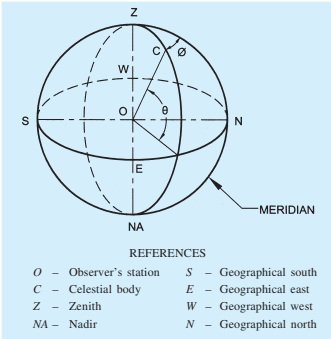
FIG. 1 ALTITUDE AND AZIMUTH OF A
5
2.1.3 Brightness Ratio or Contrast — The variations or contrast in brightness of the details of a visual task, such as white print on blackboard.
2.1.4 Candela (cd) — The SI unit of luminous intensity.
Candela = 1 lumen per steradian
2.1.5 Central Field — The area of circle round the point of fixation and its diameter, subtending an angle of about 2 ° at the eye. Objects within this area are most critically seen in both their details and colour.
2.1.6 Clear Design Sky — The distribution of luminance of such a sky is non-uniform; the horizon is brighter than the zenith, and when L z is the brightness at zenith, the brightness at an altitude (θ) in the region away from the sun, is given by the expression:
when θ lies between 1 5 ° and 9 0 ° , and L e is constant when θ lies between 0 ° and 1 5 ° ,
2.1.7 Colour Rendering Index (CRI) — Measure of the degree to which the psychophysical colour of an object illuminated by the test illuminant conforms to that of the same object illuminated by the reference illuminant, suitable allowance having been made for the state of chromatic adaptation.
2.1.8 Correlated Colour Temperature (CCT) (Unit: K) — The temperature of the Planckian radiator whose perceived colour most closely resembles that of a given stimulus at the same brightness and under specified viewing conditions.
2.1.9 Daylight Area — The superficial area on the working plane illuminated to not less than a specified daylight factor, that is, the area within the relevant contour.
2.1.10 Daylight Factor — The measure of total daylight illuminance at a point on a given plane expressed as the ratio (or percentage) which the illuminance at the point on the given plane bears to the simultaneous illuminance on a horizontal plane due to clear design sky at an exterior point open to the whole sky vault, direct sunlight being excluded.
2.1.11 Daylight Penetration — The maximum distance to which a given daylight factor contour penetrates into a room.
2.1.12 Direct Solar Illuminance — The illuminance from the sun without taking into account the light from the sky.
2.1.13 External Reflected Component (ERC) — The ratio (or percentage) of that part of the daylight illuminance at a point on a given plane which is received by direct reflection from external surfaces as compared to the simultaneous exterior illuminance on a horizontal plane from the entire hemisphere of an unobstructed clear design sky.
2.1.14 Glare — A condition of vision in which there is discomfort or a reduction in the ability to see
significant objects or both due to an unsuitable distribution or range of luminance or due to extreme contrasts in space and time.
2.1.15 Illuminance — At a point on a surface, the ratio of the luminous flux incident on an infinitesimal element of the surface containing the point under consideration to the area of the element.
NOTE — The unit of illuminance (the measurement of illumination) is lux which is 1 lumen per square metre.
2.1.16 Internal Reflected Component (IRC) — The ratio (or percentage) of that part of the daylight illuminance at a point in a given plane which is received by direct reflection or inter-reflection from the internal surfaces as compared to the simultaneous exterior illuminance on a horizontal plane due to the entire hemisphere of an unobstructed clear design sky.
2.1.17 Light Output Ratio (LOR) or Efficiency (η ) — The ratio of the luminous flux emitted from the luminaire to that emitted from the lamp(s) (nominal luminous flux). It is expressed in percent.
2.1.18 Lumen (lm) — SI unit of luminous flux. The luminous flux emitted within unit solid angle (one steradian) by a point source having a uniform intensity of one candela.
2.1.19 Luminance (At a point of a Surface in a Given Direction) (Brightness) — The quotient of the luminous intensity in the given direction of an infinitesimal element of the surface containing the point under consideration by the orthogonally projected area of the element on a plane perpendicular to the given direction. The unit is candela per square metre (cd/m2).
2.1.20 Luminous Flux (φ) — The quantity characteristic of radiant flux which expresses its capacity to produce visual sensation evaluated according to the values of relative luminous efficiency for the light adapted eye:
a) Effective luminous flux (φ ) — Total luminous flux which reaches the working plane.
b) Nominal luminous flux (φ ) — Total luminous flux of the light sources in the interior.
2.1.21 Maintenance Factor (d) — The ratio of the average illuminance on the working plane after a certain period of use of a lighting installation to the average illuminance obtained under the same conditions for a new installation.
2.1.22 Meridian — It is the great circle passing through the zenith and nadir for a given point of observation.
2.1.23 North and South Points — The point in the respective directions where the meridian cuts the horizon.
2.1.24 Orientation of Buildings — In the case of non-square buildings, orientation refers to the direction of the normal to the long axis. For example, if the length of the building is east-west, its orientation is northsouth.
2.1.25 Peripheral Field — It is the rest of the visual field which enables the observer to be aware of the spatial framework surrounding the object seen.
NOTE — A central part of the peripheral field, subtending an angle of about 30° on either side of the point of fixation, is chiefly involved in the perception of glare.
2.1.26 Reflected Glare — The variety of ill effects on visual efficiency and comfort produced by unwanted reflections in and around the task area.
2.1.27 Reflection Factor (Reflectance) — The ratio of the luminous flux reflected by a body (with or without diffusion) to the flux it receives. Some symbols used for reflection factor are:
r c = Reflection factor of ceiling.
r w = Reflection factor of parts of the wall between the working surface and the luminaires.
r f = Reflection factor of floor.
2.1.28 Reveal — The side of an opening for a window.
2.1.29 Room Index ( k r ) — An index relating to the shape of a rectangular interior, according to the formula:
where L and W are the length and width respectively of the interior, and H m is the mounting height, that is, height of the fittings above the working plane.
NOTES
1 For rooms where the length exceeds 5 times the width, L shall be taken as L = 5W.
2 If the reflection factor of the upper stretch of the walls is less than half the reflection factor of the ceiling, for indirect or for the greater part of indirect lighting, the value H m is measured between the ceiling and the working plane.
2.1.30 Sky Component (SC) — The ratio (or percentage) of that part of the daylight illuminance at a point on a given plane which is received directly from the sky as compared to the simultaneous exterior illuminance on a horizontal plane from the entire hemisphere of an unobstructed clear design sky.
2.1.31 Solar Load — The amount of heat received into a building due to solar radiation which is affected by orientation, materials of construction and reflection of external finishes and colour.
2.1.32 Utilization Factor (Coefficient of Utilizaiton) ( μ ) — The ratio of the total luminous flux which reaches the working plane (effective luminous
flux, n ) to the total luminous flux of the light sources in the interior (nominal luminous flux, φ ).
2.1.33 Visual Field — The visual field in the binocular which includes an area approximately 120° vertically and 160° horizontally centering on the point to which the eyes are directed. The line joining the point of fixation and the centre of the pupil of each eye is called its primary line of sight.
2.1.34 Working Plane — A horizontal plane at a level at which work will normally be done (see 4.1.3.3 and 4.1.3.4).