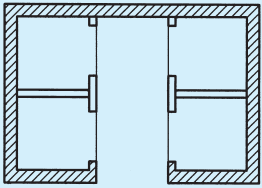
2.15.1 Door, Centre Opening Sliding — A door which
slides horizontally and consists of two or more panels which open from the centre and are usually so interconnected that they move simultaneously.
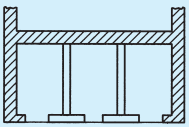
2.15.2 Door, Mid-Bar Collapsible — A collapsible door with vertical bars mounted between the normal vertical members.
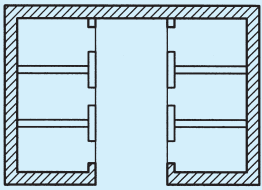
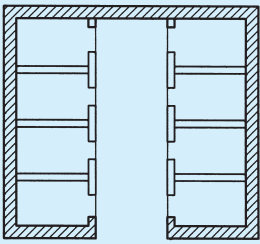
2.15.3 Door, Multipanel — A door arrangement whereby more than one panel is used such that the panels are connected together and can slide over one another by which means the clear opening can be maximized for a given shaft width. Multipanels are used in centre opening and two speed sliding doors.
2.15.4 Door, Single Slide — A single panel door which slides horizontally.
2.15.5 Door, Two Speed Sliding — A door which slides horizontally and consists of two or more panels, one of which moves at twice the speed of the other.
2.15.6 Door, Vertical Bi-parting — A door which slides vertically and consists of two panels or sets of panels that move away from each other to open and are so interconnected that they move simultaneously.
2.15.7 Door, Vertical Lifting — A single panel door, which slides in the same plane vertically up to open.
2.15.8 Door, Swing — A swinging type single panel door which is opened manually and closed by means of a door closer when released.
2.16 Door Closer — A device which automatically closes a manually opened door.
2.17 Door Operator — A power-operated device for opening and closing doors.
2.18 Dumb Waiters — A lift with a car which moves in guides in a vertical direction; has a net floor area of 1 m2, total inside height of 1.2 m, whether or not provided with fixed or removable shelves; has a capacity not exceeding 250 kg and is exclusively used for carrying materials and shall not carry any person.
2.19 Electrical and Mechanical Interlock — A device provided to prevent simultaneous operation of both up and down relays.
2.20 Electro-Mechanical Lock — A device which combines in one unit, electrical contact and a mechanical lock jointly used for the landing and/or car doors.
2.21 Emergency Stop Push or Switch — A push button or switch provided inside the car designed to open the control circuit to cause the lift car to stop during emergency.
2.22 Escalator — A power driven, inclined, continuous stairway used for raising or lowering passengers.
2.23 Escalator Installation — It includes the escalator, the track, the trusses or girders, the balustrading, the step treads and landings and all chains, wires and machinery directly connected with the operation of the escalator.
2.24 Escalator Landing — The portion of the building or structure which is used to receive or discharge passengers into or from an escalator.
2.25 Escalator Landing Zone — A space extending from a horizontal plane 40 cm below a landing to a plane 40 cm above the landing.
2.26 Escalator Machine — The mechanism and other equipment in connection therewith used for moving the escalator
2.27 Floor Levelling Switch — A switch for bringing the car to level at slow speed in case of double speed or variable speed machines.
2.28 Floor Selector — A mechanism forming a part of the control equipment, in certain automatic lifts, designed to operate controls which cause the lift car to stop at the required landings.
2.29 Floor Stopping Switch — A switch or combination of switches arranged to bring the car to rest automatically at or near any pre-selected landing.
2.30 Gearless Machine — A lift machine in which the motive power is transmitted to the driving sheave from the motor without intermediate reduction gearing and has the brake drum mounted directly on the motor shaft.
2.31 Goods Lift — A lift designed primarily for the transport of goods, but which may carry a lift attendant or other persons necessary for the loading or unloading of goods.
2.32 Guide Rails — The members used to guide the movement of a lift car or counterweight in a vertical direction.
2.33 Guide Rails Fixing — The complete assy. comprising the guide rails bracket and its fastenings.
2.34 Guide Rails Shoe — An attachment to the car frame or counterweight for the purpose of guiding the lift car or counter weight frame.
2.35 Hoisting Beam — A beam, mounted immediately below the machine room ceiling, to which lifting tackle can be fixed for raising or lowering parts of the lift machine.
2.36 Hospital Lift — A lift normally installed in a hospital/dispensary/clinic and designed to accommodate one number bed/stretcher along its depth, with sufficient space around to carry a minimum of three attendants in addition to the lift operator.
2.37 Landing Call Push — A push button fitted at a lift landing, either for calling the lift car, or for actuating the call indicator.
2.38 Landing Door — The hinged or sliding portion of a lift well enclosure, controlling access to a lift car at a lift landing.
2.39 Landing Zone — A space extending from a horizontal plane 400 mm below a landing to a plane 400 mm above the landing.