This Section covers the requirements with regard to public safety, structural safety and fire safety of all signs and outdoor display structures.
Loading…
No sign shall be erected, altered or maintained without first obtaining a permit for the same from the Authority and shall be subjected to the following conditions:
a) The written permission shall not be granted or renewed at any one time, for a period exceeding three years from the date of grant of such permission or renewal.
b) The written permission or the renewal granted by the Authority shall become void:
if any sign or the part thereof falls either through an accident or any other causes;
if any addition is made except for the purpose of making it secure under the direction of the Authority;
if any change is made in the sign or part thereof;
if any addition or alteration is made to the building or structure upon or over which the sign is erected and if such addition or alteration involves disturbance of the sign or any part thereof; and
if the building or structure upon or over which the sign is erected fixed or restrained becomes demolished or destroyed.
c) Light and ventilation of buildings, if any situated near the signs and hoardings shall not be obstructed in any way;
d) Advertisements displayed shall not be of any objectionable or obscene nature given in 3.3;
e) In the public interest the Authority shall have the right to suspend the licence even before the expiry period, upon which the licencee shall remove the signs;
f) The licencee shall be responsible for the observance of all the rules and regulations laid down by the Authority;
g) The signs should not mar the aesthetic beauty of the locality;
h) The signs other than pertaining to building shall not be permitted to come in front of buildings such as hospitals, educational institutions, public offices, museums, buildings devoted to religious worship and buildings of national importance;
j) Maintenance and inspection of advertising signs and their supports shall be as given in 4.
k) No hoarding sign on the highways shall be put without the permission of the Authority maintaining/incharge of flyovers, highways/ roads; and
m) In addition all signs shall conform to the general requirements given in 6.
n) The signs shall not be nailed or tied to trees or any other woody vegetation.
Every person intending to erect, alter or display an advertising sign for which a permit or licence is
required, shall make application to the Authority on the prescribed form containing such particulars as the Authority may require. Such a form (see Annex A) shall be signed by the applicant and by the owner of the site upon which such sign is or is to be situated and shall include the following information:
a) Full specifications showing the length, height and weight of the sign, the location where it is to be erected, the manufacturer’s name and address and where applicable, the number of lights and electrical details of the same.
b) Such form shall be accompanied by a location plan indicating the position of the sign on the site drawn to a scale of 1:500 and by full detail drawing drawn to a scale of 1:20 or an exact multiple thereof in ink or on prints including, if required by the Authority, an elevation showing the sign in relation to the façade.
c) In the case of roof signs, projecting signs or ground signs in addition to the foregoing, the size of all members of supporting frameworks and anchorages, and, if required by the Authority, the necessary design calculations shall be furnished with the application.
d) Any other particulars as may be desired by the Authority covered in 6.
e) In the case of sky signs, necessary information as desired by the Authority may be supplied.
3.1.3 The Authority may, on the receipt of an application for permit, either sanction or refuse such a permit or sanction with modifications as deemed necessary and shall communicate decision to the applicant. If within 30 days or receiving an application for a permit the Authority fails to intimate in writing to the applicant, the permit along with the plans shall be deemed as sanctioned.
3.1.4 When a sign has to be altered, information only on such plans and statements, as may be necessary, shall be included in the form. However, the changing of movable parts of an approved sign that is designed for such changes, shall not be deemed an alteration provided the conditions of the original approval and the requirements of this part are not violated.
Advertising signs in existence at the date of promulgation of the Code and covered by a valid licence or permit issued by the Authority shall not require to be licensed under the Code until such licence or permit has expired, provided it is maintained in a good and safe condition.
3.1.6 For advertising signs application shall be submitted through a structural engineer along with
| PRIVATE PROPERTY | TRESPASSERS WILL BE PROSECUTED |
|---|
necessary drawings and structural calculations. The wind load taken in the design calculations shall be in accordance with Part 4 ‘Structural Design, Section 1 Loads, Forces and Effects’.
When any sign becomes insecure, or in danger of falling, or otherwise unsafe, or if any sign shall be unlawfully installed, erected or maintained in violation of any of the provisions of the Code, the owner thereof, or the person or firm maintaining the same, shall upon written notice of the Authority, forthwith in the case of immediate danger and in any case within not more than three days, make such sign conform to the provisions of this part or shall remove it. If within three days the order is not complied with, the Authority may remove such sign at the expense of the owner.
3.3.1.1 Notwithstanding the above, it shall be the responsibility of the owner to ensure the safety of the advertising signs, even without a reference from the Authority. The owner shall also ensure to remove the remnant structures of the abandoned sign.
Any sign which in the opinion of the Authority is an
| Table 1 Advertising Signs for Which No Permit or License is Required (Clause 3.2.5) | ||||||
| Class (with Sample) | Area of Each Separate Sign (or Aegregate) | Maximum Height Above Ground Floor Level to Top of Sign | Identification Perforance of Higher Foundation | Description of Sign | Remarks | |
| 1) Functional signs of certain authorities statutory underkings, public transport underkings, and fire ridges, etc | BUS STATION | As may be reasonably required for the safe and efficient performance of the function | Not more than 4 m2 | Only to indicate that medical or similar services or supplies are available on premises where advertisement is displayed* | Any number | Not more than 750 mm (in area of special control) |
| 2) MisCELLANEOUS signs relating to premises on which they are displayed | X-RAY UNIT | Not more than 5 m (in area of special control 4 m) | Not more than 5 m (in area of special control 4 m) | Only to indicate that medical or similar services or supplies are available on premises where advertisement is displayed* | One at each entrance | Not more than 750 mm (in area of special control) |
| 3) Temporary signs (cloth banners) | HOUSE FOR SALE | Not more than 2.4 m2 (ratio of width to depth control 4 m) | Not more than 5 m (in area of special control 4 m) | Only to indicate that medical or similar services or supplies are available on premises where advertisement is displayed* | One on each frontage | Not more than 750 mm (in area of special control) |
| c) Relating to any institution of a religion, educational, cultural, or medical character, name of building or premises | COLLEGE OF COMERECE | Not more than 1.2 m2 each | Not more than 5 m (in area of special control 4 m) | Only to indicate that medical or similar services or supplies are available on premises where advertisement is displayed* | One at each entrance | Not more than 750 mm (in area of special control) |
| d) Person partnership or company carrying profession business, or trade, name or private person | CHAWLA & CO., LTD. | Not more than 0.3 m2 each | Not more than 5 m (in area of special control 4 m) | Only to indicate that medical or similar services or supplies are available on premises where advertisement is displayed* | One at each entrance | Not more than 750 mm (in area of special control) |
| e) XYZ FLATS | XYZ FLATS | Not more than 2.4 m2 (ratio of width to depth control 4 m) | Not more than 5 m (in area of special control 4 m) | Only to indicate that medical or similar services or supplies are available on premises where advertisement is displayed* | One on each frontage | Not more than 750 mm (in area of special control) |
| f) Small not be displayed after the sale of each sale or other matter due to start and shall be removed within 14 days after the conclusion of such sale or matter | Small not be displayed after the sale of each sale or other matter due to start and shall be removed within 14 days after the conclusion of such sale or matter | Not more than 750 mm (in area of special control given in col 2) | Any number but aegregate area not to exceed that not to exceed that given in col 2 | Not more than 750 mm (in area of special control given in col 300 mm) | Small not be displayed after the sale of each sale or other matter due to start and shall be removed within 14 days after the conclusion of such sale or matter | Shall not be displayed after the sale of each sale or other matter due to start and shall be removed within 14 days after the conclusion of such sale or matter |
1 0
| Class (with Sample) | Area of Each Separate Sign (or Aegregate) | Maximum Height Above Ground Floor Level to Top of Sign | Illumination Provided | Description of Sign | Remarks |
|---|---|---|---|---|---|
| (1) | (2) | (3) | (4) | (5) | (6) |
| (b) Signs relating to the carrying out of building or similar operations on the land where sign is displayed | NOT more than 4 m2 | Not more than 5 m (in area of special control 4 m) | One for each road frontage for each contractor or sub-contractor (in area of special control 300 mm) | May be displayed only while such works are in progresses | |
| (c) Signs announcing any local event in connection with an activity promoted for non-commercial purposes by various local organizations | Not more than 1.5 m2 (in aggregate area 4 m) | Not more than 5 m (in area of special control 4 m) | Any number but aggregate area not to exceed that given in co1 2 on any premises | Shall not be displayed earlier than 28 days before the event is due to start and shall be removed within 14 days of its conclusion | |
| (d) Signs and businesses premises for areas of special control, signs on business premises with reference to the business, the goods sold, or the services provided, etc., in these premises and those names and qualifications of the person carrying on such activity | Not to exceed one-twelfth of area of each face up to a height of 4 m | Only to indicate that medical or similar services or supplies are available where available where designated* | Any number but aggregate area not to exceed that given in co1 2 | Area to be completed if the advertisement were laid flat against the face of the building |
1 1
obscene, repulsive, revolting, or objectionable character or prejudicial to the municipality or savouring political propaganda or of a nature calculated to produce pernicious or injurious effect on public or any particular class of persons, or is displayed in such a place, in such a manner or by any such means as, in the opinion of the Authority, could be likely to affect injuriously the amenities of, or to disfigure any neighbourhood.
3.2.1 No permit shall be required for signs and outdoor display structures of the following types:
a) If the signs are exhibited within the window of any building provided it does not affect light and ventilation of the building.
b) If it relates to the trade or business carried on within the land or building upon which such advertisement is exhibited or to any sale, entertainment or meeting or lettering of such land or building or any effects therein; or to the trade or business carried on by the owner of any tramcar, omnibus or other vehicle upon which such advertisements is exhibited, provided it is not more than 1.2 m2.
c) In addition no permission shall be required for the signs covered in 3.2.2 to 3.2.5. Such exemptions, however shall not construed to relieve the owner of the sign from the responsibility of erection and maintenance in compliance with the Code.
The wall signs listed in 3.2.2.1 to 3.2.2.3 shall not require a permit.
Non-illuminated signs erected over a show window or over the door of a store or business establishment which announce the name of the proprietor and the nature of the business conducted therein; the sign shall not be more than 1 m in height and the width of the business establishment.
Signs erected on a municipal, state or central government building which announce the name, nature of the occupancy and information.
Any wall sign erected on a building or structure indicating the name of the occupant of building, which is not more than 0.5 m2 in area.
The erection or maintenance of a sign designating the location of a transit line, a rail track, station or other public carrier when not more than 0.5 m2 in area.
In general, advertisements of the following classes are permissible without permission though these should reasonably conform to the principles set out in 3.5.1:
a) Official warning signs, traffic directions, sign posting and notices or advertisements posted or displayed by or under the directions of any public or court officer in the performance of his official or directed duties.
Example:
DIVERSION AHEAD
b) Direction signs to places of public amenity, such as petrol filling stations, hospitals, firstaid posts, police stations and fire stations.
Example:
HOSPITAL
BUS STATION
c) Signs relating solely to any city, town, village or historic place, shrine, place of tourist interest:
Example:
| ELLORA CAVES |
|---|
| FARIDABADTOWN |
|---|
d) Signs, notices, etc, erected by the Defence Department for information of members of the armed forces or the public.
Example:
ARTILLERY RANGE AHEAD
e) Signs restricting trespass of property, limited to 0.2 m2 in area or less.
Example:
f) Signs or notices, 0.2 m2 in area or less, placed so as to show direction to a residence and planted sufficiently away from the carriageway.
Class (2) Advertisements Relating to the Premises on which these are Displayed:
a) Advertisements for the purpose of identification, direction or warning with respect to the land or building on which they are displayed, provided not exceeding 0.2 m2 in area in the case of any such advertisement.
Examples:

b) Advertisements relating to any person, partnership or company separately carrying on a profession, business trade at the premises where any such advertisement is displayed; limited to one advertisement not exceeding 0.3 m2 in area in respect of each such person, partnership or company.
Example:
RAM LAL & COMPANY
c) Advertisements relating to any institution of a religious, educational, cultural, recreational, medical or similar character or any hotel, public house, dark bungalow, block of flats, club, boarding house or hostel situated on the land on which any such advertisement is displayed; limited to one advertisement not exceeding 1.2 m2 in area in respect of each such person, partnership or company.
Examples:

ROTARY CLUB
Class (3) Advertisements of Temporary Nature
a) Advertisements relating to the sale or letting of the land on which they displayed; limited in respect of each such sale or letting to one advertisement not exceeding 2 m2 in area.
Examples:
TO LET
HOUSE FOR SALE
b) Advertisements announcing sale of goods or livestock, and displayed on the land where such goods or livestock are situated or where such sale is held, limited to one advertisement not exceeding 1.2 m2 in area.
Examples:

c) Advertisements relating to the carrying out of building or similar work on the land on which they displayed exceeding 2 m2 in area.
Example:
d) Advertisements announcing any local event of a religious, educational, cultural, political, social or recreational character, not being an activity promoted or carried on for commercial purposes; limited to a display of advertisements occupying an area not exceeding 0.6 m2 on any premises.
Examples:
DIWALI MELA

FLOWER SHOW
Construction signs, engineers’ and architects’ signs and other similar signs which may be authorized by the Authority in connection with construction operations (see Table 1).
Special decorative displays used for holidays, public demonstrations or promotion of civic welfare or charitable purposes, on which there is no commercial advertising, provided that the Authority is not held responsible for any resulting damage (see 15.2.2).
3.2.5 The qualitative requirements of signs given in Table 1 shall not require any permit.
Where the Authority is of the opinion that any site is unsuitable for display of advertising signs by virtue of the general characteristics of the locality in regard to historic, architectural, cultural or similar interest, or by virtue of its position, the display of such signs is likely to affect in any way the safety of any form of transport, erection of advertising signs on such a site shall be prohibited.
In general the following advertisements should not be permitted:
a) At or within 100 m of any road junction, bridge or railway crossing or another crossing. In urban areas, this distance may be reduced to 50 m, provided there is no conflict with the requirements stated further on;
NOTE — The safe stopping distance for a vehicle travelling at a speed of 50 km/h is 60 m. This should be the ‘uninfluenced distance’ for a driver approaching a junction. Assuming that 3 seconds is the time during which the influence of an advertisement board persists, the distance travelled in this time will be about 40 m. The sign should, therefore, be more than 100 m away from the junction. Hence 100 m is suggested.
b) In such manner and at such places as to obstruct or interfere with the visibility of approaching, merging or intersecting traffic;
c) Within 10 m of the edge of a carriageway;
NOTE — A distance of 10 m may be taken as the normal minimum setback from the edge of the carriageway, the maximum area of the advertisement being 0.3 m2 for every metre of setback.
d) Within 50 m along the road, of any sign board erected for the regulation of traffic under the orders of a Public Authority, such as a Traffic Authority, a Public Transport Authority, or a Local Authority;
e) In such a form as will obscure or hinder interpretation of any sign, signal or other device erected for traffic control by the Public Authorities. For instance, the advertisements should not imitate or resemble, in colour or shape, the standard legal traffic signs, or employ such words as ‘STOP’ in the same manner as used on traffic signs;
f) On boards, placards, cloth banners or sheets (except traffic signs) hung across a road as they distract the attention of driver and are, therefore, hazardous;
NOTE — Any advertisement allowed on the sides of a foot over bridge or flyover across the carriage-ways shall be restricted in size and shape such that no part of the advertisement board projects beyond the top, bottom and sides of the parapet of foot over bridge or flyover.
g) In such form as will obstruct the path of pedestrians and hinder their visibility at crossings;
h) Within right-of-way of the road; and
j) When these will affect local amenity.
3.5.2 Illuminated advertisements of the following description are objectionable from the angle or traffic safety and should not be allowed:
a) Advertisements which contain, include or are
illuminated by any flashing, intermittent or moving light or lights except those giving public service information, such as time, temperature, weather or date;
b) Illuminated advertisements of such intensity or brilliance as to cause glare or impair vision of the driver or pedestrians, or which otherwise interfere with any operations of driving; and
c) Advertisements illuminated in such a way as to obscure or diminish effectiveness of any official sign, device or signal.
All signs for which a permit is required, together with all their supports, braces, guys and anchors shall be kept in good repair, both structurally and aesthetically, and when not galvanized or constructed of approved corrosion-resistive non-combustible materials, shall be painted when necessary to prevent corrosion.
It shall be the duty and responsibility of the owner of every sign to maintain the immediate premises occupied by the sign, in a clean, sanitary and healthy condition.
Every sign for which a permit has been issued and every existing sign for which a permit is required shall be inspected by the Authority at least once in every calendar year.
In this part, the following types of signs are covered [see also a few explanatory figures of general sign types (Fig. 1A), comparison of roof and wall or fascia sign (Fig. 1B) and sign area computation methodology (Fig. 1C and 1D)].
a) Electric and illuminated signs (see 7);
b) Ground signs (see 8);
c) Roof signs (see 9);
d) VERANDAH signs (see 10);
e) Wall signs (see 11);
f) Projecting signs (see 12);
g) Marquee signs (see 13);
h) Sky signs (see 14); and
j) Miscellaneous and temporary signs (see 15).
Every electric sign shall be constructed of non-combustible material except where the sign is purely a flood-lit sign.
Every electric sign and illuminated sign shall be installed in accordance with Part 8 ‘Building Services, Section 2 Electrical and Allied Installations’.
7.3 No illuminated sign in red, amber or green colour shall be erected or maintained within a horizontal distance of 10 m of any illuminated traffic sign.
7.4 All advertising signs illuminated by light other than a white light at height of less than two storeys or 6 m above the footpath, whichever be the greater height, shall be suitably screened so as to satisfactorily prevent any interference with any sign or signal for the control of traffic.
No person shall erect any sign which is of such intense illumination as to disturb the residents in adjacent or nearby residential buildings. Notwithstanding any permission given for such erection, any such sign
which after erection is, in the opinion of the Authority, of such intense illumination as to disturb the occupants of adjacent or nearby buildings shall, on the order of the Authority, be suitably altered or removed by the owner of the site concerned within such reasonable period as the Authority may specify.
No electric sign, other than those necessary in the opinion of the Authority in the interest of public amenity, health and safety, shall be operated between midnight and sunrise.
No flashing, occulting or animated advertising signs, the periodicity of which exceeds 30 flashes to the minute, shall be erected so that the lowest point of such signs is less than 9 m above the ground level.
7.8 For illuminated signs in the vicinity of airports, the Directorate General of Civil Aviation should be consulted.
Every advertising sign shall be designed so as to
withstand safely the wind, dead, seismic and other loads as set out in Part 6 ‘Structural Design, Section 1 Loads, Forces and Effects’.
No sign shall be illuminated by other than electrical means and electrical devices and wiring shall be installed in accordance with the requirements of Part 8 ‘Building Services, Section 2 Electrical and Allied Installations’. In no case, shall any open spark or flame be used for display purposes unless specifically approved by the Authority.
a) Sign should not obstruct any pedestrian movement, fire escape, door or window, opening used as a means for egress or fire fighting purposes.
b) No sign shall in any form or manner interfere with openings required for light and ventilation.
c) When possible signs should be gathered together into unified systems. Sign clutter should be avoided in the landscape.
d) Signs should be combined with lighting fixture to reduce unnecessary posts and for ease of illuminating the signs.
e) Information signs should be placed at natural gathering spots and included in the design of sight furniture.
f) Placement of sign should be avoided where they may conflict with pedestrian traffic.
g) Sign should be placed to allow safe pedestrian clearance vertically and latterly.
h) Braille strips may be placed along sign edges or raised letters may be used for readability for the blind and partially sighted.
j) No sign shall be attached in anyway to a tree or shrub.
Wood or plastic or other materials of combustible characteristics similar to wood may be used for mouldings, cappings, nailing blocks, letters and latticing where permitted and for other purely ornamental features of signs.
Sign facings may be made of approved combustible materials provided the area of each face is not more than 10 m2 and the wiring for electric lighting is entirely enclosed in metal conduit and installed with a clearance of not less than 5 cm from the facing material.

COMMON FREESTANDING SIGN TYPE

WALL OR FASCIA SIGNS ON STOREFRONTS
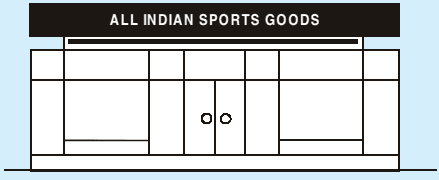
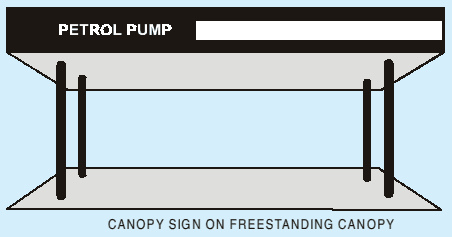
1A GENERAL SIGN TYPES
FIG. 1 TYPICAL EXAMPLES OF SIGN TYPE — Continued

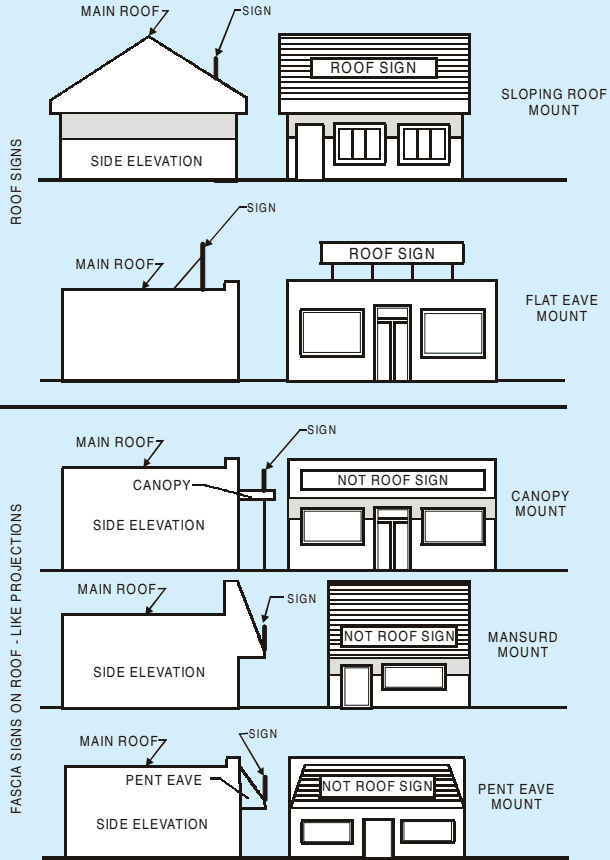
1B COMPARISON – ROOF AND WALL OR FASCIA SIGNS
FIG. 1 TYPICAL EXAMPLES OF SIGN TYPE — Continued
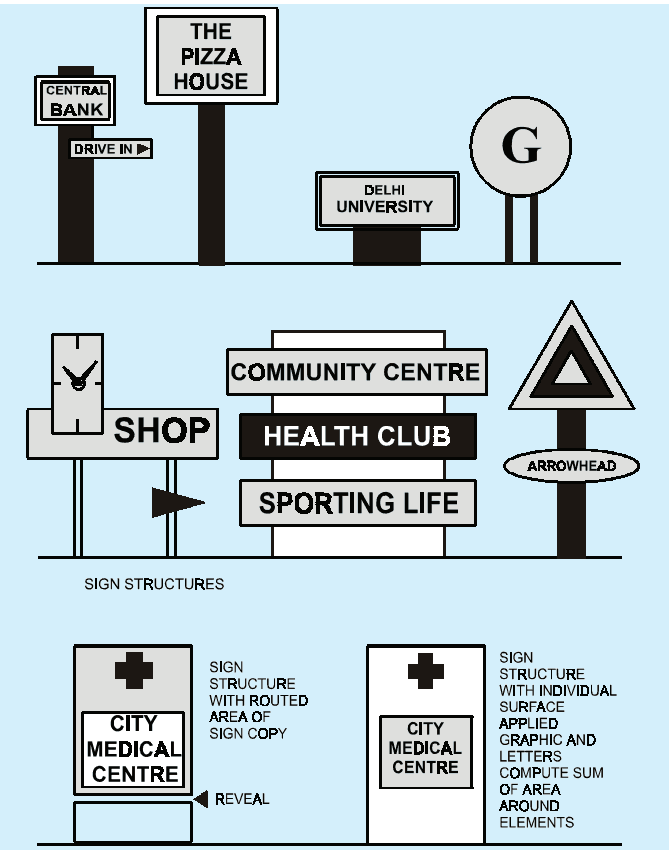
NOTE — Sum of shaded areas only represent sign area. Sign constructed with panels or cabinets.
FIG. 1 TYPICAL EXAMPLES OF SIGN TYPE — Continued
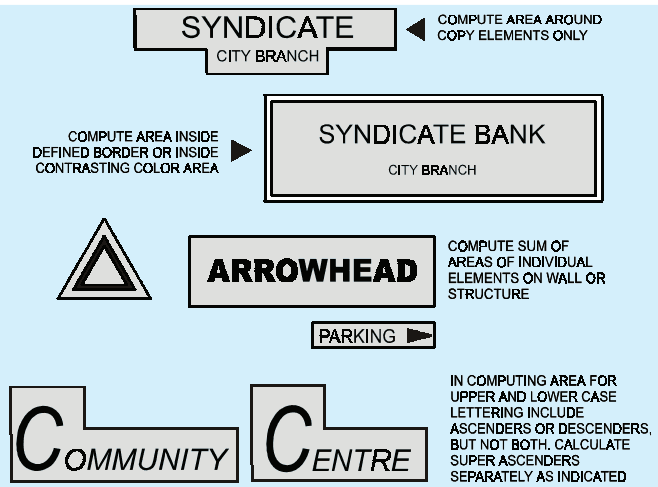
COMPUTE SUM OF AREAS OF INDIVIDUAL ELEMENTS ON WALL OR STRUCTURE
IN COMPUTING AREA FOR UPPER AND LOWER CASE LETTERING INCLUDE ASCENDERS OR DESCENDERS BUT NOT BOTH. CALCULATE SUPER ASCENDERS SEPARATELY AS INDICATED
NOTE — Sum of shaded areas only represent sign area for compliance purposes. Signs consisting of individual letters, elements or logos placed on building walls or structures.
FIG. 1 TYPICAL EXAMPLES OF SIGN TYPE
Whenever any advertising sign is removed, whether in consequence of a notice or order under the Code or otherwise, any damage or defacement to the building or site on or from which such sign was displayed, shall be made good to the satisfaction of the Authority.
Whenever any alteration is made to the ground level adjacent to any advertising sign, the owner of the site on which sign is erected, shall be responsible for the alteration of the height of such sign so as to conform to the requirements of this Section.
No advertising sign shall be erected or maintained which interferes with or is likely to interfere with any sign or signal for the control of traffic.
6.7.1 No advertising sign shall be placed particularly in bends and curves so as to obstruct the view of traffic at intersecting streets.
Adequate provision for drainage shall be made in every advertising sign, where the possibility of collection of moisture exists.
All glass used in advertising signs, other than glass tubing used in gas discharge or similar signs, shall be of safety glass conforming to accepted standards [10-2(2)] at least 3 mm thick. Glass panels in advertising signs shall not exceed 6 m2 in area, each panel being securely fixed in the body of the sign independently of all other panels. Glass signs shall be properly protected from the possibility of damage by falling objects by the provisions of suitable protecting metal canopies, or by other approved means. Use of
glass may be discouraged or avoided wherever possible for signs placed overhead.
Advertising signs shall be so placed as not to obstruct the use of the hydrants or other fire fighting appliances.
Ladders, platforms, hooks, rings and all other devices for the use of servicing personnel shall have safety devices and suitable design loadings (reference may also be made to Part 7 ‘Constructional Practices and Safety’).
Signs which contain moving section or ornaments shall have fail-safe provisions to prevent the section or ornaments from releasing and falling or shifting its centre of gravity more than 450 mm. The fail-safe device shall be in addition to the mechanism and its housing which operate the movable section or ornament. The fail-safe device shall be capable of supporting the full dead weight of the section or ornament when moving mechanism releases.
Every ground sign exceeding 6 m in height together with frames, supports and braces shall be constructed of non-combustible material except as in 6.4.
No ground sign shall be erected to a height exceeding 9 m above the ground. Lighting reflectors may extend beyond the top or face of the sign.
Every ground sign shall be firmly supported and acnchored to the ground. Supports and anchors shall be of treated timber in accordance with good practice [10-2(3)], or metal treated for corrosion resistance or masonry or concrete.
The owner of any site on which a ground sign is erected shall be responsible for keeping such part of the site as is visible from the street, clean, sanitary, unoffensive and free of all obnoxious substances and unsightly conditions to the approval of the Authority.
No ground sign shall be erected so as to obstruct free access to or egress from any building.
No ground sign shall be set nearer to the street line than the established building line.
The bottom line of all ground signs shall be at least 0.6 m above the ground, but the intervening space may be filled with open lattice work or platform decorative trim.
8.8 Ground painted signs shall conform to the requirements of 6 and 7 where applicable.
2.0 For the purpose of this Section, the following definitions shall apply.
2.1.1 Abandoned Sign — A sign structure that has ceased to be used, and the owner intends no longer to use the same, for the display of sign copy, or as otherwise defined by state law.
2.1.2 Advertising Sign — Any surface or structure with characters, letters or illustrations applied thereto and displayed in any manner whatsoever out of doors for purposes of advertising or to give information regarding or to attract the public to any place, person, public performance, article or merchandise whatsoever, and which surface or structure is attached to, forms part of or is connected with any building, or is fixed to a tree or to the ground or to any pole, screen, fence or hoarding or displayed in space.
2.1.3 Banner — A flexible substrate on which copy or graphics may be displayed.
2.1.4 Banner Sign — A sign utilizing a banner as its display surface.
2.1.5 Canopy Sign — A sign affixed to the visible surface(s) of an attached or freestanding canopy.
2.1.6 Closed Sign — An advertising sign in which at least more than fifty percent of the area is solid or tightly enclosed or covered.
2.1.7 Combination Sign — A sign that is supported partly by a pole and partly by a building structure.
2.1.8 Direction Sign — Usually included with an arrow and used for indicating a change in route or confirmation to a correct direction.
2.1.9 Electric Sign — An advertising sign in which electric fittings, which are an integral part of the signs, are used.
2.1.10 Exterior Sign — Any sign placed outside a building.
2.1.11 Freestanding Sign — A sign principally
supported by a structure affixed to the ground, and not supported by a building, including signs supported by one or more columns, poles or braces placed in or upon the ground.
2.1.12 Ground Sign — An advertising sign detached from a building, and erected or painted on the ground or on any pole, screen, fence or hoarding and visible to the public.
2.1.13 Identification Sign — A sign that gives specific location information, identifies specific items, for example, Parking Lot B, Building No. 5, First Aid, etc.
2.1.14 Illuminated Sign — An advertising sign, permanent or otherwise, the functioning of which depends upon its being illuminated by direct or indirect light, and other than an electric sign.
2.1.15 Informational Sign — Used for overall information for general organization of a series of elements that is, campus plan, bus route, building layout, shopping mall plan, etc.
2.1.16 Mansard — An inclined decorative roof-like projection that is attached to an exterior building façade.
2.1.17 Marquee Sign — An advertising sign attached to or hung from a marquee canopy or other covered structure projecting from and supported by the building and extending beyond the building wall, building line.
2.1.18 Open Sign — An advertising sign in which at least fifty percent of the enclosed area is uncovered or open to the transmission of wind.
2.1.19 Parapet — A low wall or railing built along the edge of a roof or floor.
2.1.20 Portable Sign — Any sign not permanently attached to the ground or to a building or building surface.
5
2.1.21 Projecting Sign — An advertising sign affixed to any building element and projecting more than 300 mm therefrom.
2.1.22 Regulatory Sign — Sign that gives operational requirements, restrictions or gives warnings, usually used for traffic delineation or control, for example ‘Stop’, ‘No Parking’, ‘One Way’, etc.
2.1.23 Roof Sign — An advertising sign erected or placed on or above the parapet or any portion of a roof
of a building including signs painted on the roof of a building.
2.1.24 Sky Sign — An advertising sign displayed in space like:
a) a gas filled balloon anchored to a point on the ground and afloat in the air with or without a streamer of cloth, etc; or
b) sky-writing, that is, a sign or word traced in the atmosphere by smoke discharged from an aeroplane.
2.1.25 Sign — Any device visible from a public place that displays either commercial or non-commercial messages by means of graphic presentation of alphabetic or pictorial symbols or representations. Non-commercial flags or any flags displayed from flagpoles or staffs shall not be considered as signs.
2.1.26 Sign Area — The area of the smallest geometric figure, or the sum of the combination of regular geometric figures, which comprise the sign face. The area of any double-sided or ‘V’ shaped sign shall be the area of the largest single face only. The area of a sphere shall be computed as the area of a circle. The area of all other multiple-sided signs shall be computed as 50 percent of the sum of the area of all faces of the sign.
2.1.27 Sign Copy — Those letters, numerals, figures, symbols, logos and graphic elements comprising the content or message of a sign, exclusive of numerals identifying a street address only.
2.1.28 Sign Face — The surface upon, against or through which the sign copy is displayed or illustrated, not including structural supports, architectural features of a building or sign structure, non-structural or decorative trim, or any areas that are separated from the background surface upon which the sign copy is displayed by a distinct delineation, such as a reveal or border.
2.1.29 Sign Structure — Any structure supporting a sign.
2.1.30 Temporary Sign — An advertising sign, banner or other advertising device constructed of cloth, canvas, fabric or any other light material, with or without a structural frame, intended for a limited period of display; including decorative displays for holidays or public demonstrations.
2.1.31 VERANDAH Sign — An advertising sign attached to, posted on or hung from a VERANDAH.
2.1.32 Wall Sign — An advertising sign, other than a projecting sign, which is directly attached to or painted or pasted on the exterior surface of or structural element of any building.
2.1.33 Window Sign — A sign affixed to the surface of a window with its message intended to be visible to and readable from the public way or from adjacent property.
2.2.1 Approved — Approved by the Authority having jurisdiction.
2.2.2 Area of Special Control — Any area declared an area of special control by the Authority in respect of the display of advertising signs, where the requirements for such display are more restrictive than elsewhere in the area controlled by the Authority.
2.2.3 Authority Having Jurisdiction — The Authority which has been created by a statute and which for the purpose of administering the Code/Part, may authorize a committee or an official to act on its behalf; hereinafter called the ‘Authority’.
2.2.4 Building Line — The line up to which the plinth of a building adjoining a street or an extension of a street or on a future street may lawfully extend. It includes the lines prescribed, if any, in any scheme.
2.2.5 Combustible Material — A material is combustible, if it burns or adds heat to a fire when tested for non-combustibility in accordance with good practice [10-2(1)].
2.2.6 Owner — Person or body having a legal interest in land and/or building thereon. This includes free holders, leaseholders or those holding a sub-lease which both bestows a legal right to occupation and gives rise to liabilities in respect of safety or building condition.
In case of lease or sublease holders, as far as ownership with respect to the structure is concerned, the structure of a flat or structure on a plot belongs to the allottee/ lessee till the allotment/lease subsists.
2.2.7 Street Line — The line defining the side limits of a street.
The requirements relating to plant materials and other materials; execution of work of tree planting, shrub planting and grassing; maintenance; etc shall be as given in 8.1 to 8.6. The contractor shall furnish all materials, labour and related items necessary to complete the work indicated on drawing and specified herein and shall carry out maintenance of the premises for 12 months after completion of the work or as specified by the landscape architect.
Plant materials shall be well formed and shaped true
to type, and free from disease, insects and defects such as knots, windburn, injuries, abrasion or disfigurement. All plant materials shall be healthy, sound, vigorous, free from disease, insect pests, or their eggs, and shall have healthy, well-developed root systems. All plants shall be hardy under climatic conditions similar to those in the locality of the project. Plants supplied shall conform to the names listed on both the plan and the plant list. No plant material will be accepted if branches are damaged or broken. All material shall be protected from sun and adverse weather until planted. Nursery stock shall be inspected and approved by the landscape architect and the horticulturist/botanist shall do the botanical authenticity of the selected species.
All plants shall conform to the requirements specified in the plant list, except those plants larger than specified may be used if approved, but use of such plants shall not increase the contract price. If the use of the larger plant is approved, the spread of roots or ball of earth shall be increased in proportion to the size of the plant. Plants shall be delivered with legible identification labels.
The minimum acceptable size of all trees after prunning, with branches in normal positions, will conform to the measurement specified in the bill of quantities unless stated otherwise. Caliper measurement will be taken at a point on the trunk 1.0 m above natural ground. All trees supplied shall have terminal shoots. All specimen trees shall have a minimum crown spread of not less than half the size of the overall height.
Topsoil or good earth shall be a friable loam; typical of cultivated top soils of the locality contains at least 2 percent of decayed organic matter (humus). It shall be taken from a well-drained arable site. It shall be free of sub-soil, stones, earth clods, sticks, roots or other objectionable extraneous matter or debris. It shall contain no toxic material. No topsoil shall be delivered in a muddy condition.
Dry farm yard manure shall be used. Measurement shall be in stacks, with 8 percent reduction for payment. It shall be free from extraneous matter, harmful bacteria insects or chemicals.
The root system shall be conducive to successful transplantation. Where necessary, the root-ball shall be preserved by support with hessian or other suitable material. On soils where retention of a good ball is not possible, the roots should be suitably protected
in some other way which should not cause any damage to roots.
Trees and shrubs shall be substantially free from pests and diseases, and shall be materially undamaged. Torn or lacerated roots shall be pruned before dispatch. No roots shall be subjected to adverse conditions, such as prolonged exposure to adverse conditions, such as prolonged exposure to drying winds or subjection to waterlogging, between lifting and delivery.
Each specimen of tree and shrub, or each bundle, shall be legibly labelled with the following:
a) Its name.
b) Name of the supplier, unless otherwise agreed.
c) Date of dispatch from the nursery.
During the period prior to planting the ground shall be maintained free from weeds. Grading and final levelling of the lawn shall be completed at least three weeks prior to the actual sowing. Regular watering shall be continued until sowing by dividing the lawn area into portions of approximately 5 m2 by constructing small bunds to retain water. These bunds shall be levelled just prior to sowing of grass plants. At the time of actual planting of grass, it shall be ensured that the soil has completely settled.
The soil itself shall be ensured to the satisfaction of the landscape architect to be a good fibrous loam, rich in humus.
Grass roots shall be obtained from a grass patch, seen and approved beforehand. The grass roots stock received at site shall be manually cleared of all weeds and water sprayed over the same after keeping the stock in a place protected from sun and dry winds. Grass stock received at site may be stored for a maximum of three days. In case grassing for some areas is scheduled for a later date fresh stock of grass roots shall be ordered and obtained. Small roots shall be dibbled about 75 mm apart into the prepared grounds. Grass areas will only be accepted as reaching practical completion when germination has proved satisfactory and all weeds have been removed.
As soon as the grass is approximately 30 mm high it shall be rolled with a light wooden roller in fine, dry weather — and when it has grown to 50 mm to 80 mm above ground, weeds shall be removed and regular cutting with the scythe and rolling shall be begun. A top-dressing of farm yard manure, bone meal at the rate of 50 g/m2 and NPK at the rate of 10 g/m2 shall be applied when the grass is sufficiently secure in the ground to bear the mowing machine, the blades shall be raised 25 mm above the normal level for the first two or three cuttings. That is to say, the grass should be cut so that it is from 40 mm to 50 mm in length, instead of the 30 mm necessary for mature grass.
In the absence of rain, in the monsoon the lawn shall be watered with sprinklers every, three days soaking the soil to a depth of at least 200 mm. Damage, failure
or dying back of grass due to neglect of watering specially for seeding out of normal season shall be the responsibility of the contractor.
Any shrinkage below the specified levels during the contract or defects liability period shall be rectified at the contractor’s expense. The contractor shall exercise care in the use of rotary cultivator and mowing machines to reduce to a minimum the hazards of flying stones and brickbats. All rotary mowing machines are to be fitted with safety guards.
Every roof sign together with its frames, supports and braces, shall be constructed of non-combustible material, except as in 6.4. Provision shall be made for electric grounding of all metallic parts; and where combustible materials are permitted in letters or other ornamental features, all wiring and tubing shall be kept free and insulated therefrom.
No roof sign shall exceed the following heights on buildings of heights:
| Height of Building | Height of Sign, Max |
|---|---|
| a) Not exceeding four storeys or 18 m | 2 m |
| b) Five to eight storeys or exceeding 18 m but not exceeding 36 m | 3 m |
| c) Exceeding eight storeys or 36 m, provided that in calculating the height of such signs, signs placed one above the other, or on planes at different levels of the same building shall be deemed to be one sign, whether or not such signs belong to different owners | 5 m |
a) No roof sign shall be so placed on the roof of any building as to prevent free passage from one part of the roof to another.
b) No roof sign shall be placed on or over the roof of any building unless the entire roof construction is of non-combustible material.
No roof sign shall project beyond the existing building line of the building of which it is erected or shall extend beyond the roof in any direction.
anchored to the building on or over which it is erected. All loads shall be safely distributed to the structural members of the building.
9.6 For roof signs near the airports the Directorate General of Civil Aviation should be consulted.
Every roof sign shall be thoroughly secured and
9.7 Painted roof signs shall conform to the requirements of 6 and 7, where applicable.
Every verandah sign shall be constructed entirely of non-combustible material except as in 6.4.
No VERANDAH sign exceed 1 m in height. No VERANDAH sign hanging from a VERANDAH shall exceed 2.5 m in length and 50 mm in thickness, except that VERANDAH box signs measuring not more than 200 mm in thickness, measured between the principal faces of the sign and constructed entirely of metal wired glass may be erected.
Every VERANDAH sign shall be set parallel to the building line, except that any such sign hanging from a VERANDAH shall be set at right angles to the building line.
VERANDAH signs, other than hanging signs only, shall be placed in the following locations:
a) Immediately above the eaves of the VERANDAH roof in such a manner as not to project beyond the rear of the roof gutter;
b) Against but not above or below the VERANDAH parapet or balustrade provided such parapet or balustrade is solid and the sign does not project more than 20 cm from the outside face of such parapet or balustrade; or
c) On the VERANDAH beams or parapets in the case of painted signs.
Every VERANDAH sign hanging from a VERANDAH shall be fixed in such a manner that the lowest point of such sign is not less than 2.5 m above the pavement.
Except as provided for in 10.4, no VERANDAH sign shall extend outside the line of the VERANDAH to which it is attached.
Every wall sign exceeding 4 m 2 in area shall be constructed of non-combustible material except as in 6.4.
a) The total area of any wall sign shall not exceed 20 m2 for every 15 m of building frontage to the street to which such sign faces; except that in the case of a wall sign, consisting only of the name of a theatre or cinema, the total area of such sign shall not exceed 200 m2.
b) No wall sign which exceeds 30 m2 in area shall be located on any wall not directly facing the road; provided that any such sign or signs shall not exceed 25 percent of the side wall area visible from the street.
No wall sign shall extend above the top of the wall or beyond the ends of the wall to which it is attached. At any place where pedestrians may pass along a wall, any wall sign attached thereto shall not project more than 7.5 cm therefrom within a height of 2.5 m measured from the level of such place.
Every wall sign attached to walls shall be securely attached. Wooden blocks or anchorage with wood used in connection with screws, staples or nails shall not be considered proper anchorage, except in the case of wall signs attached to walls of wood.
Every projecting sign and its support and framework shall be constructed entirely of non-combustible material.
No projecting sign or any part of its supports or frame work shall project more than 2 m beyond the building; however it shall not project beyond the plot line facing the street; when it projects into the street it shall be at clear height of 2.5 m from the road (see Part 3 ‘Development Control Rules and General Building Requirements’):
a) The axes of all projecting signs shall be at right angles to the main face of the building. Where a V-construction is employed for the faces, the base of the sign against the building shall not exceed the amount of the overall projection.
b) No projecting signs shall extend above the eaves of a roof or above the part of the building face to which it is attached.
c) The maximum height of a projecting sign shall be related to the height of the building to which it is attached in the following manners:
| Sl No. | Height of Building | Height of Sign, Max |
|---|---|---|
| i) | Not exceeding four storeys or 18 m | 9 m |
| ii) | Five to eight storeys or not exceeding 36 m | 12 m |
| iii) | Exceeding eight storeys or 36 m | 15 m |
Every projecting sign shall be securely attached to a building so that movement in any direction is prevented by corrosion-resistant metal brackets, rods, anchors, supports, chains or wire ropes so designed and arranged that half the number of such fixing devices may safely support the sign under all circumstances.
12.3.1 Staples or nails shall not be used to secure any projecting sign to any building.
Projecting sign structures which could be used to support an individual on a ladder or other servicing device whether or not specifically designed for the servicing device shall be capable of supporting the anticipated additional load but in no case less than 500 kg concentrated horizontal load and 1 500 kg vertical concentrated load applied at the point of assumed loading or point of most eccentric loading. The building component to which the projecting sign is attached shall also be designed to support the additional loads.
Marquee signs shall be constructed entirely of metal or other approved non-combustible materials.
Such sign shall not exceed 2 m in height nor shall they project below the fascia of the marquee nor lower than 2.5 m above the footpath.
Marquee signs may extend the full length but in no case shall they project beyond the ends of the marquee.
Lawn mower with roller shall be used periodically, taking care that the lawn is not too wet and sodden.
Water shall be applied at least once in three days during dry weather. Water whenever done should be thorough and should wet the soil at least up to a depth of 200 mm.
Prior to regular mowing the contractor shall carefully remove rank and unsightly weeds.
None of the following advertising signs shall be erected or maintained, other than as temporary signs erected in accordance with 15.2:
a) Any advertising sign which is painted on or fixed on to or between the columns of a VERANDAH;
b) Any advertising sign which projects above or below any fascia, bearer, beam or balustrade of a VERANDAH or balcony;
c) Any advertising sign which is luminous or illuminated and which is fixed to any fascia bearer, beam or balustrade of any splayed or rounded corner of a VERANDAH or balcony;
d) Any streamer sign erected across a road;
e) Any sign not securely fixed so as to prevent the sign swinging from side to side;
f) Any advertising sign made of cloth, paper mache, or similar or like material but excluding licensed paper signs on hoardings or fences;
g) Any advertising sign on a plot used or intended to be used exclusively for residential purposes, other than a brass plate or board preferably not exceeding 600 mm x 450 mm in size, affixed to the fence or entrance door or gate of a dwelling, and in the case of a block of flats, affixed to the wall of the entrance hall or entrance door of any flat; and
h) Any sign on trees, rocks, hillsides and similar natural features.
15.2.1 All temporary advertising, travelling circus and fair signs and decorations during public rejoicing shall be subject to the approval of the Authority and shall be subjected to the approval of the Authority and shall be erected so as not to obstruct any opening and to minimize fire risk.
15.2.2 The advertisement contained on any such sign shall pertain only to the business, industry or other pursuit conducted on or within the premises on which such sign is erected or maintained. Temporary
advertising signs shall be removed as soon as torn or damaged and in any case within 14 days after erection unless extended.
15.2.3 The Authority shall be empowered to order the immediate removal of any temporary advertising sign or decoration, where, in its opinion such action is necessary in the interests of public amenity and safety.
Pole signs shall be constructed entirely of non-combustible materials and shall conform to the requirements for ground or roof signs as the case may be (see 8 and 9). Such signs may extend beyond the street line if they comply with the provisions for projecting signs (see 12).
Temporary signs and banners attached to or suspended from a building, constructed of cloth or other combustible material shall be strongly constructed and shall be securely attached to their supports. They shall be removed as soon as torn or damaged, and in no case later than 14 days after erection; except, that permits for temporary signs suspended from or attached to a canopy or marquee shall be limited to a period of 10 days.
Temporary signs shall not exceed 10 m2 in area.
Temporary signs of cloth and similar combustible construction shall not extend more than 300 mm over or into a street or other public space except that such signs when constructed without a frame may be supported flat against the face of a canopy or marquee or may be suspended from the lower fascia thereof but shall not extend closer to the footpath than 2.5 m.
All temporary banners suspended from building or hung on poles, which extend across streets or other public spaces shall be subject to special approval of the Authority.
15.2.9 Bill boards set up by the Authority shall be used for temporary signs, symbols, bills for entertainment, etc, so that other walls of the city are not defaced.
15.2.9.1 Bills for entertainment and other functions shall not be affixed on to building walls other than the bill boards (see 15.2.9). The organization responsible for such bills and posters shall be held responsible for any such defacement and non-removal of signs.
16.1 Erecting maintaining and owning signs in rural areas shall be encouraged so as to boost the information and economic status of the rural population.
16.2 The tolerance criteria for the permission granted towards putting up any signs for any urban area shall be as given in 16.2.1 to 16.2.4.
The traffic hazards in small towns are few and the defacement due to excessive advertising signs has not occurred. Therefore, orderly development of signs may enliven the town environment and boost the economy. The tolerance here may be high. The following guidelines may be followed for signage:
a) Advertising Sign — Electric sign, ground sign, building sign, illuminated sign, sky sign and temporary sign are permissible.
b) Directional Sign — Electric sign, ground sign, building sign, illuminated sign and temporary sign are permissible while sky sign is not permissible.
c) Informational Sign — Electric sign, ground sign, building sign, illuminated sign and temporary sign are permissible while sky sign is not permissible.
d) Identification Sign — Electric sign, ground sign, building sign, illuminated sign and temporary sign are permissible while sky sign is not permissible.
e) Regulatory Sign — Electric sign, ground sign, illuminated sign and temporary sign are permissible while building sign and sky sign are not permissible.
The traffic hazards in medium towns are few and the defacement due to excessive advertising signs has not occurred. Proper design, erection and maintenance of the signs shall be encouraged. The following guidelines may be followed for signage:
a) Advertising Sign — Electric sign, ground sign, building sign, illuminated sign, sky sign and temporary sign are permissible.
b) Directional Sign — Electric sign, ground sign, illuminated sign are permissible while building sign, sky sign and temporary sign are not permissible.
c) Informational Sign — Electric sign, ground sign, illuminated sign, and temporary sign are permissible while building sign and sky sign are not permissible.
d) Identification Sign — Electric sign, ground sign, building sign, illuminated sign and temporary sign are permissible while sky sign is not permissible.
e) Regulatory Sign — Electric sign, ground sign, illuminated sign and temporary sign are permissible while building sign and sky sign are not permissible.
The traffic is high and hazards of accidents are many in large cities. Defacement of buildings, roads and the urban spaces due to advertisements has to be checked. Therefore, the permissivity and tolerance for erecting signs is very low. The following guidelines may be followed for signage:
a) Advertising Sign — Electric sign, ground sign, illuminated sign and sky sign are permissible while building sign and temporary sign are not permissible.
b) Directional Sign — Ground sign, illuminated sign are permissible while electric sign, building sign, sky sign and temporary sign are not permissible.
c) Informational Sign — Ground sign, illuminated sign, building sign and temporary sign are permissible while electric sign and sky sign are not permissible.
d) Identification Sign — Electric sign, ground sign, building sign, illuminated sign and temporary sign are permissible while sky sign is not permissible.
e) Regulatory Sign — Ground sign, illuminated sign and temporary sign are permissible while electric sign, building sign and sky sign are not permissible.
The traffic hazards in mega and metro cities are many and the defacement due to excessive advertising signs has marred the urban environment. The density of population is very high and the danger of greater loss of life due to disasters is self evident. Therefore, the permissivity for erecting signs is very low and no tolerance exists for law breakers. The following guidelines may be followed for signage:
a) Advertising Sign — Electric sign, ground sign, illuminated sign and sky sign are permissible while building sign and temporary sign are not permissible.
b) Directional Sign — Ground sign, illuminated sign are permissible while electric sign, building sign, sky sign and temporary sign are not permissible.
c) Informational Sign — Ground sign, illuminated sign and temporary sign are permissible while electric sign, building sign and sky sign are not permissible.
d) Identification Sign — Electric sign, ground sign, building sign, illuminated sign and temporary sign are permissible while sky sign is not permissible.
e) Regulatory Sign — Ground sign, illuminated sign and temporary sign are permissible while electric sign, building sign and sky sign are not permissible.
17.1 The urban environment may be susceptible to confusion and chaos due to improper graphics, hoardings and advertisements. Therefore, the signage should be installed following requisite guidelines laid down keeping the functional, safety and aesthetic aspects in view.
The scale of the project should also be considered for implementing signage design. In urban design/planning
projects and landscape projects on a large scale, the following criteria should be followed for signs and outdoor display structures:
a) The aesthetic and harmonious development of the visual environment.
b) Signage for the handicapped at all grade changes, entry points to buildings and public conveniences and facilities. Braille strips used should be displayed not above 1.5 m height for the benefit of the visually impaired at all important nodes, entrances and routes. Ramps for the people on wheelchair should be highlighted with the appropriate international sign of the wheelchair. These need to be lighted adequately even for night time.
c) Environmental graphics should be creatively designed to cater to the basic function of information, identity and way finding, with the objective of improvement of urban scape.
d) Safety aspects.
e) Protection of trees and other vegetation from harm due to signs.