2.0 For the purpose of this Section, the following definitions shall apply.
2.1 Avenue — A wide road or pathway lined with trees on either sides.
2.2 Buffer — The use of landscape to curtail view, sound or dust with plants or earth berms, wall, or any such element.
2.3 Climber (Creeper/Vine) — A non-supporting plant, woody or herbaceous, which clings to a wall, trellis or other structures as it grows upward.
2.4 Columnar — A slender, upright plant form.
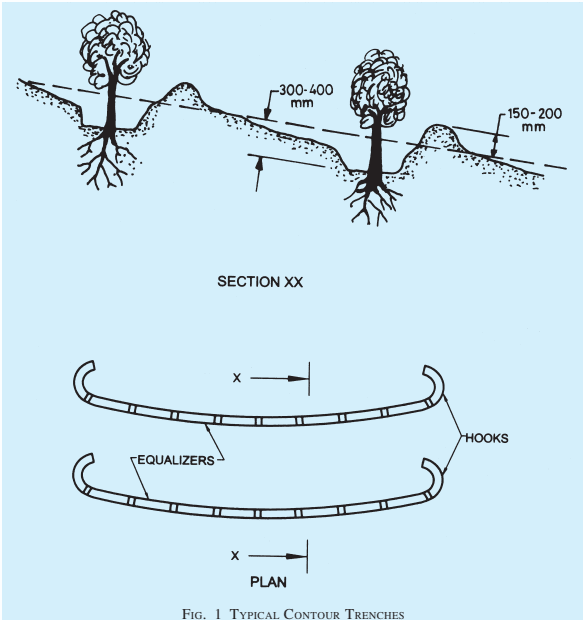
2.5 Contour — The form of the land, existing or proposed; a part of the topography, indicated by map lines at intervals as desired, to understand the landform clearly. The contour line though imaginary, indicates continuous elevation above mean sea level or an assumed datum line.
2.6 Contour Interval — The difference in elevation or the vertical distance measured between consecutive contour lines.
2.7 Egress — A way out, or exit.
2.8 Elevation — A contour line or notation of relative altitude, useful in plotting existing or proposed feature.
2.9 Exotic — A plant that is not native to the area in which it is planted.
5
2.10 Fencing — A barrier of plant or construction material used to set off the boundary of an area and to restrict visual or physical passage in or out of it.
2.11 Foliage — The collective leaves of a plant or plants.
2.12 Geo-textile — Any permeable textile (natural or synthetic) used with foundation, soil, rock, earth or any other geotechnical engineering-related material as an integral part of a human made project, structure or system.
2.13 Grade — The slope or lay of the land as indicated by a related series of elevations.
2.13.1 Natural Grade — Grade consisting of contours of unmodified natural landform.
2.13.2 Finished Grade — Grade accomplished after landscape features are installed and completed as shown on plan as proposed contours.
2.14 Gradient — The degree of slope of a pipe invert or road or land surface. The gradient is a measure of the slope height as related to its base. The slope is expressed in terms of percentage or ratio.
2.15 Grading — The cutting and/or filling of earth to establish smooth finish contours for a landscape construction project. Grading facilitates good drainage and sculpts land to suit the intent of landscape design.
2.16 Grasses — Plants that characteristically have joint stems, sheaths and narrow blades (leaves).
2.17 Groundcover — The planting material that forms a carpet of low height; these low-growing plants are usually installed as the final part of landscape construction.
2.18 Hard Landscape — Civil work component of landscape architecture such as pavement, walkways, roads, retaining walls, sculpture, street amenities, fountains and other built environment.
2.19 Hardy Plant — Plants that can withstand harsh temperature variations, pollution, dust, extreme soil conditions, and minimal water requirements and the likes. These plants have ability to remain dormant in such conditions and survive.
2.20 Hedge — Number of shrubs or trees (often similar species) planted closely together in a line. A hedge may be pruned to shape or allowed to grow to assume its natural shape.
2.21 Herb — An annual plant with a non-woody or fleshy structure. Certain herbs are highly useful for cooking or of high medicinal value.
2.22 Ingress — A way in, or entrance.
2.23 Invert — The low inside point of a pipe, culvert, or channel.
2.24 Kerb — A concrete or stone edging along a pathway or road often constructed with a channel to guide the flow of storm water and thereby serving dual purpose.
2.25 Mound — A small hill or bank of earth, developed as a characteristic feature in landscape.
2.26 Native — A plant indigenous to a particular locale.
2.27 Screen — A vegetative or constructed hedge or fence used to block wind, undesirable views, noise, glare and the like, as part of in landscape design; also known as ‘screen planting’ and ‘buffer plantation’.
2.28 Sediment — The product of erosion processes; the solid material, both mineral and organic, that is in suspension, is being transported or has been moved from its site of origin by air, water, gravity or ice.
2.29 Shrub — A woody plant of low to medium height, deciduous or evergreen, generally having many stem.
2.30 Soft Landscape — The natural elements in landscape design, such as plant materials and the soil itself.
2.31 Spot Elevation — In surveying and contour layout, an existing or proposed elevation noted as a dot on the plan.
2.32 Street/Outdoor Furniture — Items of furnishing in outdoor landscape.
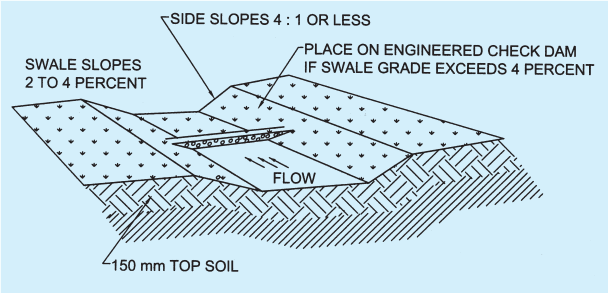
2.33 Swale — A linear wide and shallow depression used to temporarily store, route or filter runoff. A swale may be grassed or lined.
2.34 Topsoil — The uppermost layer of the soil.
2.35 Transplanting — Moving a plant from its place of origin to another location.
2.36 Tree — A woody plant, generally taller than 2.00 m, with a well-distinguished trunk or trunks below the leaf crown.
2.36.1 Deciduous Tree — Tree that sheds all its leaves in autumn or in dry season.
2.36.2 Evergreen Tree — Tree that remains green for most part of the year and sheds leave slowly throughout the year.
2.37 Tree Grate — A metal grille, installed at the base of a tree otherwise surrounded by pavement, that allows the free passage of air, water, and nutrients to the tree root, but does not interfere with the foot traffic.
2.38 Tree/Plant Guard — The protection constructed around a tree to deter vandalism and help to prevent damage. It could be made of metal, bamboo or concrete or the like.