17.2.1 Rainwater Disposal
The roof (terrace) of a building and the remaining area of the building unit shall be provided with an effective rainwater drainage system so as to ensure that the rainwater is not discharged into adjacent building units and no dampness is caused in any walls or foundation of adjacent buildings.
2 Rainwater pipes shall be affixed to the outside of the walls of the building or in recesses or formed in such walls or in such other manner as may be approved by the Competent Authority.
3 No roof or terrace abutting on a public street shall be constructed without providing sufficient number of down take pipes and such pipes shall be so fixed as to discharge the rainwater at a level not higher than 0.6 m above the street level.
4 The manner of channelling rainwater discharge from a building unit to a public storm water drain, if available, shall be determined by the Competent Authority.
17.2.2 Rainwater Harvesting
Rainwater harvesting refers to collecting / capturing the runoff from the roofs / terraces and open areas of the building unit for 1) storing it for future use, and 2) using it to recharge the underground water aquifers.
1 Rainwater Storage
Rainwater storage is mandatory for all building units having an area of 100 sq m and above. Rainwater storage tank of adequate capacity shall be constructed in marginal open space such that rainwater from the roof and plot drains into it. The water may be used for household uses such as washing, cleaning, and gardening.
Page No 152
2 Ground Water Recharge
Ground water recharge is mandatory for all building units having an area above 100 sq m. It shall be provided for as follows:
a) For building units / plots having area 100 sq m and above and up to 500 sq m Percolation pit or bore recharge shall be provided in the marginal space around the building. Such pits shall be filled with small pebbles, brick jelly or river sand and covered with perforated concrete slabs (Refer Figure No. 17.4).
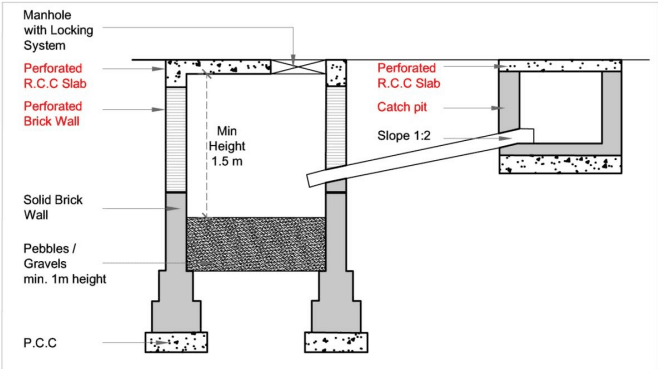
Figure No. 17.4: Percolation Pit or Bore Recharge
b) For building units having area above 500 sq m and up to 1500 sq m: Percolating well with rainwater harvesting system shall be provided (Refer Figure No. 17.5- Left Image) (up to first ground aquifer).
c) For building units having area above 1500 sq m and up to 4000 sq m Percolating well with rainwater harvesting system shall be provided (Refer Figure No. 17.5- Right Image) (up to second ground aquifer).
Page No 153
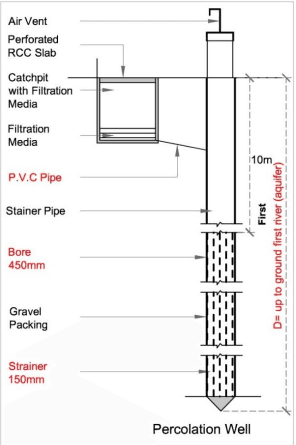
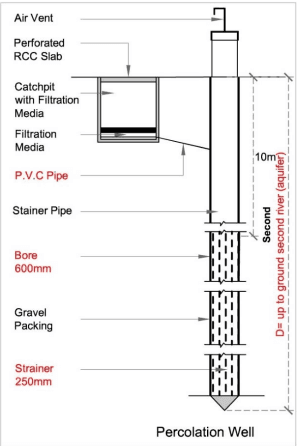
Figure No. 17.5: Percolation Well with Rainwater Harvesting System upto Ground First River (Left) and upto Ground Second River (Right)
d) For buildings with building unit area above 4000 sq m
One percolating well shall be provided as per Rule No. 17.2.2(c) for every 4000 sq m land area. As an alternative to providing multiple percolating wells, a water retention pond with minimum capacity of 300,000 litres with a percolating well for every five percolating wells or part thereof shall be permitted.
17.2.3 Open Spaces within Layouts
All open spaces / common plots that is provided must be provided with ground water recharge wells. The gradients must be such that the runoff from the layout leads towards these.
17.2.4 Public Open Spaces
All public parks, gardens, water bodies must be provided with ground water recharge wells.