33.1 Introduction
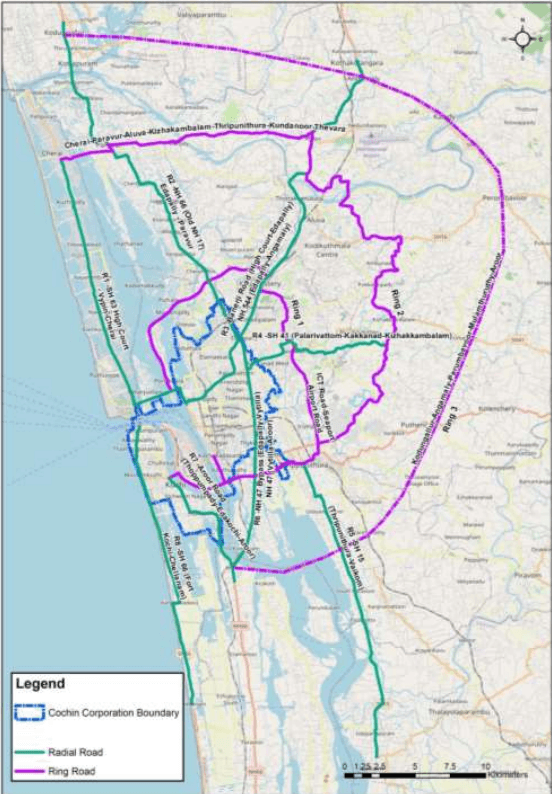
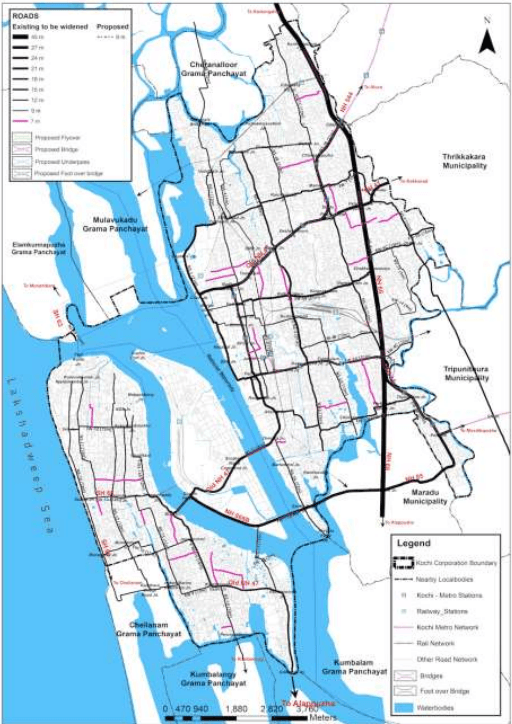
Transport is fundamental to supporting economic growth, creating jobs and connecting people to essential services. The sector plays an important role to sustainable development. Formulation of a long-term transportation plan is the key to solving the issues that pertain with the sector in Kochi. With new infrastructure and development schemes in and around the city coupled with traffic projections will help in evaluating the shortfall in the pattern of road network and shortfalls in ensuring connectivity. The strategies that are formulated for the sector to address these shortfalls are:
• Development of an effective road network strategy at a regional and city level.
• Integration of Land Use and Transport sectors through concepts like Transit Oriented Development (TOD) etc.
Reducing dependency on private vehicles and congestion caused by it through placing increased importance on Non-Motorised Transport, shared mobility and improving the efficiency of existing public transport facilities.
Make Kochi walkable and cyclable by retrofitting existing and proposed roads to be “Healthy & Green Streets” by ensuring equitable distribution of road space to create an urban environment that is healthy & liveable.
Ensuring Multi-Modal Integration as a key principle to be followed at all transit stations.
Ensuring seamless movement on roads through junction improvement schemes and grade-separated facilities.
• Management of parking in Kochi
Provide emphasis on traffic movement within the city and delineate efficient traffic engineering strategies
Formulation of a Freight management plan
• Incorporation of technology for various uses such as smart parking, real-time traffic management etc.
Proposed Road Network Development Strategy
Various transport related problems facing the city along with the development plans for the city prepared by various agencies have been taken into account while formulating the long term network development strategy for the city. The traffic problems of the city are the inter-mixture of various problems where the solution could not be found at the level of individual problems.
Proposed Road Network Hierarchical Pattern
Based on the evaluation of the future year traffic loadings on the base year network, alternative network development schemes have been formulated to reduce the traffic loadings on routes where the traffic volume exceeded the capacity. All committed road
TRANSPORTATION
development schemes and the proposed land use development plan for the city were taken into account while formulating the alternative network development plans. As a prerequisite for the urban network development plan for the city, the roads in the urban area have to be classified into different types according to the functional hierarchy of these roads. Four different types of hierarchical order have been assigned for the roads in Kochi City and the details are given below:
Arterial roads:
Roads, which are expected to carry a large proportion of regional and intra-urban movement, characterized by long trip lengths and a desire for fast and uninterrupted transit have been classified as arterial road. The right of way of such roads will be between 50 and 60 meters and an average travel speed of 50 to 60 kmph is maintained. To ensure uninterrupted movement along the arterial roads, in discriminate access from the abutting land use needs to be controlled for which separate service lanes on either side of the main carriageway would be provided. The intersections resulting on such roads will have to be grade separated and designed to ensure the smooth and faster operation of traffic.
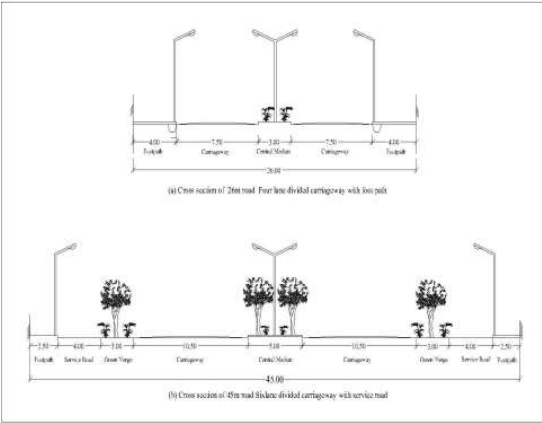
Figure 33:1 Typical Cross-section of arterial road proposed for Kochi
Two typical cross-sections of arterial roads are proposed for Kochi City. The first type of arterial road has a six lane divided carriage way with a median of 5 m in an ROW of 45 m. The cross section includes 10.5 m carriageway on either side of a median of 5m. Green verge of 3m, service road of 4 m and footpath of 2.5m are provided on either side of the arterial road. The second type of arterial road has a four lane divided carriageway with a median of 3 m in an ROW of 27m. On either side of the median, there is a carriageway of width 7.5m and footpath of 4.5 m.
Kochi Municipal Corporation
TRANSPORTATION
Sub-Arterial Roads
Sub-arterials are second in hierarchy of urban roads. These roads serve as an intermediary between arterials and the lower hierarchy of roads. These roads also carry a significant amount of traffic, which has fairly long trip lengths. In the normal conditions, service roads are not considered essential but limited access control by regulatory measures is essential. The intersections can be controlled by the provision of channelisers and divided carriageway. The capacity of these intersections can be increased by automation and effective control. The desirable right-of-way of subarterial road is between 12 and 21 meters and the average journey speed is expected to be of the order of 30 to 40 kmph. These roads are required to connect the important city functions viz. work centers, market places and transport terminals with the residential areas both within the city and in suburbs. Four typical cross-sections of sub-arterial roads are proposed for Kochi City.
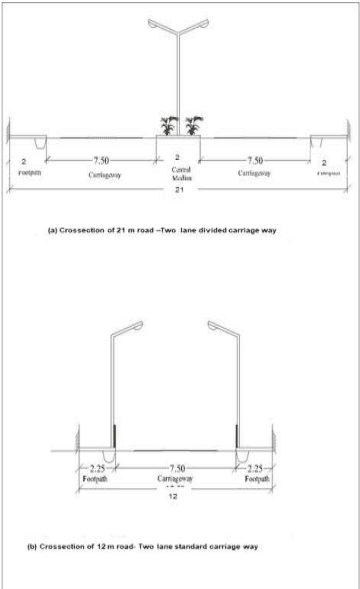
Figure 33:2 Typical cross-section of Sub-arterial road proposed for Kochi
Collector Roads
The collector roads function as a distributor and collector of traffic exiting from the subarterials or brought in through local roads. These are basically the first to aggregate the traffic. Since many local roads need to be connected on to a collector road, the necessity
Kochi Municipal Corporation
TRANSPORTATION
for numerous road junctions is inevitable. Because of this, the average journey speeds are comparatively low and in the range of 20 to 30km. per hour. Collector roads are designed to have a right-of-way of 8 to 12 meters where kerb side parking is allowed to a limited extent.
Two typical cross-sections of collector roads are proposed for Kochi City. The first type of collector road has a two lane carriage way in an ROW of 12m with a footpath of 2.25m on either side of carriageway of 7.5m. The second type of collector road is proposed in a ROW of 9m with a two-lane carriageway of 7 m with shoulder of 1 m on either side.
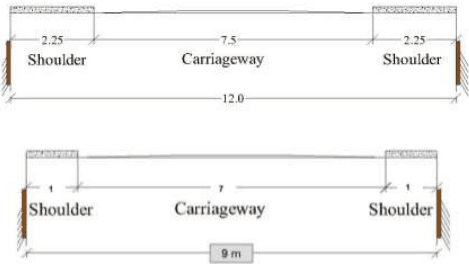
Figure 33:3 Typical Cross-section of collector road proposed for Kochi
Local Roads
Local roads or access roads are the last in the hierarchy of urban roads. These roads functionally serve as an access road from and to the collector roads. All the private roads leading in to abutting properties should generally be connected on to local roads. The traffic on these roads would generally be proportional to the number of private accesses on to these roads. In keeping with the low volume of traffic, the local roads are designed for a right of way of 7-9 meters. Right-of way of 7 m is proposed for select roads in Kochi City.