To maintain enough water supplies in the city, it is imperative that water supply infrastructure facilities need to be upgraded. It is also important to ensure an equitable distribution of water in those areas having scarcity of water. It is also important to ensure that the existing network works efficiently and unaccounted losses and thefts are minimised. Information technology and GIS is to be integrated with the water supply system and its maintenance. Measures to combat the water scarcity in West Kochi area are also proposed.
Proposals for overhead service reserves
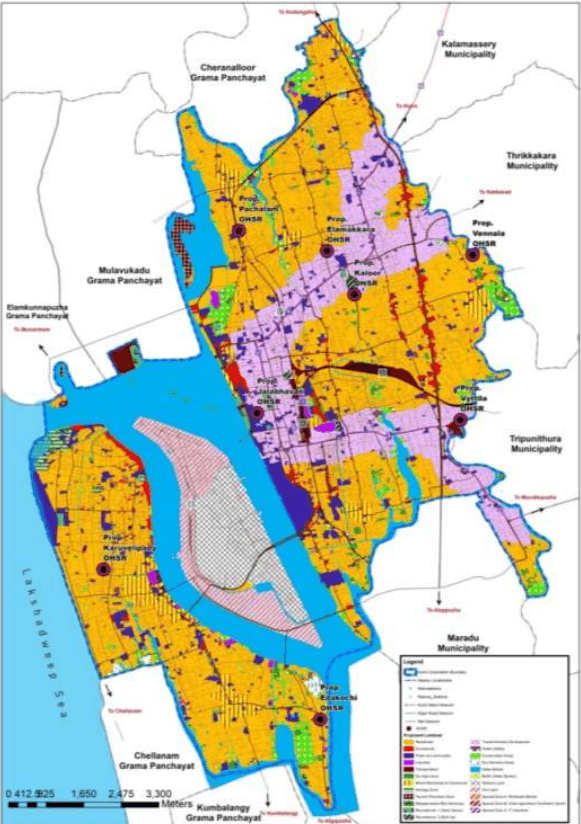
The following overhead service reserves are proposed in the Kochi Municipal Corporation area. They are proposed in those areas where an equitable distribution of water is not achieved and are affected by head loss. They can reduce the head loss and thereby improve the pressure in their respective zones.
The Overhead service reserves proposals are:
40 Lakh Litres (LL) OHSR at Kaloor
13 LL OHSR at Edakochi
17 LL OHSR at Pachalam
25 LL OHSR at Karuvelippadi
10 LL OHSR at Elamakkara
10 LL OHSR at Vennala
10 LL OHSR at Vyttila
10 LL OHSR at CE Central Zone (Jalabhavan) Office
Kochi Municipal Corporation
OHSR of 10 LL proposed at Elamakkara, Vennala and Vyttila cater to the water scarcity and ensures sufficient water supply in these areas. Also an OHSR of 10 LL is proposed in the existing Jalabhavan office in the Hospital Road where the basic provisions for water tank have already been made. It is also proposed to recharge the existing OHSR at Cemetry Junction near Ayyappankavu and at Ravipuram to get the required head in their zoning areas.
Figure 32:25 Location of the proposed Overhead Service Reservoirs in Kochi Corporation Area Source: Generated by LSGD (Planning)
Kochi Municipal Corporation
Augmentation of existing water supply
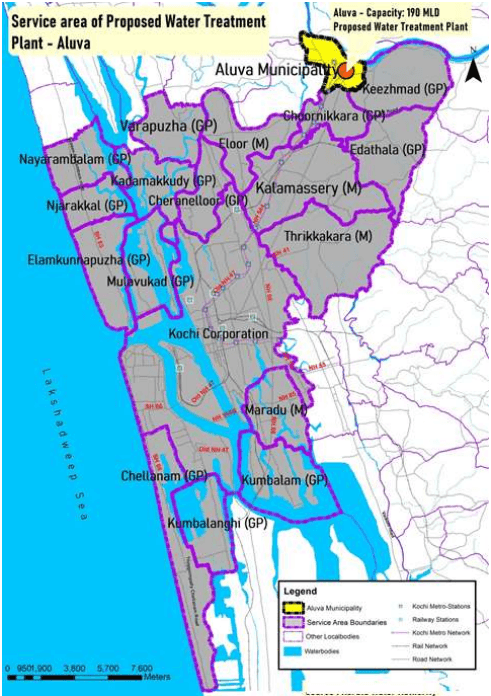
As part of the KWA project (State Plan), KWA has formulated “Augmentation of Water Supply Scheme to Kochi City and Adjoining areas (Phase 1) – Construction of 190 MLD Ultimate Capacity Water Treatment Plant at Aluva and Allied Works” that would cater Kochi City & adjoining areas. This could bridge the demand – supply gap by the horizon year for Kochi Corporation area. The proposed WTP is to be constructed in the 1.57 Hectares of land owned by KWA at Aluva which is very close to the present WTP Complex. The proposed WTP could cater to the nearby so that the existing 900 mm, 1050 mm and 1200 mm lines to the Ernakulam area from the existing Aluva WTPs will be released in load and can be effectively used for distribution to Ernakulam City, Vypin, Mulavukad and Cheranelloor areas.
Figure 32:26 Service Area of the proposed WTP at Aluva Source: LSGD (Planning), KWA
Kochi Municipal Corporation
The project area for the water supply distribution master plan consists of Corporation of Kochi, Aluva, Thrikkakara, Kalamassery, Eloor, Maradu Municipalities and Kumbalam, Kumbalangi, Chellanam, Varappuzha, Cheranelloor, Kadamakkudi, Mulavukad, Elamkunnappuzha, Njarakkal, Nayarambalam, Keezhmad, Edathala & Choornikkara Grama Panchayaths which are very close to Kochi city and surrounding it. Most of the tapping from these existing lines can also be delinked. As per the projection, a supply demand gap of 21 MLD is estimated in the horizon year which could be made available from the 190 MLD WTP at Aluva. The 100 MLD WTP at Maradu which at present is not functioning to its full capacity, is also to be made fully functional so that, Western Kochi and nearby panchayaths will get its benefit substantially apart from Maradu areas.
Natural Ground water Sources & Rainwater Harvesting
Every natural water body should be identified, documented and protected to ensure water quality. Installation of Rainwater harvesting facility is to be made mandatory in all institutions in the corporation to ensure water conservation and to ensure ground water replenishment.
Strict monitoring of KMBR provisions related to rainwater harvesting measures has to be ensured and its functioning to be ensured in every permitted building to reduce the increasing demand for water. Government schools and buildings should be provided with a model rainwater harvesting systems. The rain water harvesting system is to be provided for Middle Income Households at subsidized rate
Water Quality Monitoring Protocol
With consultations to State Pollution Control Board (KSPCB), water quality of the water sources and the water supply systems to be monitored in compliance with the IS:10500 standards for drinking water
Replacement of Old and Worn-out Pipe System
The percentage of waste and losses in the present water supply system is about 35%. This has to be brought down to below 15%. Pipes that are worn out or broken, as well as the allied infrastructural facilities, should be identified and replaced by Kerala Water Authority. If the losses due to old and worn-out pipes are minimised, that will result in more water entering the pipe system.
Incorporation of Smart systems and SCADA (Supervisory Control and Data Acquisition)
Incorporation of smart systems includes the use of technology in monitoring, maintenance and detecting thefts and losses in water supply system. Sensors have to be placed at appropriate places so as to detect the leakages and at the same time, report the Water
Kochi Municipal Corporation
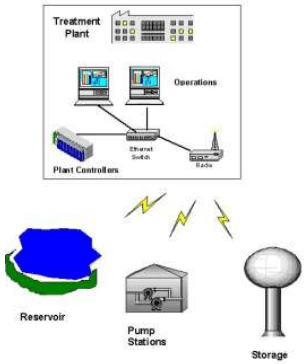
authority online. This method could SCADA (Supervisory Control and Data Acquisition) could be used in the remote maintenance of water supply lines.
Figure 32:27 Schematic diagram showing the working of SCADA in water supply system Source: SCADA Applications in Water Treatment Plant, https://www.electrical4u.com/scada-system/
Managed Aquifer Recharge
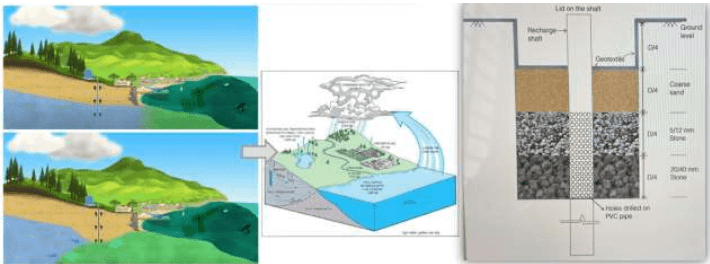
Managed Aquifer Recharge includes the recharge of the surplus surface run off water into the ground through injection wells directly into the aquifers after proper filtration thereby increasing ground water levels in quantity as well as quality. For this, specially designed injection wells are used. This can be an effective method to combat salt water intrusion in Coastal areas mainly in West Kochi. Pilot studies should be done and based on the success; corporation could incentivise such methods of ground water recharge.
Figure 32:28 Usage of injection wells in managed aquifer recharge Source: United States Geological Survey
Kochi Municipal Corporation
Chapter 32Sectoral Proposals
In these chapter details of proposals identified in each sector has been provided. The preferable locations of sectoral projects have been marked in the proposed land use map as a point feature. The project may be undertaken by corporation or any agency subject to be availability of land and fund at the time of project implementation. The projects and project locations are suggestions developed through detailed study and analysis of each sector.
32.1 Industries
There is diversified industrial sector surrounding the Municipal limits (Including SEZs & Info Park) with 6 large scale industries within the Kochi corporation limits. There is a non-availability of suitable land for large scale industrial purposes due to tremendous hike in land value. Due to the increasing vulnerability of the coastal area, the West coast is unsuitable for polluting industries. However there is a High potential for green category micro enterprises, traditional industries, IT based industries etc. The following strategies could be adopted for the industrial sector. The industries coming under white, green and orange is to be promoted in the Kochi city.
• Mitigation measures for pollution abatement at industries to be adopted.
• Monitoring of water quality at the backwaters at regular intervals by PCB
Non-polluting industries are only allowed in west coast
Revival of traditional handicrafts and produce to be prioritised.
IT & Business tourism to be promoted in Kochi by providing facilities for staycations, conferences etc.
PPP models in all sectors to deliver public goods and services.
95
IT based Industries at Pipeline Junction
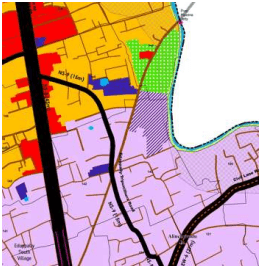
A set of land parcels have been identified in Padivattom ward in Edapally south village for promoting and placing IT industries with an area of 25 acres. The IT industry covers IT services, IT-enabled services (ITES), e-commerce (online business), and Software and Hardware products. The project can be implemented by utilizing KSIDC funds.
Figure 32:1 Proposed Location for IT based industries
Industrial Training Center SIDCO land at Pachalam
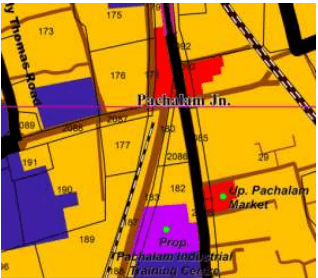
The identified location is at Pachalam of Ernakulam village. To improve the quality of vocational training and make it demand-driven so as to ensure better employability of the graduates. Industrial training centres with the major objectives of providing vocational and apprenticeship training to the youths. The project can be implemented using SIDCO funds.
Figure 32:2 Proposed location for Industrial Training center
32.6Heritage
Fort Kochi- Mattancherry Walkable Heritage Circuit
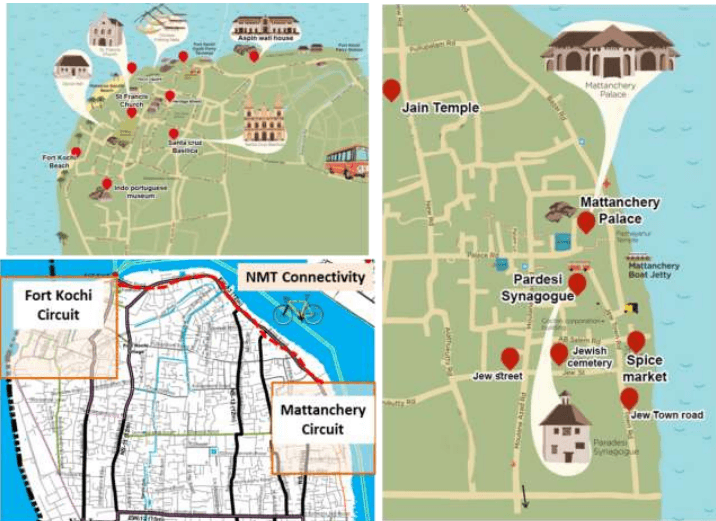
Fort Kochi and Mattancherry area comprises several significant heritage destinations which could be accessible through walking in a single day. Two separate walkable circuits, Fort Kochi circuit and Mattancherry circuit can be developed which could be connected through NMT corridor.
Fort Kochi beach, Indo Portuguese Museum, St Francis church, Santa Cruz Basilica, Aspin wall house, eateries and handicraft shopping experience, walkway and open spaces, heritage roads etc. can provide an exclusive experience for the visitors as whole.
32.6.1.2 Mattancherry circuit
The Mattancherry circuit consists of importance centres like Jain temple, Pardesi synagogue, Mattancherry palace, Jewish cemetery, Spice market, Jew street etc. all at walkable distance. Both the circuits which are 2.7 km apart can be connected via NMT proposals (bicycle, buggy rides or half an hour long walk)
Heritage Circuit at Central Area Kochi
Several locations along the backwaters of Kochi at the central area form part of the heritage of a bygone era of interventions from both royal kings of Kochi as well as colonial invasions. A heritage circuit connecting these destinations from the old railway station near to Mangalvanam, Ram Mohan Palace, High court, St Mary’s Cathedral Basilica, St Albert’s college, Bishop’s house, Ernakulam market, Broadway and other connecting streets, Synagogues, TD Temple, Old Jew cemetery, Govt. Law college, Kochi corporation building, Tahasildar’s office, Maharajas college, District court, Ernakulathappan ground, Durbar hall connecting Rajendra Maidan, Subash park, Children’s park etc.
Heritage Zone at Edapally
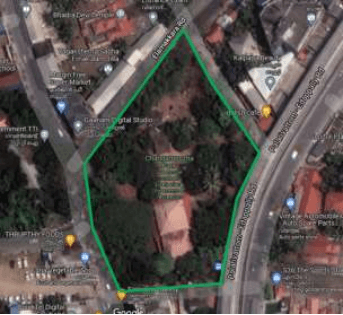
Several locations like Museum of Kerala History, Madhavan Nayar Foundation, St George church Edapally, Shi Mahaganapathy temple and Changampuzha park can be connected together as heritage circuit and can be a single day package for day travellers connecting the Fort Kochi and Mattancherry circuit.
Heritage Point at Rajendra Maidan
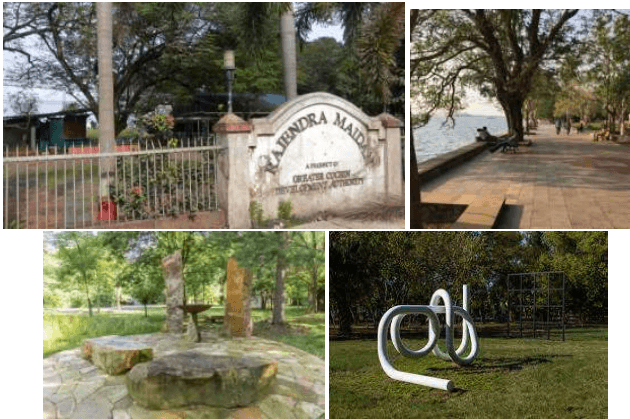
It was a venue which witnessed some glorious agitations during the pre-independence era. Great leaders delivered speeches at this venue, inspiring people to be a part of the freedom struggle. The existing Rajendra Maidan may be developed into a heritage point with facilities like to set up a permanent podium at the venue for the public to deliver lectures on any topic and an open gallery of memorabilia associated with historic events held at Rajendra Maidan and also steps to be taken to ensure the conservation of historic importance of the ground.
Figure 32:21 Rajendra Maidan and conceptual images of outdoor memorabilia
Railway Museum at Cochin Harbour Terminus
It is located in Willingdon Island. The Cochin Harbour Terminus was the principal station providing rail connectivity to the southern segment of the Port of Kochi located on the Willingdon Island. Cochin Harbour terminus can house a railway museum exhibiting the by gone days of railways and the significance of the station.
Rejuvenation of Thekkumbhagom and Kadavumbhagom Synagogues
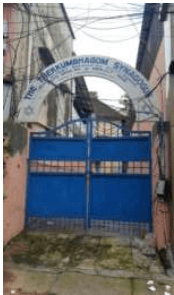
Rejuvenation of existing Synagogues: The Thekkumbhagom and Kadavumbhagom synagogues located in the central area are under private parties and trusts. The historic monuments can be maintained with the help of corporation. Synagogue can be subtly exhibited with a museum character which is accessible to the public without hindering the prayer timings and exclusive nature.
Kochi Municipal Corporation
Cultural Center at Kochi Municipal Corporation Office
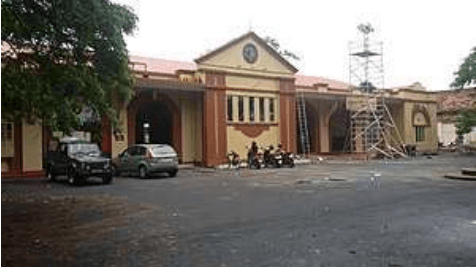
Once the corporation activities are shifted to the new building near high court the existing building can be used for adaptive reuse undertaking activities like performing arts, museum, art gallery, yoga and recreational space etc. within its premises.
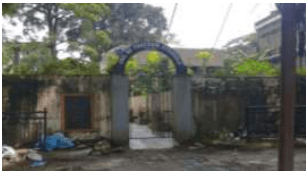
Museum of Freedom Struggle at Fort Kochi Jail Premises
The project envisaged considers conceptualisation, design and development of a Museum of Freedom Struggle in the old Fort Kochi Jail premises. The proposal is to revamp the existing unused Fort Kochi Jail by improving the physical infrastructure of the complex and converting it into a museum with its cells as exhibition spaces along with landscaping, hardscaping, electrification, water supply, sanitation, provision of new toilet block and renovating the security cabin and also development of adjacent plot for landscaping and seating.
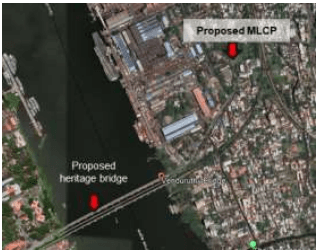
Venduruthy Bridge to be developed as Heritage Bridge with Food Street
It is an 83 year old bridge made by Sir Robert Bristo in 1930 to connect Wellington Island with the mainland. It is proposed to renovate the old bridge and make it a beautiful food street. With this, it will become a place where one can enjoy the beauty of the backwater, including the unique cuisine of Kochi and elsewhere. Heritage themed beautification can be
Kochi Municipal Corporation
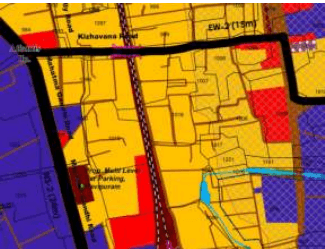
done with Corporation, PWD and tourism department tie-up. It can be converted to pedestrian bridge for further safety. An MLCP has been proposed near to Venduruthi Bridge in order to accommodate the parking need that may arise due to the project. The visitors may park their vehicles and avail feeder buses/buggy services that may be provided to commute to the bridge.
Figure 32:22 Proposed food street at Venduruthy bridge and proposed MLCP at Ravipuram
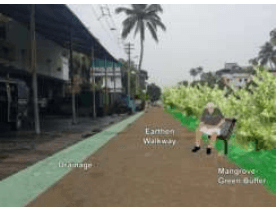
32.6.10 Earthen Walkway at Old Railway Station, Mangalavanam
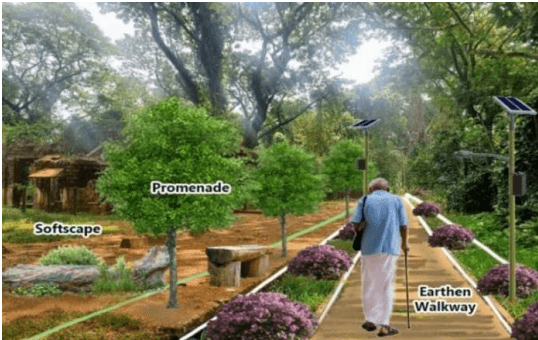
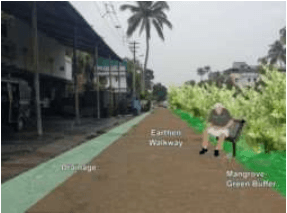
Earthen Walkway is proposed at the Old railway track area: It is close to Mangalvanam. The alignment is proposed uptill Pachalam and diverted to Queen’s walkway. The earthen walkway is envisaged above the railway track with softscaping provided along the path. Minimum interventions in sustainable manner to be adopted to avoid disturbing the birds of Mangalvanam nearby
Figure 32:23 Conceptual image of earthen walkway Source: LSGD (Planning)
Kochi Municipal Corporation
Figure 32:24 Proposed earthen walkway
32.5Fisheries
The fisheries sector faces several issues like lack of modern technology, lack of adequate cold storage facilities, lack of insurance schemes in shrimp/fish culture, over exploitation of marine resources, water pollution, climate change effects, declining traditional practices, lack of skilled man power & training institutes and shift to other job opportunities. Following are the proposals to be undertaken in the fisheries sector.
Upgradation of Cochin Fisheries Harbour
The following proposals are to be provided in the Cochin Fisheries Harbour under the ownership of the Cochin port
Mechanical retrieval system
• Temperature controlled auction hall & electronic display board for auction .
Conveyance system
• Sewage treatment plant
Provisions for safe landing & berthing of vessels
Pontoons for easy parking maintenance works of boats
• Facilities for fishing vessels to operate throughout the fishing season
Establishing hygienic conditions as per standards & international standard fish packing facility.
Net mending shed
Chill rooms for keeping fish 0 to 4 degree temperature
Cleaning machines
Ice crusher with conveyors
Weigh bridges Retail market & food court
Internal roads & canteen
• Office space amenities for fish workers
The project can be implemented by utilizing MPEDA funds.
Aquaculture Zones
The aquaculture area, pokkali farming, chemmeen kettu and related activities come under this. All activities allowed as per valid CRZ notification are allowed here.
SECTORAL PROPOSALS
Major aquaculture areas are found in:
Thanthoni thuruthu
Mundamveli
Edakochi
Ponnurunni
• Champakara
Tourism possibilities can be explored in these areas by including the “You catch, We cook concept”. The fish caught by the tourists could be cooked in the premises and served.
Upgradation of Fish Landing Centres
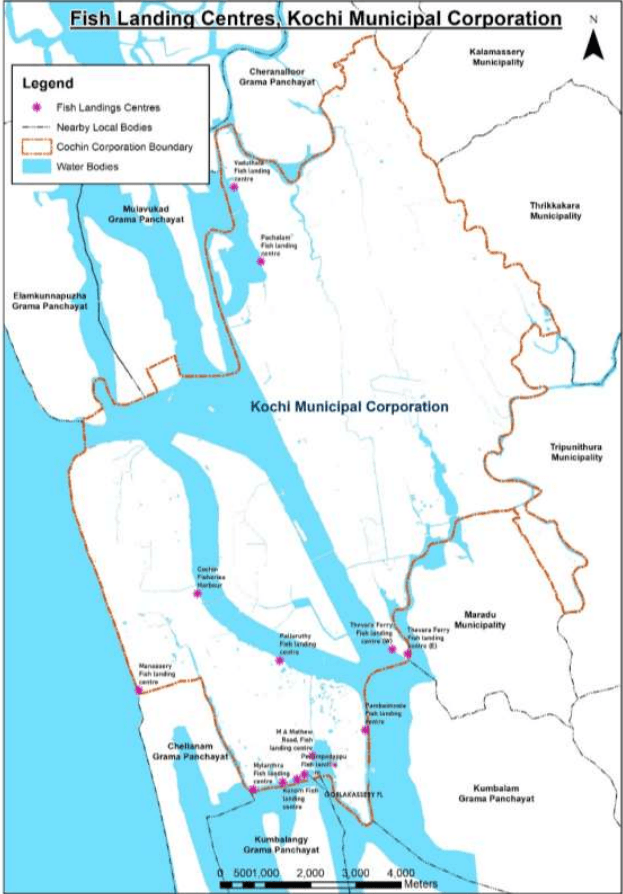
Fish landing centres have been identified within the corporation area which requires the following facilities:
Net mending yards,
Organised fish market (cold store & stalls),
Comfort station and proper waste management
Upgradation of existing facilities
Pontoons for easy parking maintenance works of boats
Cleaning machines
The following fish land centres are identified for up gradation and rejuvenation work
Sl no:
Fish Landing centres
1
Upgradation of Fish landing centre at Manasserry
2
Upgradation of Fish landing centre at Mylanthara
3
Upgradation of Fish landing centre at Konam
4
Upgradation of Fish landing centre at Perumbadappu & market
5
Upgradation of Fish landing centre at Karunakaran road
6
Upgradation of Fish landing centre at Pambaimoola
7
Upgradation of Fish landing centre at Palluruthy
8
Upgradation of Fish landing centre at Thevara ferry (west)
9
Upgradation of Fish landing centre at Thevara ferry (east)
10
Upgradation of Fish landing centre at Pachalam
11
Upgradation of Fish landing centre at Vaduthala
12
Upgradation of Fish landing centre at Chilavannoor lake
13
Upgradation of Fish landing centre at Oorulakkasserry
Figure 32:18 Fish landing centres in Kochi Corporation Source: Generated by LSGD (Planning), Fisheries Department
Fish landing centres which require detailed intervention are provided below:
Kochi Municipal Corporation
• Fish landing centre at Manasserry:
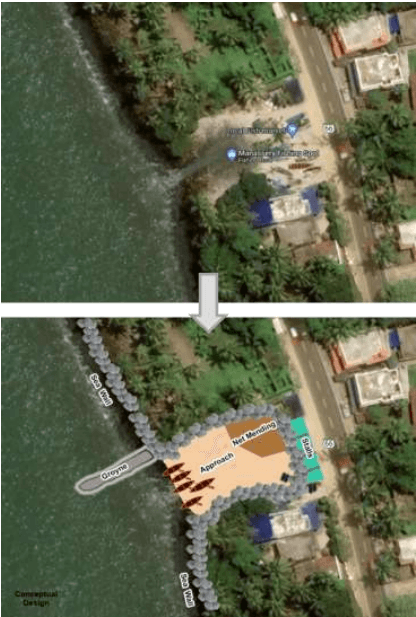
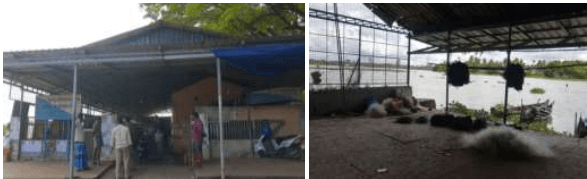
The fish landing centre is owned by around 14 families of fishermen community. The landing had an opening at the sea wall towards sea to launch boats which was closed with sea wall as a result of sea surge into the coastal area. However, this started affecting the livelihood of the families and the sea wall was opened again partially. Now the fish landing centre is no longer as active as before, the livelihood of the people are affected and the fish is brought from Thoppumpady to sell here.
Figure 32:19 Proposed Fish Landing Center at Manasserry- conceptual sketch Source: LSGD (Planning)
The new proposal requires redesigning of the coastal area with the beach to be located outside the sea wall enclosure. This will provide sufficient space to park the boats and launch it without much hindrance and also create enough space for net mending. The stalls can be provided along the road or the fish can be sold directly. A groyne can also be designed to stabilise the beach. The project requires good harbour engineering interventions and the sketch provided below is only conceptual.
Kochi Municipal Corporation
SECTORAL PROPOSALS
• Fish landing centre near Karunakaran road:
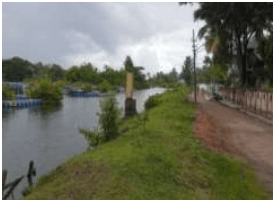
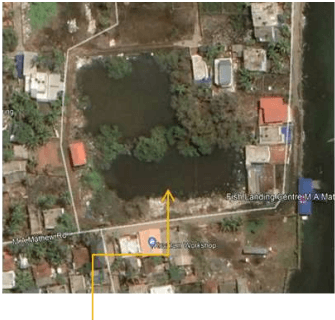
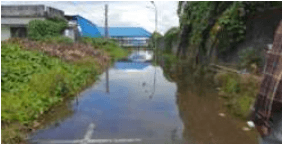
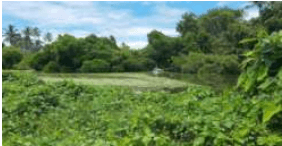
The approach road is inaccessible due to flooding by tidal waters. The storm water drains to be deepened and redesigned to accommodate the flood waters. Also the wetland pond nearby could be deepened to accommodate the excess water.
• Deepening of wetland pond nearby to collect part of tidal water.
• Fish landing centre at Perumbadappu:
The fish landing centre is associated with the market. The fish brought here in small boats are directly sold from the market. The bus bay is also located close by. More eateries selling fried fish etc. could be provided here also utilising the beautiful landscape of the area for tourism.
Other Strategies to be Adopted:
32.5.4.1 Inland fishing activities
The major threat for aquaculture activities in inland waters is ekkel (sediments) which reduce the depth of the water bodies and block the nets. This needs to be removed scientifically. The backwaters are infested with aquatic weeds which need to be removed periodically by engaging the locals. The weeds only live in fresh water and are therefore prominent in the post monsoon time when it germinates profusely. The Chinese fishing nets are often affected by this and the wooden beams are often stuck in the weeds or uprooted. Thevara to Kumbalangi ferry, GIDA Chathiyathu area etc. are majorly affected. The weeds can be used for developing value added products like the following
The removed aquatic weeds have high calorific value and can therefore be deposited in biogas plants for longer hours of burning.
High nitrogenous content of the weeds can be a potential ingredient in developing fertilisers for coconut farming. Branding under Kochi Corporation can be done.
Can be dried and used as fibre for landscaping and pot planting which would last very long.
Small scale fish feed mills can be developed as there is a shortage for quality feeds. The feeds can be branded under the corporation label and training can be provided under CMFRI and Thevara VHSC fisheries school.
• The pond within the Thevara VHSC school can be developed for bioflock/aquaculture.
The fishes cultivated under the subsidies of fisheries department and corporation could be branded under the corporation to obtain better reach for the products and obtain quality assurance.
• Vendors who sell fish along the roads needs to be provided with subsidies for proper selling carts.
32.5.4.2 Marine Fishing Activities:
Fort Kochi, Manaserry, Saudi areas have communities which are engaged in marine fishing. The have insurance for boat and engine but not for the net which is a major issue. Due to the presence of sea wall the communities find it hard to launch their boats directly into the sea. Often they travel to Thoppumpady to launch the boats.
The major threat for marine fishing activities are climate change and excessive septic waste dumping in the sea. Sea cages are not feasible due to sea jurisdiction under NAVY and Port trust. Several studies have noticed variations in PH values and expect future growth of antibiotic resistant pathogens.
Similarly illegal flushing out of waste from the factories in Eloor (especially when the rain fall is high or when the dam is opened up) leads to destruction of aquaculture facilities provided in the backwaters.
Insurance policies needs to be provided for fishing net
128
Multi-storeyed residential flats are proposed under “Punargeham” scheme to house fishermen from the CRZ areas. The proposed location is under the ownership of corporation in ward 26
32.8Solid Waste Management
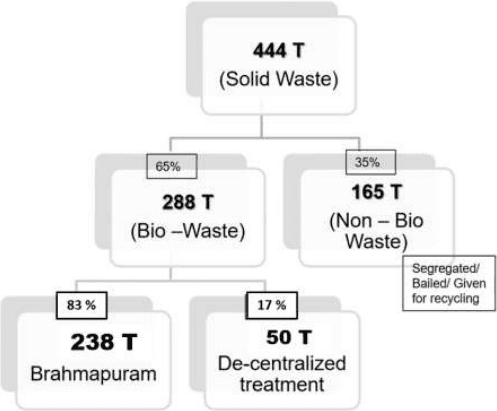
The Municipal Solid Waste Management requires a methodical treatment right from the collection till the disposal or recovery. It is one of the primary functions of the Urban Local Body. On the basis of 2040 population projection, 444 T of solid waste will be generated by the horizon year and 65% of the total solid waste i.e. 288 T comes out to be bio-waste. The solid waste management plan strategizes the treatment of about 50 T of this Bio-waste in a de-centralised way at 4 identified sites within the corporation area along with the treatment of waste at source like houses, communities, markets and other bulk generators of organic waste. The remaning can be sent to centralised treatment unit at Brahmanpuram. The decentralised treatment of solid waste is to be gradually strengthened. The use of non-recyclable faction of the non-bio waste is to be discouraged. The use of non-recyclable plastics needs to be discouraged while the recyclable plastics are to be segregated at designated Material Collection Facilities, bailed and given for recycling. Using the extended producer responsibility approach, the producers of the non-bio waste are to be given a significant responsibility – financial and/ or physical for the treatment or disposal of post-consumer products.
The frame work for this De-centralised waste treatment plan for Kochi is given in the Figure below:
Figure 32:29 Frame work of the De-centralised waste treatment plan for Kochi Corporation Source: LSGD (Planning)
Decentralized waste management systems or community level waste management systems reduce the burden of handling large volumes of MSW at a centralized location like Brahmapuram, with corresponding reduction in costs of transportation and intermediate
Kochi Municipal Corporation
storage. This strategy is based on the fact that the local communities are not the part of the problem, but they are the solution. The local communities are empowered with necessary tools and techniques for the treatment of their waste,
Some of the advantages of decentralized waste management plant for Kochi Municipal Corporation include the following:
• De-centralized systems allow for lower level of mechanization than the centralized solutions, and provide job opportunities for informal workers and small entrepreneurs.
These options can be tailor made for the local waste stream, climate, social, and economic conditions.
• They reduce the cost incurred for the collection, transportation, and disposal of waste by the ULBs.
The proposals also include facilities for the treatment of non-bio waste along with the policy level measures.
Rejuvenation of existing MCF at Edappally
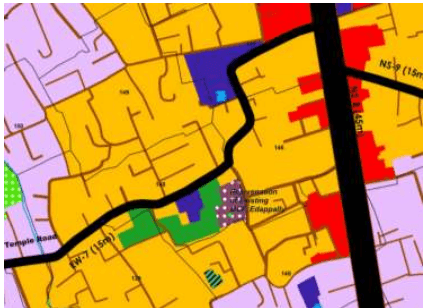
The proposed project aims to rejuvenate the existing Material Collection Facility near Edappally Zonal Office for better efficiency in the collection and segregation of waste thereby making the process of solid waste collection and segregation easier. The site is near
to Edapally Zonal Office. The existing facility is to be renewed with designated place for collection, segregation, storage, de-dusting and bailing of the non – bio waste. The segregated Non – bio waste are sold to end buyers or sent for recycling. Green buffers should separate the sight from nearby habitations. Minimum intervention is needed to make this MCF workable.
Figure 32:30 Location of MCF at Edappally
140
Rejuvenation of existing RRF at Mattancherry
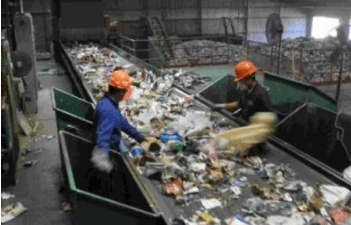
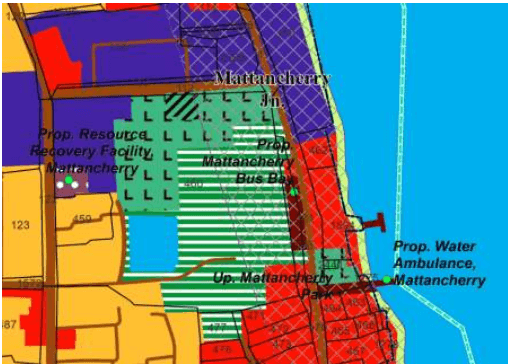
The existing Resource Recovery Facility at Mattancherry is proposed to be rejuvenated with necessary infrastructure for efficient collection and segregation of Non – Bio waste along with their bailing. The shredded plastic can be used in a variety of ways including road construction. This will mainly help in the efficient collection of non-bio waste from West Kochi and Island areas.
Figure 32:31 Location of RRF at Mattancherry
Rejuvenation of existing RRF & Solid waste management at Ravipuram
141
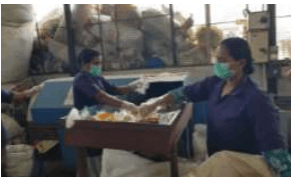
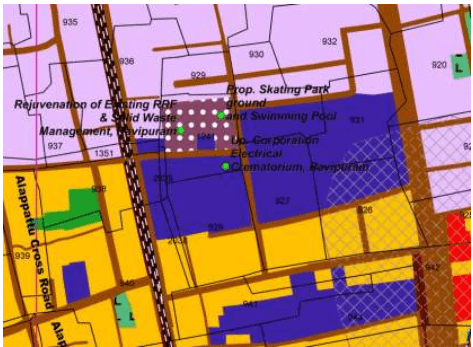
The existing Resource recovery Facility at Ravipuram is rejuvenated to have facilities for collection so as to handle the Non – bio waste of the main land. It should be provided with necessary infrastructure, machinery, tools and human power to sort, clean and store non-biodegradable discards from primarily sorted municipal waste and made available for production or consumption purposes. The existing bailing and shredding units are to be made workable and the facility should have segregated spaces for collection, segregation, storage and recycling of recyclable materials. Suitable collaborations need to be formed with Haritha Kerala Mission, Clean Kerala Company and KEIL (Kerala Enviro Infrastructure Ltd) for the handling of recyclable, recycled and hazardous waste. The bio waste treatment canter proposed at Ravipuram may be merged with this.
Figure 32:32 Location of RRF at Ravipuram
Rejuvenation of existing MCF at Manappattiparambu near Kaloor (along with proposed solid waste management plant) and Padiyath near Mullassery canal
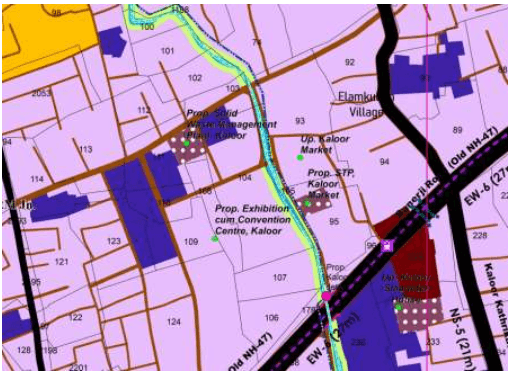
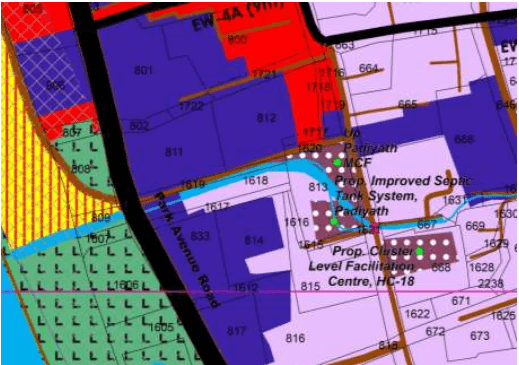
The corporation land with material collection facility at Manappattipparambu - Kaloor and Padiyath is to be rejuvenated with facilities for collection, segregation and bailing of recyclable waste. A small scale solid waste treatment plant is also proposed at Manappattiparambu. A glass shredding unit can also be integrated with this plant for the shredding of glass collected from different parts of the corporation area. Proper sound monitoring mechanism needs to be installed here. Thumboormozhi type waste bins for the treatment of bio-waste may be installed here as part of decentralised waste management plant.
Kochi Municipal Corporation
Figure 32:33 Rejuvenation of existing MCF at Manapattiparambu and Padiyath
Installation of Community Vermin Compost Pit
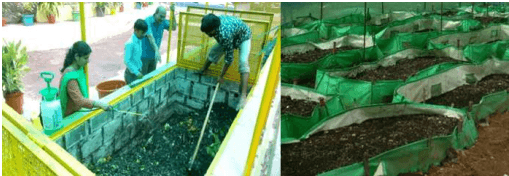
Community composting is a largely unexploited solution that is gradually getting its fair share of attention in India’s sustainability and waste management landscape. The power to harness the potential of waste lies with housing societies and gated communities today that can reap the benefits of large-scale composting, produce rich organic fertiliser, create organic community gardens, or even generate revenue from the sale of good quality compost.
The wastes from households are collected and converted to the fertilizers. A green buffer cum park surrounds the waste management unit so as to minimise the disturbance to the surroundings. Organic farming activities and classes and training programs on scientific solid waste management could be encouraged here. This can be encouraged in the residential areas of Kochi corporation.
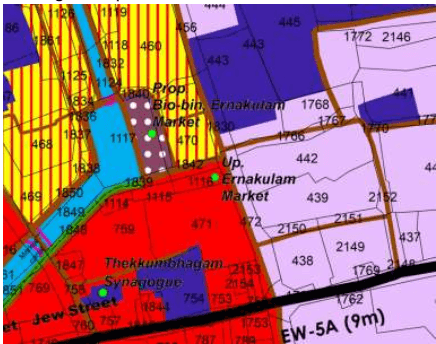
Installation of Bio-Bins at Broadway market
The project is done as a pilot project for Solid Waste Management within markets. The project is envisaged in the broad way market area of Division 67, Ernakulam North.
Kochi Municipal Corporation
Presently solid waste dumping is observed in this area. Bio bins are installed after clearing the site with necessary amenities. The high quality fertilizer obtained can be sold to the end buyers. A special committee is to be formed in the market which is responsible for the maintenance and running of the plant.
Figure 32:34 Location of Bio-Bins at Broadway market
Incorporation of technology in solid waste management & collection
Incorporation of technology helps to have a centralized mobile application based system for
monitoring the waste collection and management activities. It also helps to track the users the real time movement of waste collection network. This helps to have a better co-ordination and efficiency in waste collection activities. The mobile application also lets the citizens mark the unauthorized dumping sites (black spots) and helps in the timely clearance. This would also let the citizens know the locations of community/ street bins. These works can be coordinated by Integrated Command and Control Centre (IC4), which has already been operational in Kochi.
Decentralised Solid Waste Management Plan
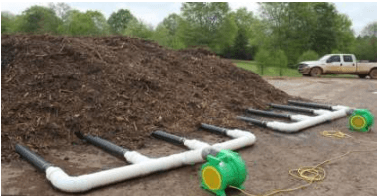
The decentralised solid waste management plants are proposed in 5 sites in Kochi Corporation area for treating bio-waste generated in the Corporation area after sending the suitable quantity of bio-waste to Brahmapuram. A combination of OWC and Windrow composting is used, so as
Figure showing aerated windrow composting
144
to maximize the efficiency of the process and minimize the disturbances to the surroundings. The community level waste management systems reduce the burden of handling large volumes of Municipal Solid Waste at the centralized location, with corresponding reduction in costs of transportation and intermediate storage. The local communities are made part of the process thereby imbibing a participatory solid waste management culture in the community level which helps the process of Solid Waste Management easier and efficient. Aerated Windrow Composting can be used that involves forming organic waste into rows of long piles of windrows and aerating them periodically by either manually or mechanically turning the piles. The introduction of air blower in a forced aeration system is observed to be successful in supplying oxygen to the microorganism for successful and faster metabolic activity thereby making the whole process faster in minimum land area. The land area also includes loading and unloading space for waste collection vehicles and the office space. Landscaping and vertical gardens helps to create a positive space inside the Solid Waste Treatment site.
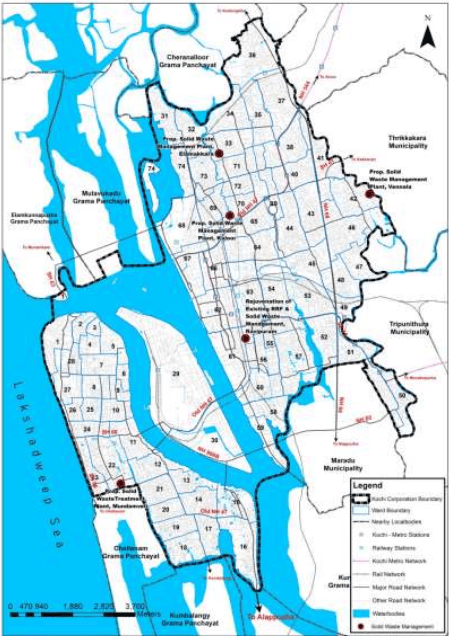
Green buffers are to be provided along the periphery site, so as to prevent the odours and noise from getting outside. The compost obtained as the end product can be shredded and sold as fertilizers. The project can be done with the assistance of the corporation while the profit can be shared between those who run the waste treatment plant. The Solid Waste Treatment plants are proposed at Mundamveli, Manapattiparambu, Vennala and Elamakkara. For lower capacities, Thumboormozhi type plants are also viable options. The waste treatment plants are to be provided with green buffers to provide separation from nearby habitations. Vertical gardens are to be provided with landscaping to provide aesthetic appearance and positive atmosphere in the sites.The locations of the treatment planrts are shown in the figure below and details are given in Table below:
Table 322 Details of Decentralized Treatment Plants
Sl. No
Location
Capacity(T/day)
Decentralised Solid Waste Management in vacant lands.
In addition to above 5 sites vacant spaces found for treatment plants, spaces like under the bridges, vacant plots, puramboku land etc which is poorly feasible for economic activities can be used temporarily / permanently for solid waste management activities like installing thumboormuzhi plants, material collection facilities, resource recovery facilities,backyard gardens utilising the manure generated etc.
Kochi Municipal Corporation
32.8.10 Policy level measures
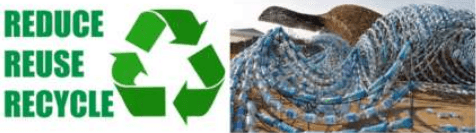
Subsidizing sustainable solid waste management practises and giving support to new technologies in the Solid Waste Management scenario need to be taken up. To promote the source level treatment of bio-degradable waste, pot composting, kitchen bin/ ring compost, bucket composting, bio composting and indoor 147reas -composting need to be popularised and adequate awareness and training need to be given to people. The generation of non – biodegradable materials can be regulated to a great extent by incorporating the age old mantra, “Reduce, Reuse and Recycle” which should be given proper thrust in Solid Waste Management activities. Plastic art installations can raise awareness on the amount of plastics being generated by the community.
The “Rag pickers” who have been silently working in our communities as waste collectors need to be properly assigned a role in solid waste collection and are to be paid for their work. Their Employment, Education and Empowerment serves the dual role low cost door step collection as well as raising their standard of living.
Refining of the existing technologies for the household level waste treatment by minimizing the odour need to come up. The use of Bio bins may be promoted in high rise buildings and large housing complexes. The treatment facility up to 5 TPD can be setup in community level which needs to be encouraged. Markets, Restaurants, and all institutions and gated communities having an area greater than 5000m² are made mandatory to treat biodegradable waste within their premises. Markets are to be made self-sufficient in waste disposal and each market should have a dedicated waste management committee. The Corporation needs to have proper collaboration with Haritha Keralam Mission, Suchitwa Mission, Clean Kerala Company, Kerala Enviro Infrastructure Ltd (KEIL) for the disposal of hazardous waste, bio-medical waste and Construction & Demolition waste generated in the municipal corporation. The process of Bio-mining helps to process the existing waste into energy. Conditions for the proper disposal of construction and demolition waste are to be added while issuing building permit. Active Community participation should be the main component of Integrated Waste Management in populated city like Kochi. Future studies should be carried out for checking the efficiency of the proposed methods. Through the
147
combined efforts of individuals from household and a proper Municipal Solid Waste Management system, Kochi city will be able to dispose waste generated and in future, piling up of legacy waste can be avoided.
32.9Drainage
For a city that depended mostly on canal based drainage system, the recent urbanisation and associated development has caused a massive impact on the natural drainage system in Kochi. These are to be identified and preserved. Also, the various activities regarding drainage requires an inter sectoral – inter departmental linkage. Such an integrative approach is to be formulated. Major proposals are discussed below:
Drainage Master Plan
In order to facilitate an integrated approach to deal with storm water flows and to ensure an inter – departmental co-ordination in various activities, Corporation of Kochi in consultation with concerned departments should prepare a drainage master plan which among other things should cover:
a) Preparation of detailed inventory of the canals and drains and mapping the same in finding the area which are not served by the existing system.
b) Review of the status and efficacy of primary and secondary drainage in Kochi to identify interventions to rehabilitate / develop them given city topography and water flows by preparing a detailed inventory of the canals and drains.
Run-off management strategy at a regional / zonal level giving thrust to low lying areas where gravity based flow is limited and pumping maybe required addressing water logging.
Network Zoning and phasing for implementation of comprehensive area level drains across the city to achieve the service level norms for storm water drains within Corporation area.
Kochi Corporation in consultation with Government should clarify accountability for operations and maintenance of drain systems. Preparation of detailed inventory of the canals and drains and mapping the same over lay with natural drainage helps in in finding the area which are not served by the existing system.
Given that the drain network is being executed and maintained by multiple agencies including concerned local bodies, Irrigation Department and Public Works Department, it is advisable to constitute special purpose vehicle (SPV) exhaustively for the preparation of the drainage plan and monitoring all issues relating to the same.
Following the preparation of the Drainage Master Plan, the Corporation and other agencies should in consultation with the Government prepare Detailed Engineering studies and Project
Rejuvenation of canals through Local Area Plans/ DTP Schemes
Rejuvenation of major canals and their banks are to be done through Local Area Plans (LAP) and DTP Schemes that facilitates greater detail in the development of canals. As the local
Kochi Municipal Corporation
conditions around each of the canals are different, their management also requires localised planning efforts that suit the local physical and social conditions which are made use with the help of Local Area Plans and DTP Schemes in Canal Bank Management.
Renovation of ponds, water bodies & Canals
The existing drainage network including the Canal system and water bodies need to be restored and renewed. These ponds should be protected to retain their drainage properties.The width of the canals are to be measured as per records and need to be widened to the earlier width wherever possible. The following canals need to be rejuvenated:
a. Renovation of Polakkandam Market Canal: The Polakkandam market canal which is a part of Rameswaram Canal needs to be cleaned and side protected. Screens are to be placed at different parts of the canal for bigger wastes to accumulate which are to be removed regularly. The canal also needs desilting and restoration to original width.
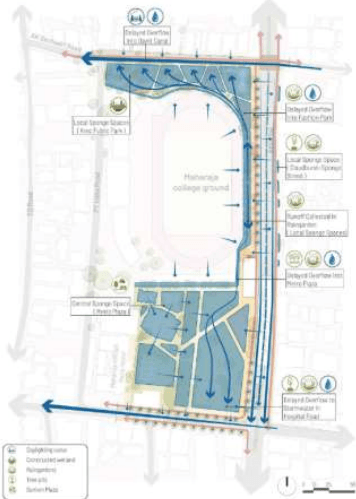
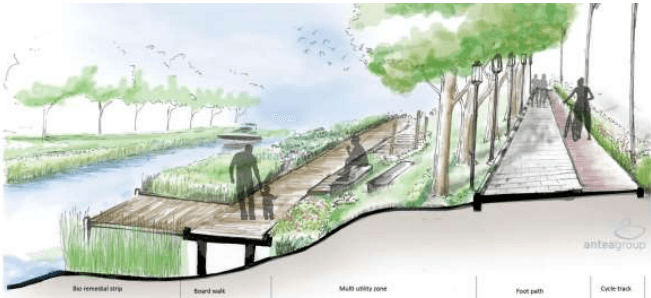
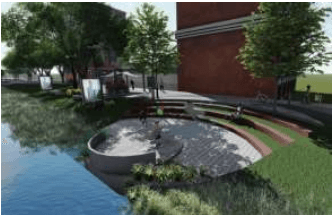
b. Renovation of Mullassery Canal: Mullassery Canal forms the core of water logging in the city area including KSRTC Stand. The Mullassery canal is to be rejuvenated through integrated blue green infrastructure for flood mitigation and street scape improvements. This project is to be integrated with water management & flood mitigation, Bio diversity planning, mobility planning, canal edge development, sustainable livelihood plan, open public space planning, coastal edge development along with engineering measures mainly for slope correction.
149
Effecting natural drainage to the nearest outlet is the most viable solution for preventing flooding up of water in KSRTC/ South Railway Station area. Excess water from the GHS School for Girls is directed to the Perandoor canal. The bed level of Mullassery Canal has to be lowered to the bed level of nearby Perandoor canal about 1.25 m to facilitate the un-obstructed flow of water. The Mullassery canal is proposed to be opened up. The opened up section of the canal is widened and connected to parks on both sides. The park alternates low lying wetlands to encourage bio-diversity and allows for permeability with higher sections that can be re-wilded and programmed for social activity. To manage water in the KSRTC stand area, large water holding areas are to be created. Here the local catchment options are used to slow down the speed of flow, store and route excess run-off to reduce floods. Large sections of the KSRTC plots are excavated to hold water during flooding. These are designed as tanks or landscaped as floodable parks and the excess water is then pumped back into the Mullassery Canal and to the Perandoor canal through multiple pipes across the railway lines once the rain subsides. All developments on the KSRTC plots are to be raise above the 100 year flood line. The rail culvert connecting Mullassery Canal and Perandoor canal is to be kept free of obstruction as this is a juncture point of many water bodies and drains.
Figure 32:36 Mullassery Canal area
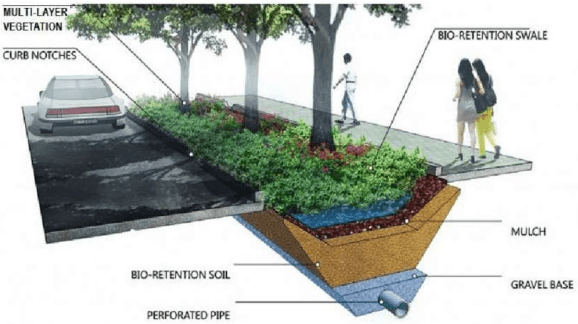
Hospital road and MG Road which are the collector streets are provided with rain gardens and tree pits to collect water from the streets and surrounding run – off. These blue – green infrastructure helps the existing storm water drain from getting overwhelmed by delaying the water. This helps to slow down the run-off before the water is released into the canal in case of cloud burst event. The project should also include community initiatives for effective waste management of communities on the banks of Mullassery Canal.
Figure 32:37 Integrated water management and flood mitigation strategies for sub-site as per Concept Plan for Mullassery Canal Area Source: GIZ, India for Kochi Municipal Corporation
Kochi Municipal Corporation
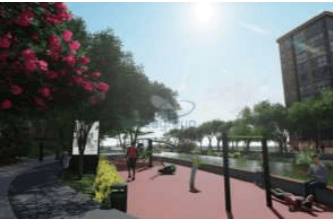
c. Renovation of Thevara Market Canal: Thevara Canal that runs along the Thevara market requires desilting and side protection. Effective community spaces are proposed along the banks of this canal including canal beautification and promenade development.
d. Renovation of Thevara Perandoor Canal (TP): ThevaraPerandoor canal requires silt removal especially between the Perandoor ROB and backwaters. The blockage of pipe culverts needs to be removed near the CBI quarters. Cables, ducts and pipes across the TP canal causing obstruction to the free flow of water needs to be shifted. TP canal is also linked through the backwaters through a system of link canals. These link canals need from Vaduthala to Atlantis hotel needs to be opened and cleaned. The boundaries of the canal have to be surveyed as per the revenue records and have to be brought back to its original shape. The Edges of the canal is to be beautified and preserved. The span and height of culverts especially in the Panampilly Nagar area, Pulleppadi – Kaloor area has to be increased. The storm water from MG Road has to be diverted directly into Kayal near shipyard area so that the water load of the TP Canal can be minimized. The mouth of the branch canal should be widened at Mullassery Canal Junction to avoid flooding in Kammattippadam area.
a. Connection of Changadampokku Thodu and Karanakodan Thodu at Kaloor: The Chilavannur canal needs to be fully opened and the connection of parts of the Chilavannur canal i.e. Changadampokku Thodu and Karanakodan Thodu is to be restored at Kaloor Metro Station to ensure the uninterrupted flow of water. This connectivity should be restored atleast by constructing a drain having minimum width of 4m from the sub-station compound by crossing Banerjee road adjacent to the JLN Stadium metro station so as to facilitate the flow of water in either direction. The width of the thodu is to be restored to original width. The canal banks are to be protected from encroachment. Existing culvers having no head room and vent way has to be reconstructed. Interlinking of parallel canals wherever possible to facilitate the natural flow of water for easy drainage. Providing high capacity pumps with shutter arrangements helps to drain out flood water to the lake so as to combat tidal variations.
Figure 32:38 Connection of Changadampokku Thodu and Karnakodan thodu
Kochi Municipal Corporation
The rivers & lakes encompassing the main lands have to be desilted regularly in order to accommodate the flood water. Water storage capacity of Perendoor canal and Chittor puzha shall be increased by desilting so as to reduce the travelling time of runoff water to kayal and to reduce the tidal inflow of water towards the thodu.
b. Restoration of Konthuruthy river and rehabilitation: The Konthuruthi river whose width has drastically reduced needs restoration to the original width. Desilting has to performed and delta formed at the end needs to be removed. The obstructions in the course of the channel also need to be removed. The pipe culverts provided under the thodu causing hindrances to the smooth flow of water needs to be removed and a culvert having necessary width and clearances need to be constructed. This area can be developed as a community space. The families along the river needs to be resettled and the encroached area is to be regained for the canal.
c. Renovation of Edappally, Chilavannoor and Market Canals: The Edappally, Chilavannoor and Market Canals are to developed through canal bank infrastructure development, Canal cleaning, canal widening and canal shore protection. Parks and other public places are to be set up along the banks of the canal to prevent the encroachment.
Figure 32:39 Canal bank infrastructure development of Edappally Canal-conceptual sketch Source: IURWTS Detailed Project Report, KMRL
The desiltation and rejuvenation of Canals in West Kochi area like Rameswaram Canal, Mantra Canal, Pallichal, Pashni thodu and Pandarachal that forms the life lines of canal network in West Kochi area also need to be carried out.
Considering the future generation of waste water and the high water table of Kochi Municipal Corporation, it is imperative that it should have a waste water treatment mechanism. With the unique to topography as well as interaction between various parts of the city a decentralised water treatment mechanism is proposed. In –situ liquid waste
Kochi Municipal Corporation
management systems like septic tanks and soak pits are not suitable to Kochi Corporation area mainly due to high water table, high population density and due to the risk of contamination of other bodies. So it is imperative that we need to move gradually to piped sewer system and decentralised collection of sewer.
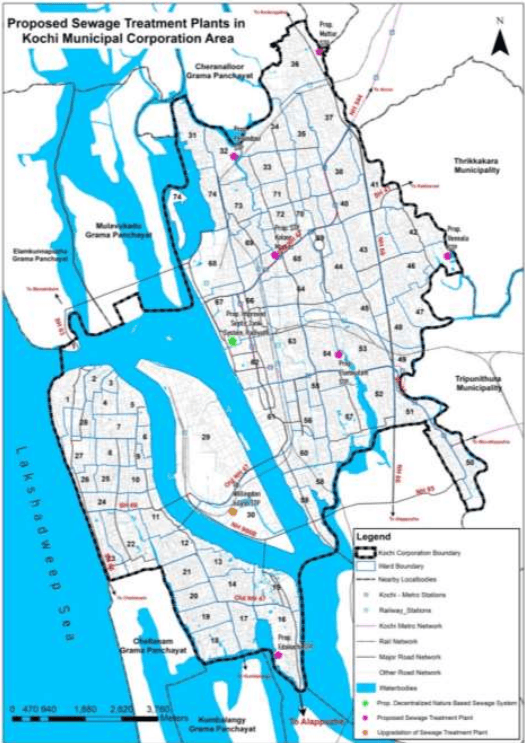
Presently various schemes are being carried out in the corporation for carrying out the sewage treatment. These schemes are also integrated with the proposals.With better utilization of solar energy sources and IT based sensors for the operation of the plant, the operational cost can be reduced and the projects can be made eco- friendly. Absence of neat and clean toilets with proper signage and markings are proposed. Major proposals are detailed below:
Figure 32:40 Location of Proposed Sewage Treatment Plants Source:Generated by LSGD (Planning)
Kochi Municipal Corporation
32.10.1 Sewage Treatment Plant of 14 MLD at Vennala
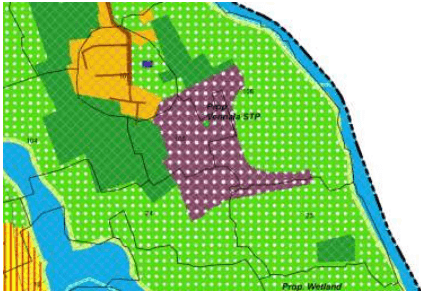
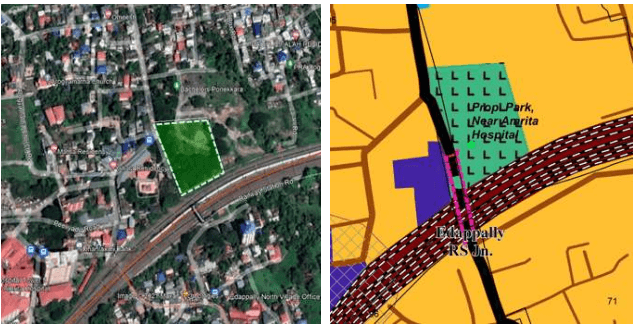
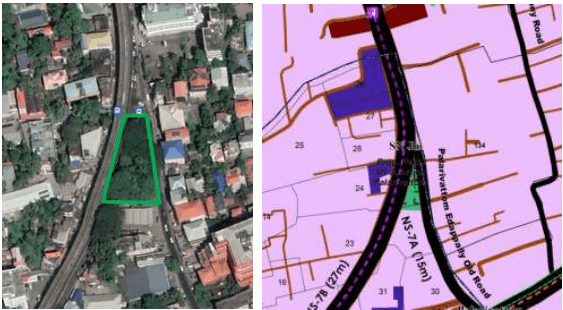
A Sewage Treatment Plant of 14 MLD is proposed in Edapally South Village in the eastern end of Chakkarapparambu division covering the eastern parts of the corporation area in Zone 6. This includes parts of Vennala, Chalikkavattom, Ponnurunni, Thammanam, Palarivattom and Southern areas of Kaloor.
Figure 32:41 Proposed location for Vennala STP
32.10.2 Sewage Treatment Plant of 18 MLD at Muttar
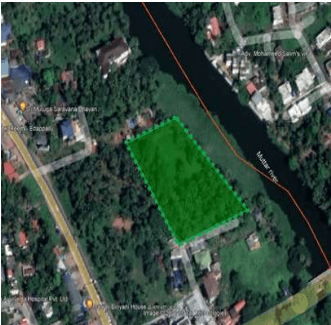
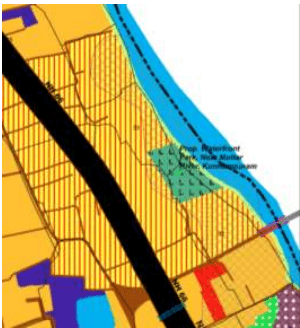
A Sewage treatment plant in Edapally North Village of 18 MLD is proposed near Muttar at Kunnumpuram division partially serving the requirements of Zone 5, the other STP of 15 MLD being at Perandoor. The Muttar STP mainly serves the North Eastern parts of corporation mainly covering Kunnumpuram, Edappally, Devankulangara, Mamangalam, Padivattom and Karukappilly areas. A Sequencing Batch Reactor Technology is used.
Figure 32:42 Proposed location for Muttar STP
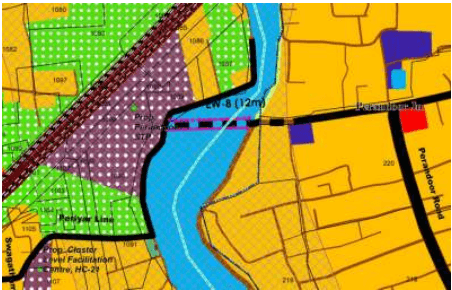
32.10.3Sewage Treatment Plant of 15 MLD at Perandoor
A 15 MLD plant in Cheranallur Village is proposed at Vaduthala East Division partially serving the requirements of Zone 5. This STP covers the North and North Western parts of the main land mainly covering Vaduthala, Pachalam, Elamakkara, Thrikkanaravattom,
Kochi Municipal Corporation
Thattazham and Ayyappankavu areas. The Sequencing Batch Reactor technology is proposed.
Figure 32:43 Proposed location for Perandoor STP
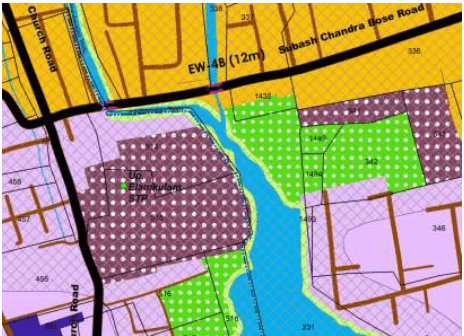
32.10.4 Sewage Treatment Plant of 23 MLD at Elamkulam
The existing KWA land of KWA STP in Elamkulam Village at Elamkulam can be utilized to serve the need of 23 MLD waste water by the horizon year. For that, the existing KWA land at Elamkulam is proposed to have a 23 MLD STP serving the Ernakulam city, Gandhi Nagar, Panampilly Nagar, Girinagar, Vyttila, Perumanoor, Konthuruthy and Thevara. This STP will serve the Kochi city and main residential areas of Kochi Corporation. The Poonithura and Chambakkara areas can also be added in the future. The capacity and efficiency of existing 4.5 MLD Sewage Treatment Plant can be enhanced with SBR technology.
Figure 32:44 Proposed location for Elamkulam STP
Kochi Municipal Corporation
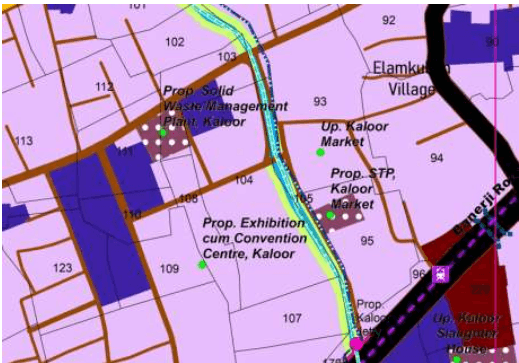
32.10.5 Sewage Treatment Plant of 0.25 MLD at Kaloor Market
A 0.25 MLD STP is proposed in Rameswaram village near the GCDA Kaloor Market. This will mainly treat the sewage effluents in and around the GCDA Kaloor market area; in the future, this STP service with capacity augmentation can be expanded to the neighbouring residential areas as well.
Figure 32:45 Proposed location for Kaloor STP
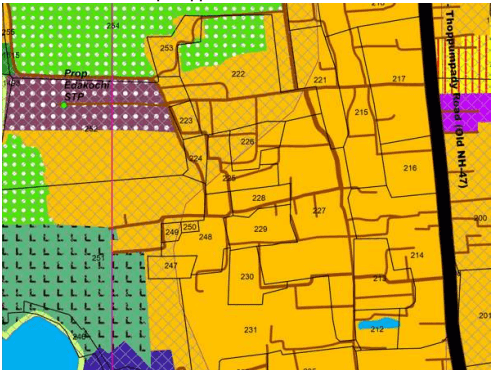
32.10.6 Sewage Treatment Plant of 1.1 MLD at Edakochi
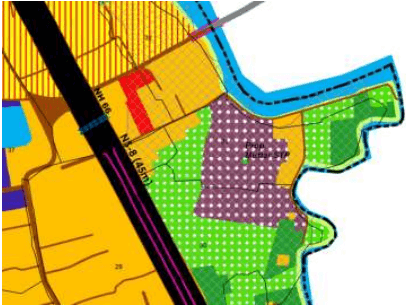
The Sewage treatment plant of 1.1 MLD capacity is proposed in Division 16 near Ambedkar Colony which using Sequential batch reactor technology. The coverage area of sewage plant area includes Edakochi and Perumpadappu areas.
Figure 32:46 Proposed location for Edakochi STP
156
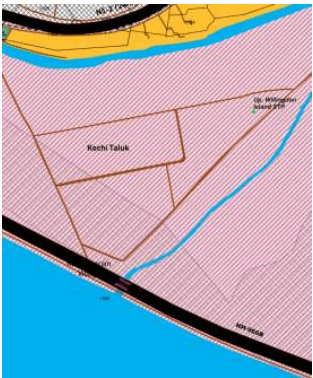
32.10.7 Upgradation of existing FSTP at Willington Island to STP of 1.1 MLD
The existing FSTP at Willingdon Island is to be upgraded to 1.1 MLD STP for the whole of Willingdon Island.
Figure 32:47 Proposed location of Willingdon island STP
32.10.8 De-centralized nature-based Sewage Systems and improved septic tanks in West Kochi
The West Kochi area is to be provided with improved septic tanks which offer a higher degree of efficiency (usually up to 85% in place of conventional septic tanks that offer 30 – 35% efficiency). Similarly, small Decentralised Nature Based Waste Water Systems are proposed in the West Kochi area covering the housing pockets and low-income household areas. The waste water and sludge can be used in cultivation or urban agriculture thereby strengthening the local communities nearby.
32.10.9 Improved septic tanks and sewage systems in Padiyath
Improved septic tanks which offer a higher degree of efficiency has been proposed near Mullassery canal to serve the Padiyath East and Padiyath West in Padikathukulam colony. Nature based sewage systems can also be explored based on the availability of land area. The waste water generated can be used for gardening purposes in the colony. This system can help to tackle water pollution in Mullassery canal.
32.10.11Policy level initiatives
Creating a positive atmosphere around the Sewerage Treatment Plants helps in the implementation of such projects easier by minimizing public protests. Green belts inspired landscaping and vertical gardens around the STP create a clean, green and odourless environment and mask the outside view. Growing plants at the exterior of STP components and various units provides a natural filtration and final treatment by removing harmful bacteria, viruses and nutrients. Using the solar energy sources and IoT (Internet of Things) based sensors for operation of the plant, operation cost and time for inspection of quality at various stages can be reduced. The treated water contains many useful plant nutrients and will be beneficial for the environment when discharged as soil infiltration. Re-use of the recycled water for gardening and toilet flushing should also be encouraged. The sludge obtained after drying provide excellent manure for agriculture and gardening. The performance of the STP need to be constantly monitored by testing of influent and effluent samples at regular intervals.
The Sewage treatment is to be made mandatory in all major housing projects and commercial complexes. Its functioning and performance also need to be assessed regularly. Improved septic tanks which will give better bacterial filtration efficiency should also be encouraged by giving subsidies in their construction.
Energy
32.11.1Kochi to be envisioned as a Self-Reliant Energy Efficient City
• Integration of low carbon sources of energy into the system at various sectors.
Encouraging & Marketing of energy efficiency devices like CFL, energy star appliances and its mandatory usage in all public/institutional buildings in the city.
Encouraging public transport system, bicycle usage, pedestrianisation to reduce pollution & dependence on petroleum by creating clean and safe facilities.
• Mandatory feasibility check for harnessing solar energy at institutional levels.
• Green pricing and Incentives to those who choose to buy energy from renewable resources.
• Guidelines to reduce energy usage at building level with passive heating and ventilation, alternative technologies etc.
Feasibility check for Harnessing solar and tidal energies in the islands & coastal areas in Kochi and along with floating solar plants
Stand alone, de centralised power generation units can be encouraged with Private investments in energy sector and with ideas of energy generation through sustainable solutions like energy from urban municipal waste in each ward through Bio gas.
Excess energy harvested can be sold back to the main grid reducing pressure on the public energy sector.
• ECBC training programs for the local body members to learn about energy efficiency and encouraging the usage in wards.
Kochi Municipal Corporation
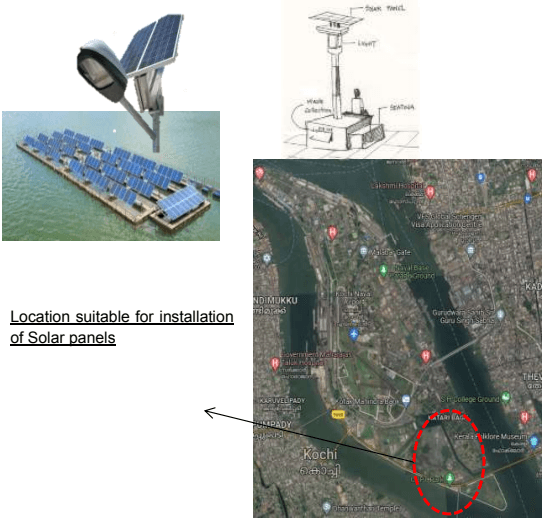
Although almost entire Kochi is having the potential to harvest solar energy, from study conducted it was found that particular area in Willingdon island is very good with large expanse of open area and continuous stretch of solar radiation ranging from 1750-1762 KWH/m2. This area could be used to identify solar related projects or including solar projects in the existing land use.
Location suitable for installation of Solar panels
Figure 32:49 Location suitable for installation of solar panels
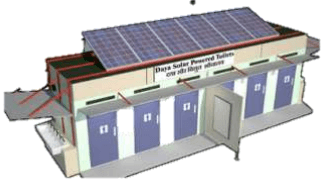
Solar powered public amenity units like e-toilets or comfort stations, street lights, mobile charging units, information centres, public transport terminals and waiting sheds could be adopted to reduce the stress on KSEB and to allow them to work as stand along units.
Figure 32:50 Public toilets with solar panels for power generation
Kochi Municipal Corporation
An alternative solution for power fluctuations during disaster is required. There are instances of collapse of concrete and wooden posts which could be replaced by fibre reinforced polymer (FRP), which have proved to offer durability even during high intensity typhoons. Power projects and substations should be located in non-flood plain area. ‘The crisis and disaster management plan for power sector’ by Ministry of Power Govt. of India should be used a guideline in power project planning within the corporation.
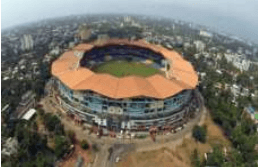
• A roof top solar energy harvesting unit can be provided at JLN stadium, Kaloor as the solar potential energy is found to be high here.
32.11.2E-mobility in Kochi
KMRL stations have been established both along the existing high-density areas, a key characteristic of Transit Oriented Development, as well as in those areas where the city is projected to expand. This reflects a new paradigm for decision-making in Kochi, wherein KMRL plays an integral role in the transportation and energy sectors.
• Adopting models like solar panels over roofs of metro stations can be adopted throughout the stretch.
Greening the metro pillars can be done in a more wide spread manner throughout the stretch to reduce the city heat and the energy usage arising from it.
The proposed water metro could be steered in a direction of sustainable travel for common people. Solar powered boats and technologies using less energy could be opted.
• Marketing of electric cars and bikes with more provision for charging stations. An EV charging station is proposed at Vytilla.
Pole mounted charging stations are proposed by KSEB in 121 locations within Ernakulam district and the work is under progress. Provision for easy
Kochi Municipal Corporation
SECTORAL PROPOSALS
installation of electric charging stations in various land uses have been provided in the Development control regulations.
Fast charging stations are located in 10 locations within the corporation limits, more such charging stations requires to be installed by KSEB in association with petrol pumps or in parcels of land along the main transport corridors to encourage the usage of electric vehicles.
Use of Water transport in freight movement
• Encouraging the use of water metro which can be a sustainable mode of travel
• Walking and cycling tracks within the city can encourage people to rely more on pedestrian movement.
32.11.3Saving Kochi from being a Heat Island.
More heat in the city corresponds to more usage of power for cooling and ventilations purposes.
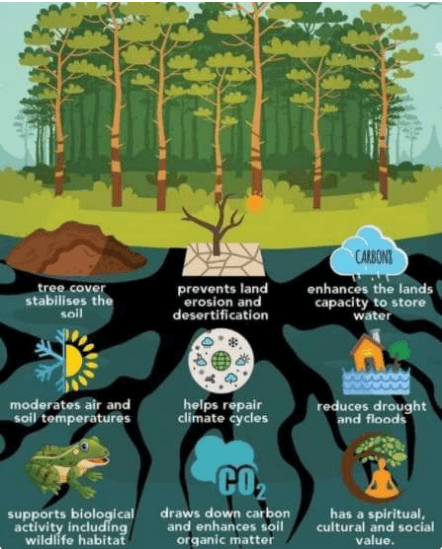
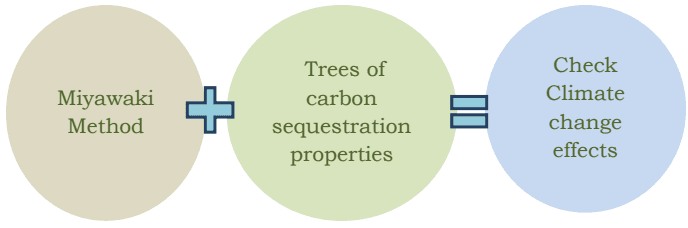
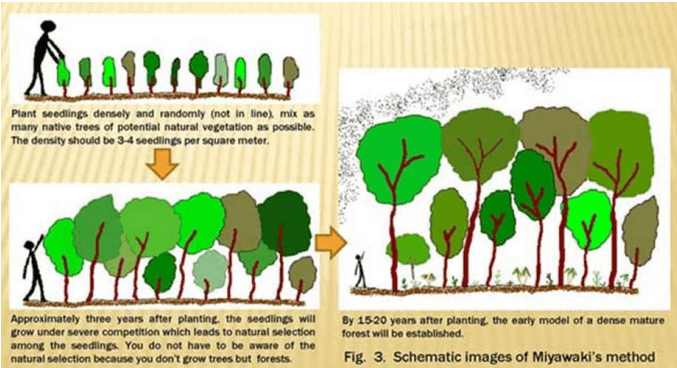
Urban forests: with endemic species of carbon sequestration capacity could be adopted as a model by the corporation which could be adopted elsewhere to reduce the rise in temperature and its effects. These could be provided in institutions or open parks preferably by adopting the Miyawaki method. Endemic species like Teak, ebony, mangroves etc. have high carbon sequestration property which can be used in social forestry initiatives as effective carbon sink.
Sensitisation and incentives for adopting energy efficient measures like reduction in paved surfaces especially in parking lots and front yards of complexes or tiles with turfs could be encouraged. An institution /organisation/building satisfying all criteria of IGBC green building guidelines could be offered incentives by the local government.
32.11.4Buildings identified for solar installations.
Based on the solar potential analysis a few buildings/institutions of large expanse have been found that can undertake solar harnessing projects within its premises.
Cochin Harbour Building
• Cochin Shipyard
Central Institute of Fisheries Technology
GCDA Building, Kadavanthra
JLN Stadium, Kaloor
Education
Education is fundamental to development and growth. It is only through enriching human minds that achievements in development can be made, from health advances to innovations and growth in various sectors. To reap full benefits of the human mind, education is the best tool that can make it happen. It improves the quality of people’s lives in ways that it transcends benefits to the individual and family by contributing to economic prosperity and enables socioeconomic mobility. In a period of varied educational advances there are still
challenges that need to be overcome. Albeit accessibility has substantially improved, new challenges that the city faces needs to be assessed and incorporated into the sector. The main strategies adopted for the sector is to address the challenges faced by the sector, to provide varied learning experiences for all and to specially address the differently abled in the sector. Sector proposals include
32.10.10Public Comfort Stations at Major Destinations
The absences of clean, neat and women friendly toilets have created a lot of health risks as well as discomfort for the people of Kochi as well as the commuters. Major gaps in the locations of the existing comfort station in the city are identified and proposals for the Public Comfort Stations are given based on the gaps as well as the need.
Kochi Municipal Corporation
SECTORAL PROPOSALS
Public Toilets with refreshment facilities at the GCDA Parking facility near Marine Drive
Public Toilet at Abraham Madamakkal Road near Goshree bridge
Public Toilets at Jawaharlal Nehru Stadium, Kaloor
Public Toilet at Shihab Thangal road near Panampilly Nagar
Public Toilet near Vaduthala Junction
Public Toilet near Edappally Junction
Public Toilet at Palarivattom Junction
These comfort stations should have proper signage and markings and other ancillary infrastructure for refreshments, cloak room, wash room and breast-feeding rooms. Such toilets should have separate provisions for trans genders. All the existing and proposed public comfort stations need to be integrated with GIS applications so that they could be easily found out using GIS platforms.
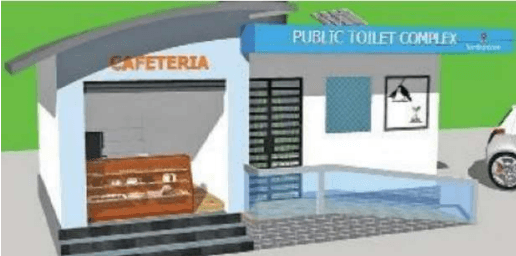
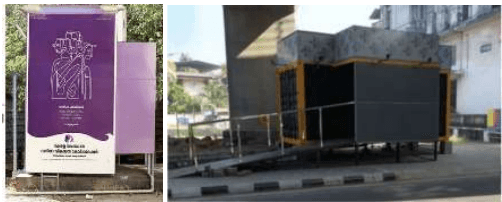
Figure 32:48 Proposed prototype of Public Toilet Complex
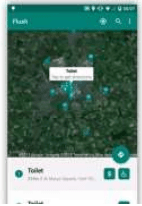
An app based public toilet finder is also proposed, that lets the commuter to spot the public toilet facilities in the vicinity and to spot their real time availability. Such an app can also report the unclean toilets to the authorities. This could also integrate the public toilets as well as the private toilets especially in the shopping complexes etc. that are willing to co-operate with the local authority in providing better sanitation network for the people. Such building owners could be given additional benefits including a reduced rate of taxes. The users can give ratings based on their experience.
32.12.1Upgradation of Existing Educational Facilities
As per the gaps observed in the sector in the existing scenario and projected requirements, pre-primary, primary schools are deficit within the planning area. Anganwadis on the other hand are a surplus within the area. For optimum usage of land, pre-primary facilities can be integrated with the existing Anganwadis. Policy level initiatives can be formulated to address this.
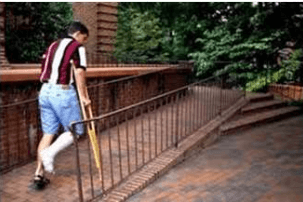
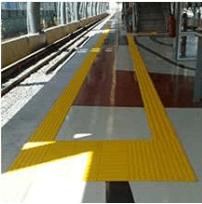
Anganwadis is proposed to be upgraded through provision of Hi-Tech Facilities, physical infrastructure, provision of recreational spaces etc. The existing schools within the planning area need to be upgraded in physical infrastructure and retrofitted to be universally accessible through provision of ramps, braille tiles, barrier-free design, grab bars etc.
32.12.2 Establishment of a Blind school
Various guidelines has been laid down by agencies regarding design of such special needs school. The appropriate guidelines and design need to be adopted to ensure school is designed catering to the needs of the students. It can be provided at an appropriate location keeping in mind the specific requirments of the students.
32.12.3 Establishment of a Pedagogy Park
Play is an essential part of learning. Rethinking traditional schools and closed classrooms through play can bring out new behaviours, events and interaction which are crucial for a holistic development of children. The project envisions provision of new avenues to make learning holistic, integrated, enjoyable and engaging. A pedagogy park involves designing an educational environment where nature and senses play an integral element of the educational experience. It can be provided at an appropriate location ensuring the safety of students and providing barrier free access.
32.12.6Live Training Classes in Adaptive Spaces
Kochi with its rich heritage and culture offers a myriad of learning opportunities in the area of art, culture, design, traditional art-forms and the like. The project envisions on provision of a dynamic and evolving space that provides platform for artists, poets, musicians, photographers etc. to teach their craft to the public. The space will act as a multi-generational space where live training classes will host and people of all ages can come and learn.
Figure 32:51 Live Training Classes at Adaptive Spaces
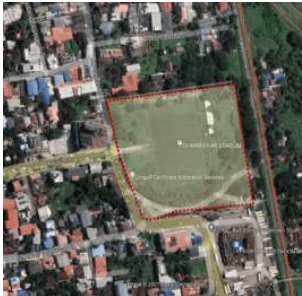
The site identified for the project is at Rajendra Maidan owned by the Greater Cochin Development Agency (GCDA). The site is located along prominent tourist attractions and the project can serve as an additional tourist attraction. The location of the identified space is shown in the figure above.
Health
Kochi has strong and widespread healthcare facilities in both the Government and Private Sector. The healthcare facilities include a range of hospitals, dispensaries, nursing homes, Urban Primary Health Centres, General Hospitals, veterinary hospitals etc. operating at
Kochi Municipal Corporation
various parts in the Corporation Area. Healthcare sector in the planning area has facilities at various levels and serves the area well. The advanced healthcare services offered in the city has resulted in the catchment area of these facilities to be at a regional and international scale. The strategy adopted for the sector is to strengthen the existing healthcare infrastructure, promote Kochi as a healthcare hub for wellness & health tourism, cross-sectoral interventions to address challenges faced by the city and to propose facilities catering to specific challenges such as for ageing population, addiction etc.
As per URDPFI guidelines, the Government healthcare infrastructure in the city currently caters to the needs of its present population, except in the category of General Hospital. For the projected population, the requirements of the population are also met except in the category of General Hospital.
The shortfall in one category of healthcare facilities as per URDPFI guidelines when analysed with the present number of private healthcare facilities and with respect to the availability f Genral Hospitals in nearby local bodies, the existing infrastructure cater to the needs of the projected population as well. The sector proposals include
32.13.1 Infrastructural Upgradation of Hospitals
The present Government facilities cater to a large section of the society and currently require Upgradation of infrastructure and proper maintenance. By ensuring quality care at all levels, the dependency on private sector will be optimum and a strong public healthcare delivery system will ensure health for all.
32.13.2E-Health Services
E-Health services use digital technologies and telecommunication such as computer, internet, mobiles etc. to facilitate health improvement and health care services. eHealth program enables to achieve the vision under Smart City of using ICT to improve healthcare effectiveness and lower healthcare cost for citizens. It provides citizen friendly and
convenient centralized healthcare service to bring about accountability and transparency and thereby brings in a system which can monitored and analysed online using digital platform. The benefits of it are many as it provides easy access to patient records, reduces paper work, reduce duplication of costs and thereby bringing down cost of health care.
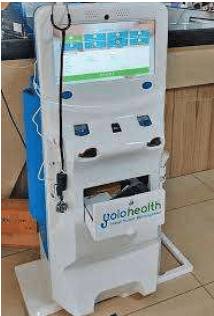
Health ATM is an ‘ATM for Healthcare’ wherein all basic and primary healthcare services can be delivered in an ATM-like concept, targeting communities who don’t have access to a hospital or doctor. With the ability to screen patients, capture vital health parameters and provide access to quality healthcare within reasonable proximity, Health ATM is able to deliver complete primary care. Health ATM can screen
people, capture health parameters and do basic diagnostic tests, all with a “human touch.”
Kochi Municipal Corporation
Health ATM and eHealth services are currently being implemented within the planning area under the Cochin Smart City Mission. The project can be studied and upscaled to many major hospitals in the city.
32.13.3Wellness and Health Tourism
166
Health Tourism is a term used to describe the rapidly-growing practise of travelling across international borders to seek healthcare services. Services typically sought by travellers include elective procedures as well as complex surgeries. Wellness tourism focuses more on wellness systems (AYUSH) such as Ayurveda, Yoga, Siddha etc . Kochi offers excellent services and quality healthcare in both these sectors making the city in a unique position to be developed as a healthcare hub catering to both systems of medicine.
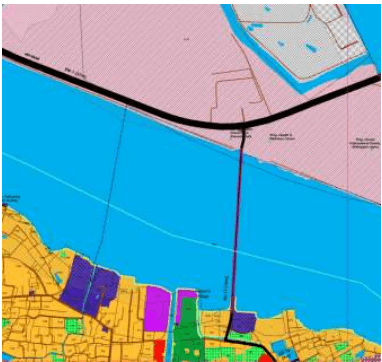
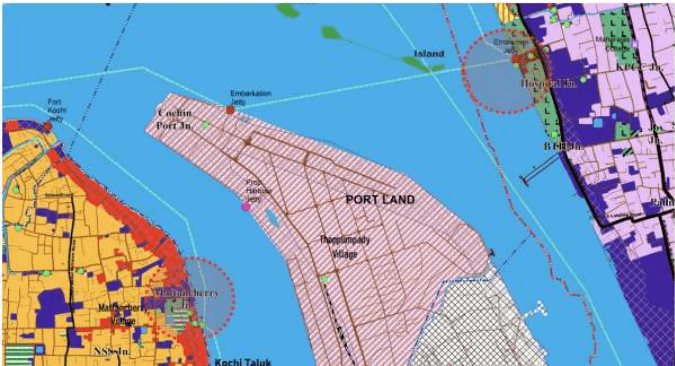
Kochi is envisioned to be developed as a destination catering to its health and wellness tourism potential. To further boost the wellness potential of the city, a health and wellness centre can be established a prime location in Kochi that brings together traditional forms of medicine to provide a holistic healthcare. The project envisions to establish a centre where a person can get the treatment they seek and provide an opportunity to embody the Ayurveda lifestyle. The location of the site is shown below.
Figure 32:52 Wellness Centre at Willingdon Island
32.13.4 The centre is to be designed to showcase the local architecture and can house local artisans and provide a platform to showcase their work. The identified site for the project is at the South of Willingdon Island. The location for this centre is chosen along the scenic backwaters that are unique to Kochi and is under the ownership of the Port Trust. The Department of Tourism, Port Trust and Kochi Municipal Corporation can work in tandem to design, establish and run the centre. The project has the potential to put Kochi on the map for Wellness Tourism.Geriatric Care
Population in a city will age. Due to dramatic improvements in nutrition, sanitation, health, education and general economic well-being, longevity has increased while at the same time fertility has decreased. This can shape the demographic profile and needs of the society. Population aging can produce profound distributional issues like gender gap, intergenerational disparities, spatial disparities and socioeconomic inequalities. There will be changes in the employment pattern, accumulation of pension entitlements, care responsibilities and other vulnerabilities related to old age. According to World Bank, a country is defined to be ‘aging’ when the share of people ages 65 or older is above 7 percent, ‘aged’ when the share is 14 percent or more and ‘superaged’ when it exceeds 20%. In the present scenario, average number of elderly citizens per household is 1.27 for Ernakulam District. In Kochi 66% of the Households are headed by an elderly citizen. Albeit the numbers seem safe but the requirements of an aging population can only be catered through better preparedness and planning in phases for increasing care needs.
With rising income levels, a growing number of the senior citizens are now economically independent and willing to pay for facilities and services related to their physical, medical and psychological services. On the other hand, there is a section of the elderly who do not have the proper financial resources to cater to their respective needs. This section of the elderly tends to be burden and a possibility exists for poor treatment in their respective homes. The geriatric care in the city is thus designed in a ‘segmented approach’ that is sensitive to the diversity within the population of senior citizens to cater to their different needs. The facilities are proposed at different care levels which are detailed out as follows
32.13.4.1 Retirement homes
Retirement Homes are essentially residential complexes or form a part of residential complex. This type of care facilities includes a residential complex with provision of specialized care to its residents, elderly friendly built environment, recreation spaces and agreed customized services to be provided on payment of appropriate service/maintenance charge. This category of care facilities is targeted to benefit the urban upper- and middleincome elderly citizens whose children have migrated to better employment opportunities or for other reasons. This segment of the elderly is left alone to take care of themselves and more often than not, they are quite capable of doing so. Strengthening systems of formal and reliable care-giving is essential for this segment.
Kochi Municipal Corporation
To materialize this concept within the planning area, a flexible model is devised wherein, land is not earmarked for the same but rather a category under Residential Land use, namely ‘Retirement Home’ will be incorporated. The projects must meet the requirements as laid down in the “Model Guidelines for Development and Regulation of Retirement Homes “by Ministry of Housing and Urban Affairs, Government of India. Retirement Home projects although falls under Residential Land use, they are different from conventional real estate projects and have special requirements. To encourage the promoter/developer to build such Retirement Homes projects, the provisions for incentives can be worked out.
32.13.4.2 Pakal Veedu
“Pakal Veedu “are essentially day care centres for the elderly. It is a planned program of activities in a professional care setting designed for elderly citizens. These centres enable seniors to socialise while receiving the needed health services. The services offered can be varied. While one type of centre focuses on social and recreational services another type can include comprehensive medical and therapeutic services. The target population are senior citizens who require supervised care with their primary caregivers occupied during the day or those who are isolated and lonely. Feeder bus services can also be incorporated to pick up the citizens from their homes to these centres and drop them back to their homes. “Pakal Veedu” can be established at a cluster level, combining two or more wards to cater to the needs of the citizens in those respective zones.
32.13.4.3 Domiciliary Care Centres
This is the kind of care that is provided by a qualified home care worker at the patient’s own home. These centres can cater to senior citizens and can be given to people with special needs that require the attention of a professional domiciliary care worker. This can be provided at a cluster level or in tandem with the Urban Primary Health Centre at that respective ward. These centres are also envisioned to serve during a pandemic outbreak as a First Line Treatment Centre that are intended for patients diagnosed with the disease and otherwise eligible for home isolation, but do not have the facility for the same at home. Thus they will help in reducing the stress on the existing major hospitals during pandemics and events of disasters. These centres must be designed as per the Domiciliary Care Centre Guidelines at LSG Level as laid down by the Kerala Government.
32.12.4Immersive Training Centre
Immersive Learning Centre is specifically a centre where classic pedagogical theories endorse the idea of Virtual Reality integration into education. Virtual Reality (VR) can aid students with special needs especially those with autism spectrum disorder. VR can serve as a tool for professional training and school education. It can be used to provide real-life in a friendlier environment, thereby providing the learners a safe space to prepare for various scenarios. VR creates role-playing environments for practising social skills and can help in alleviating phobias.
The centre is envisioned to teach social, behavioural, communication and life skills to learners with various neurodiverse conditions. The centre can be upscaled in the long run. It can be provided at an appropriate location in close proximity to a special needs school.
Kochi Municipal Corporation
32.12.5 Studio and Film Institute
The Greater Cochin Development Authority (GCDA) and the Kerala State Film Development Corporation in conjunction to setting up a theatre complex in Kakkanad and will establish a post-production studio and film institute within the planning area. Kochi city being a film hub, offers the scope for a post-production studio. The project envisaged is to establish a modern dubbing studio and a film institute. The project can be established at an identified location by both the bodies.
32.13.6De-addiction Centre
Kochi city is now privy to rampant use, sale and abuse of drugs. With more and more cases being registered for the sale and possession of drugs, the issue needs to be addressed at various levels. The establishment of a Government-run de-addiction centre is crucial and a necessity in the city. A portion of the migrant labourers are also heavy users of drugs. There is an absence of an affordable rehabilitation centre where the urban poor and the migrant labourers can go to. The services offered in many private hospitals is out of reach to them due to affordability.
Owing to the constraint in availability of land, the De-addiction centre is proposed to be established outside the planning boundary near the Kalamassery Medical College. The centre will be run by the Corporation / Municipality in tandem with National Health Mission and Excise Department/ Police. The Centre can also cater to phone addictions as well.
Kochi Municipal Corporation
Recreational Facilities
Urbanization enables people to come together to benefit from agglomeration of economic activities by increased productivity that is facilitated by economic density and greater mobility which ensure higher access to jobs and services. On the downside, it places enormous stress on existing land and natural resources that can create cities and communities that are faced with a myriad of problems such as pollution, congestion, unaffordability and the like. The urban spaces often bear the brunt of these issues which lead to their neglect and with public spaces such as streets being dominated by automobiles.
Well-designed public spaces and greenery are now turning to be a barometer to measure the vibrancy and livability of a city. Recreational facilities include public spaces such as open and green spaces (parks, plazas, water bodies, water fronts), streets and pedestrian access and higher order public facilities like stadiums, libraries etc. Provision of parks and open spaces forms a major thrust area under AMRUT scheme. On assessment of the existing recreational facilities within the planning area, it is observed that albeit facilities exist, it falls short in terms of the area standards as per URDPFI guidelines. The spatial allocations of these facilities are concentrated towards divisions within the central part of the city. Some of the identified issues faced by the city’s population to the sector are
• Accessibility to nearby facilities
• Shortage on time to engage in recreational activities due to the existence of other high priority tasks
Inadequate provision of parks, footpaths, cycling tracks and recreational facilities in proximity to residential areas or workplaces.
• Inadequate child friendly street design and pedestrian friendly street infrastructure
Concerns with respect to security and crime, especially among girls, women and parents of young children.
The strategies adopted for the sector includes :
Provision of varied recreational facilities through hierarchical classifications and to ensure the existing and future needs of the population are met.
Provision of a diverse, engaging and wide array of recreational facilities that offer various experiences that are uniformly distributed spatially.
Improving existing parks and open spaces and transforming them into engaging spaces that are universally accessible, inclusive and safe to all age groups and all sections of the society.
Integrating and planning green spaces with natural resources at the core, upgradation of existing parks and open spaces, creation of water promenades and new spaces to create vibrant recreational facilities that are universally accessible and gender inclusive.
Kochi Municipal Corporation
32.13.5Water Ambulances
The healthcare facilities are distributed majorly in the corporation area along prominent transportation routes. The sector does pose certain weaknesses with respect to accessibility with respect to the road network. Although the hospitals are well-connected, they are concentrated along major transportation routes with high traffic volume. This can pose as an issue during times of emergency. Water ambulances prove to be a good emergency service option in the planning area owing to the extensive backwaters and
Kochi Municipal Corporation
waterways. The water ambulance is on par with modern ambulances with all requirements essential for rescue missions as well as basic medical care with a capacity to accommodate 20 passengers along with the crew members. These vessels will function at the high speed of 12 knots while providing medical service round the clock. Besides handling emergency medical situations and launch rescue missions, the water ambulance crew will also have to be trained in rescue swimming, deep-water search and rescue, emergency oxygen administration and first aid.
The water ambulances are proposed to be docked at Mattancherry and Ernakulam Jetty. The project can be upscaled to a regional level by leveraging the water metro and existing Inland water transport infrastructure to increase the coverage area to a regional scale.
Figure 32:53 Identified Locations for Water Ambulances
32.14.1Active city concept
An active city provides opportunities for physical activity and active living for all. The built and social environments are key focal points.
Figure 32:54 Framework for developing Kochi as an active city Source: Derived from a healthy city is an active city, WHO, 2008
The built environment includes land-use patterns, transport systems, urban design, green spaces and all buildings and spaces that are created by people (including schools, homes, workplaces and recreation areas). Elements in the social environment that influence participation in physical activity include income, equity, culture and social support.
A comprehensive active living strategy aims to enhance opportunities for all population groups shown in the above figure. The promotion of active living in the city also needs to focus on a variety of settings, including schools, workplaces, health care settings, neighborhoods and homes and recreation and sport facilities. The concept of developing
Kochi Municipal Corporation
Kochi city as an active city is intended to benefit multiple sectors and at the same time meet the recreational needs of the city population. The multi-sectoral benefits of active city concept is delineated below
Figure 32:55 Sectoral linkages of Kochi as an active city
Most visions of a healthy, active city share some common factors or themes:
➢ a wide range of accessible and attractive routes for active transport such as cycling and walking and access by foot or bicycle to efficient public transport;
➢ mixed-use, high-density communities with easy access to destinations such as shops, parks, schools and recreation facilities;
➢ walk-able, attractive neighborhoods and trail connections between neighborhoods;
➢ planning decisions related to the built environment consider public health and physical activity concerns;
➢ schools, workplaces and health care facilities support active living choices;
➢ ample green and open spaces for physical activity, sport and enjoying nature;
➢ accessible facilities and equipment for physical activity;
➢ streets and neighborhoods that are safe in terms of road safety and crime;
Kochi Municipal Corporation
SECTORAL PROPOSALS
32.14.2Proposed Hierarchy/Typology of Recreational Spaces in Kochi
The design of parks and other recreational open spaces is mainly guided by two aspects:
Hierarchy: The hierarchy relates to a park’s role in serving the population of the city. Determining the appropriate hierarchy level informs the Level of Service determination. The Level of Service provides the amount of developed parks needed for a given population.
Typology: The typology relates to a park’s design purpose. Determining the appropriate typology informs the application of design guidelines. Universal and typology design guidelines provide the minimum standards for park development. The proposed hierarchy of parks and open spaces in Kochi is shown below
Table 32-3Proposed hierarchies of parks and open spaces in Kochi and its attributes
Sl. No
Park Type
Physical setting
Built environment
Natural environment
Programs to be served
1
Mini parks/pock et parks and plazas
In all zones, especially in dense urban areas in the form of ornamental areas, traffic islands, small boulevards, oversized right of ways, medians, small canal banks etc.
Seating facility, landscaped area, lighting, public art. No parking facility required.
Not necessary.
Small community gatherings.
2
Housing area parks
In residential areas for serving the recreational needs of residential clusters.
Seating facility, landscaped area, lighting , public art, Tot-lots No parking facility required.
Not necessary.
Small community gatherings.
3
Neighbour hood parks
Residential neighbourhoods surrounded by residences, small businesses, small or arterial streets.
Play grounds, Tot-lots, open lawn areas for unstructured play, seating and activity oriented facilities, neighbourhood gardens. Can have off-street parking facility.
Small natural green patches can be included.
Small sports and physical activities, community gatherings, small events etc.
4
Communit y parks
Should be next arterial, institutional or natural area accessible by arterial or collector streets.
Active play oriented outdoor facilities like playgrounds and courts, cultural amenities, natural amenities and trails. Can be connected by pedestrian and NMT facilities. Off- street parking facility, lighting etc. to be provided.
May contain natural areas, water features and other green patches. Small areas can be dedicated to Miyawaki urban forestry techniques
Accommodat e group activities and recreational facilities not available at neighbourhoo d level. Community gatherings, small sports events, small cultural events, nature related activities, food vendors without permanent space.
5
Regional parks
Can be located in and surrounded by any compatible land uses.
Large open areas, recreation complexes, athletic facility, picnic facilities and other multi activity areas. Rest rooms, off street parking facility and lighting to be provided.
May contain natural areas which are not eco sensitive areas. Small areas can be dedicated to Miyawaki urban forestry techniques.
Catering city wide, regional and tourist population. Can be scheduled for small events and concerts, naturalistic activities , food vendors etc.
6
Conservati on parks
Eco sensitive natural areas like mangroves, wetlands, estuary etc.
Low impact green infrastructure facilities, plastic free zoneTheir design promotes bio-diversity and habitat
Yes
Catering city wide, regional and tourist population. Conservation Parks can host environmenta l education
Kochi Municipal Corporation
preservation.
and interpretive programmes. Low impact passive activities like nature trails, bird watching, environmenta l and nature education, biodiversity related activities etc.
7
Higher order sports facilities
With any compatible land uses.
Higher order facilities like track and field, game courts, cricket and football grounds etc. Adequate seating facility as per the seating capacity to be mandatorily provided.
No
Catering city wide regional and tourist facilities.
8
Special parks/Open areas
With any compatible land uses.
Facilities catering specific uses with adequate off street parking.
May contain natural areas as per the specific uses.
Catering city wide, regional and tourist population. Accommodat e highly organized activities providing economic, social and physical well-being.
Kochi Municipal Corporation
9
Water edges and promenad es
Along the major canals and waterfront area in the city. Only means to link all city greens by linking to neighbourhood and community parks.
Pedestrian and NMT facilities for walking, jogging, cycling etc. Open lawn areas for unstructured play, seating and activity oriented facilities facing water, facilities for water related activities etc. Adequate parking facility to be provided at equal intervals near the entry and exit points.
Canals, backwaters, sea etc.
To provide water or beach-based active and passive recreation opportunities Activities requiring long and continuous stretches like walking, jogging, cycling. Water sports like swimming, canoeing, kayaking etc.
10
Institutiona l parks and open spaces
Located in the institutional areas, these can be utilized on a shared basis when there is limited availability of land for providing new facilities. Can fulfil the community level needs.
Shared usage of available institutional facilities.
May contain natural areas, water features and other green patches.
Recreational needs of the institution and community.
Being rich in natural, cultural and built heritage, the city should explore the possibilities of providing the special parks/open areas at suitable locations such as conservation parks, Art parks, Heritage parks, neighbourhood/community gardens or Immersive Art centers. It is also proposed to formulate linear open spaces and walkways along the canals utilising the buffers.
Kochi Municipal Corporation
SECTORAL PROPOSALS
32.14.3Park Design Guidelines
All parks irrespective of the hierarchy or typology should be designed as per the guidelines of universal design standards as shown below:
Table 324 Design Guidelines for Proposed Parks in Kochi
Aspects in design
Guidelines
Access and external linkages.
• Shall link to other major features and destinations • Should link to the open space system • Should extend to street edge • Should maintain and relate to streetscape hierarchy • Should link to public transit • Shall accommodate emergency vehicle access • Should provide safe and direct access for pedestrians and cyclists
Internal Circulation
• Should create a hierarchy of pathways with primary pathway as organising element and secondary pathways to link features in the park
Parking
• Adequate parking to be provided which is organised to limit impact on pedestrian circulation and park use.
Universal Access
• Shall maintain a minimum unobstructed width of 1.5 m on the primary pathway and 1.2 m on all secondary pathways • Shall locate lighting columns, signposts, refuse/recycling containers, trees, bollards, benches and other furniture or fixtures at or beyond the boundaries of pedestrian routes • Shall create a clear distinction between pedestrian routes and adjoining surfaces using visual and audible indicators and tactile paving • Shall use a maximum gradient of 1:20 on all pedestrian routes; gradients above 1:20 shall use steps with integrated ramping • Shall provide a minimum of 10% reserved parking facilities for disabled access in higher order parks with minimum dimensions of 2.4 m x 4.8 m located near the primary circulation route • Should design seating arrangements to allow mobility restricted users to sit alongside friends and family or in groups
Buildings
• Shall design buildings to reflect the unique character of the typology • Shall locate and screen maintenance buildings away from public use areas
Special Features
• As per the typology especially in natural resource areas , special parks, water edges and promenades etc.
Shading
• Ensure adequate shade for primary and secondary walkways and seating provided. • Should use various types of shade structures, softscape features
32.14.5Small and Medium Level Parks for the Local Population
New playground at Vaduthala Kadavu
The defined area at Vaduthala kadavu which is often used as a playground can be developed into a full-fledged playground accommodating football, volley ball and other sports Proper Bleachers, store area & lighting to be provided.
Figure 32:64 New playground at Vaduthala kadavu
Rejuvenation of parks at Gandhi Nagar
The existing park at Gandhinagar under the ownership of corporation is in a dire need of rejuvenation to cater to the residential population of the area. This includes the residential area park and the garden walkway park.
Figure 32:65 Location of parks at Gandhi nagar
• New Park and Play Area at Girinagar
32.14.6Other Proposals
Food Truck Zone
The project envisions to provide a space for food trucks to park and for people to enjoy an array of cuisines for a fixed time duration. The zone can be established at areas with high footfall or in proximity to tourism centres and the like. The food trucks will only be allowed to park in this zone after the trucks are registered with the Kochi Corporation
Kochi Municipal Corporation
and is in compliance with the safety norms. Seating arrangement, lighting, surveillance and the like needs to be provided in the zone. Solid Waste management must be ensured to avoid littering and dumping of waste into the adjacent plots. The zone can be established at suitable locations in the planning area.
Revitalization of Public Buildings
Public buildings within the city limit possess immense potential to be transformed into spaces that are engaging. These buildings can be refurbished and restored to create new possibilities for the use of its space. A pilot project can be taken up for the C-HED building at Kacheripady. The buildings can be revitalized to establish a heritage and artists hub. Biophillic design concepts can be used to transform the building. The connection with nature will provide a healthy built environment for artist and for the offices housed within the building.
Renovation of Karipallam ground Mattancherry
The project is being implemented by CSML to cater the ground as a recreational open space for local population.
Figure 32:73Karipallam ground Mattancherry
190
Walkways connecting Abraham Madamakal rd, Park Avenue road, Shanmugham road, Gandhi square, Durbar hall rd.
32.15.2Slaughterhouses
There are two authorized Slaughterhouses at Kaloor and Marakkakadavu. At present, they lack modern facilities and proper waste handling & disposal facilities. Illegal slaughtering occurs at many parts of West Kochi associated with the markets. Therefore modernisation of these slaughter houses is a necessity of dire importance.
Kaloor Slaughter house:
Kaloor Slaughterhouse lacks proper organized space for cattle and has a poor waste management system. The slaughterhouse being in a prime location, there is a necessity to raise the gate at the entrance and height of the compound wall.
Marakkakadavu Slaughter house:
The area needs to be reconstructed and the existing water source needs to be cleaned. The entire slaughterhouse is primitive in handling the slaughtering process.
It is proposed to establish modern slaughterhouse facilities at both these locations. Upgradation of slaughter house should be as per the guidelines of Suchitwa mission and as per the norms of the Pollution Control Board. The slaughter house can also be relocated overtime to an appropriate location that does not hinder with the predominant land use of that area and to activities such as tourism.
The main components as per the guidelines may be roughly as follows
a. Production Modules
198
• Slaughter floor
Lairage
Chiller
Tripe room
32.15.1Crematoriums
More than 40 Crematoria/burial grounds are located in the Corporation area, most of which are religious institutions and privately owned burial grounds/crematoriums. The following crematoriums have been proposed to be upgraded upon analysis from the Corporation asset register and local enquiry.
Kochi Municipal Corporation
SECTORAL PROPOSALS
Corporation Crematorium, Ravipuram
Shanthi Kavadam Gas Crematorium, Pachalam
Koovapadam public crematorium, Mattanchery
Corporation crematorium & burial ground, Edakochi
Public crematorium, Fort Kochi
Kochi Corporation Crematorium, Vathuruthy
Moksha dam Crematorium Edappilly
Corporation crematorium, Palluruthy
Crematorium, Pullepady
Crematoriums are proposed to be upgraded or redesigned to respond to the deep emotions surrounding cremation. It is proposed to upgrade crematoriums keeping in mind the hierarchy of activities involved in the cremation and with utmost sensitivity to create a space that ties together personal spaces for mourning with public spaces for a shared space of loss.
Overall up gradation include providing quality infrastructure like the following:
Provision of large spaces that accommodate groups
Pavilions and resting places
Ceremonial spaces
Service related buildings
Pathways that allow unobstructed movement
• Landscape elements such as parks , gardens, trees that act as visual buffers and a calming ambiance.
• Repair of faulty gas crematorium or up gradation to electric crematorium
Proper waste management
• Adequate parking space
Comfort stations
Table 32:5 Specific proposals for some of the identified crematoriums
Pachalam Crematorium
Training to be given for operation of Gas crematorium.
Waste to be taken by corporation like wreath flowers etc
• Proper parking facilities
32.14.4Regional Level Recreational Space
Wetland Conservation Parks
Wetland Parks are proposed to be established in Vennalla and Vaduthala. The wetland parks have the potential to be transformed into a conservation, education and tourism facility. The following needs to be ensured so as to not destroy the integrity and character of this sensitive space.
o The park is envisaged to be a no construction zone
o The zone shall be a nature park being a hub for birds and other fauna
Kochi Municipal Corporation
SECTORAL PROPOSALS
o Wetland walk (board walk) shall be provided for not crushing the roots of the vegetation
o Watch towers shall be provided to view the area and for recreation
o Softscaping with wooden seating etc. merging well with the surrounding land
o Temporary bamboo pavilions & stalls can be placed
o Are is a Plastic free zone
o The area shall be under CCTV surveillance
The wetland parks proposed within the city should strictly follow the above mentioned points so as to not destroy the space. The identified locations are given below
Wetland park at Vennala
From the analysis a regional park of 0.25 sqkm (as per URDPFI standards) is required on the eastern side of corporation which could cater to the regional population from surrounding municipalities also.
Figure 32:56 Location of Wetland Conservation Park at Vennala
New Wetland Conservation Park at Vaduthala
A new waterfront park is proposed along with conservation of wetlands near Chinmaya Vidyala School to act as recreational space for the local population
32.15.3Ward/cluster level Facilitation Center at Health circle level
It is proposed to provide a facilitation center at a cluster level to ensure decentralised easy access to facilities. These facilitation centers are envisioned to provide public & sociocultural utilities that are a necessity to the area it caters to. This ensures improved accessibility to facilities at a decentralised level. Envisioned components in the facilitation center include:
• Anganwadi
EV Charging Stations
Pakal Veedu
Sakhi Centers
Government Offices
Buds School
Domicilliary Care Centers
• Auto Stands
• Akshaya Centers
Disaster Rescue Center
Police Aid
• Waste Collection Points
Information Center
Public Utilities
Depending on the requirements and the context of the health circle the centre caters to, additional functions can be incorporated.
Figure 32:77 Locations of proposed CLuster Level Facilitation Centre Source: Generated by LSGD (Planning)
Kochi Municipal Corporation
Housing
Housing is an important aspect that is to be considered for making the city a liveable city, as shelter is one of the basic needs that affect the human well-being. Housing affordability is vital to the social and economic sustainability of our community. Also, Housing sector is employment intensive; it generates employment during its construction period and for its maintenance. The demand for housing increases due to growth of population, rapid pace of industrialization and urbanization. This chapter details about Housing characteristics, Housing shortage, sub-standard housing and the issues faced.
32.16.1 Creating slum free city with re-development projects
Various Slum Improvement Programmes has been introduced by Central and State Government. This can be utilised for clearing the slumps and offering a better living for the inhabitants in the slumps. This will ensure shelter, basic services and employment opportunities for the vulnerable sections of the society. Redevelopment programs can be designed as either rental or ownership basis.
32.16.3Policy level Initiatives
Shelter is one among the basic needs of human. These days housing has become an unaffordable commodity especially in metro city like Kochi. Policies must be initiated so that all the sections of people get shelter and basic facilities. Provision for mandatory 15% for EWS housing in housing projects should be implemented. The expense of this can compensated through incentives and fast track approvals. Reservation of affordable housing should be implemented for large scale housing projects so that EWS can also be a part of large housing projects.
The rent for housing in Kochi city has gone so high that the common people is finding it difficult to afford it. Affordable rental housing should be introduced for the marginalized community. This can be implemented by agencies like housing board.
One of the main reasons for expensive housing is the cost of construction has gone so high that the builders are finding it difficult to provide housing in affordable price. This problem can be resolved by promoting low-cost building construction. Native building materials and industrial wastes can be utilized as building materials so that there will be marginal decrease in the construction cost. Various agencies like Cosford, Habitat are specialized in providing cost effective construction. Their services can be utilized so that the housing sector will be affordable for common man.
Kochi Municipal Corporation
In order to attract middle income group to housing sector, housing finance should be made more friendly and fast track approvals should be made. So that middle income group can be more attracted to housing sector. All development programs by the central and state government should be converged for the benefit of the poor. Incentivise participation of private sector can be made in affordable housing. Innovative planning techniques like land pooling schemes, TDR- transferable development rights, accommodation reservation, etc. could be tried.
32.16.4 Provide effective disaster management plans
Earthquake and flood resistant systems in housing should be introduced. Minimum plinth level height for buildings must be specified at flood prone areas. Introduction of incentives system for densification in suitable areas avoiding the vulnerable areas must be under taken while formulating the development direction.
32.16.5 Improving and provisioning of housing, basic civic infrastructure and social amenities
32.16.6Proposed housing projects under various schemes
Corporation is constructing 2 towers for 195 families at Kalvathy covering the areas of Kalvathy – Thuruthy – Kolenchery. Construction of 2 n d R A Y Tower is taken up by CSML under their slum re-development project. The1st tower being completed by Kochi Municipal Corporation.
Under PMAY – LIFE Mission Housing Scheme , Slum Development Project is undertaken in PPP Model at
o Vennalapara Colony (Dn 42) which is an ongoing work as a social Housing Scheme accommodating 28 Families in Individual Houses & G + 2 flats
o AKG Colony (Dn 45) which is an ongoing work with 36 out of total 56 houses completed at present.
o Udaya Colony
o LIFE Mission and PMAY Housing Complex in GCDA Land at Mundamveli accommodating 82 families in 4 Blocks (G+3) with Prefab Construction including social centres, Library etc.
202
• Under “Punargeham “Project
o Relocation Project for safe housing of fishermen community from CRZ areas within 50 m of the High Tide Line
o Location under the ownership of corporation in Ward 26 in 33 Cents of Land with 63 beneficiary fishermen community families. Project is under taken by fisheries department.
Rejuvenation of Shanthipuram colony in division 44 accommodating 198 colonies in 2.25 acres in multi-storeyed flats.
Restoration of Konthuruthi river and rehabilitation of 123 families
32.17.1Strategies to be adopted
• She Taxis, Autos & Online taxi services to cater women exclusively needs to be envisaged
Child care Support/ Crèches & Feeding rooms must be made mandatory in Public Buildings & Government Offices with more than 50 employees.
Barrier free Infrastructure to be ensured in all Public Places especially roads, foot paths and parks. For example tactile pavings to be made mandatory in public buildings. All public spaces must be made universally accessible.
• Inclusive, Neat and Clean toilets in public places and Govt. offices along with mandatory KMBR provisions
• More women’s self – help groups like Kudumbasree also needs to be brought into the main stream public acitivities,
Housing Grants, Vulnerable Communities Development Program, Self Employment Schemes, Stipends/ Scholarships for SC’s & ST’s must be envisaged at corporation
• Counselling, Medical & Legal backing to be provided for the trans genders
Gender inclusive parks and open spaces
• Incentivizing and encouraging the establishments owned by trans- genders and for their empowerment
Figure 32:79 Example of Universally accessible park
32.17.2 Container Toilets in other locations
This manufactured by novel utilization of shipping containers and can be provided in major tourist areas and market locations. The technology used is Bio-digester technology incorporating ramps, clearly labeled toilet door signages, raised height water closets, hand rails, baby changing stations.
204
Separate toilets for transgenders and disabled, arrangements for menstrual hygiene, trained attendant at all hours is also part of it. This ongoing works can be extended beyond smart city area to other locations in Corporation.
32.17.4She Hostel at South Railway Station
A lot of people, especially women travel to the city for various reasons like in search of jobs, educational, personal and so on. During such travels, women find it difficult in finding a safe and responsible place to stay. She hostels are proposed so that women could find a safe shelter to stay over night. The location identified for the project is of Ernakulam Village in Division 67, occupying occupying approximately 23 Cents of land close to Ernakulam south railway station with around 50 – 60 beds with common amenities.
Figure 32:80 Location of She Hostel at south railway station
32.18.2Development and Conservation of Green Infrastructure
Kerala state Environmental policy 2009 supports Mangrove conservation. Mangroves, marshes, paddy and wetlands are all home to wide variety of biodiversity. Tidal wetlands, marshes, mangroves are often found interlinked to each other within the corporation and therefore can be conserved as a unique habitat cluster.
Developmental activities in these areas have to be kept bare minimum. Mild, low density tourism activities involving organic living with no heavy built up, board walks (not to crush the roots and to protect the pneumatophores), environmental education programs etc. can be allowed in these areas without disturbing the ecological balance. Filling up of marsh lands and reclamation of backwaters can be hazardous and therefore not to be allowed as per the Kerala Wetland and Paddy Conservation act 2008.
THE IMPORTANCE OF MANGROVES FOR PEOPLE AND WILDLIFE
Figure 32:83 Uses of Mangroves
Collective clusters of these small pockets need to be developed with buffers and needs to be considered as part of green infrastructure and natural sink for surface runoff.
Table 326 Clusters of green spaces
Clusters
Locations
Cluster 1
Wetland and Mangrove area in EdaKochi
Cluster 2
Wetland , Mangrove and marsh area in ThanthoniThuruthu
Cluster 3
Wetland , Mangrove and Marshes above Panchavady Colony
Cluster 4
Wetland, Mangrove and Marshy patch in Edapally North
Cluster 5
Marsh near EdapallyThodu
Cluster 6
Wetland and Marsh land at Vaduthala at mouth of ThevaraPerandoor canal
32.18.1Mangalavanam: Eco sensitive Zone
Mangalavanam as ESZs is notified by MoEFCC, Government of India under Environment Protection Act 1986.
Figure 32:82 Mangalavanam location map
206
The activities allowed here shall be according to the Annexure I of guidelines prescribed by MoEF for Eco sensitive zone. Below is a brief of the same.
Prohibited Activities: Commercial mining,saw mills, industries causing pollution (air, water, soil, noise etc.), commercial use of firewood, establishment of major hydroelectric projects (HEP), Use or production of any hazardous substances, Tourism activities like hotair balloons over the National Park, discharge of effluents or any solid waste.
Regulated Activities: Felling of trees, establishment of hotels and resorts, commercial use of natural water resources including ground water harvesting, erection of electrical cables, drastic change of agriculture system, e.g. adoption of heavy technology, pesticides etc, widening of roads, movement of vehicular traffic at night, introduction of exotic species, protection of slopes and banks, air and vehicular pollution and usage of sign boards and hoardings.
Permitted Activities: On-going agricultural or horticultural practices, rainwater harvesting, organic farming, use of renewable energy sources, and adoption of green technology for all activities.
Other restrictions:
Guidelines for light restrictions at night to buildings close to Mangalavanam is advisable by using dark blinds and encouraging the use of less bright lights in order to reduce light pollution and its effect on migratory birds.
Strict regulations regarding garbage dumping in these areas should be undertaken to control the crow population that scare away the migratory bird population
The quality of water in the lake within the Mangalavanam depends on the water quality of the estuary as there is an existing connection. This water body is vital for the sanctuary and therefore the water quality needs to be monitored within and in the estuarine area.
• Activities/Land use that can affect the air water, soil, noise quality of the area should be avoided in ESZ.
In terms of Noise pollution the ESZ has been earmarked ‘Silent zone’ as per the Noise Pollution (regulation and control) Rules, 2000.
32.18.3Urban forestry: Developing Green Sponges in the City
Green Sponge: urban forests in metro cities to reduce urban heat island effect and increase carbon sequestration using the combination of Miyawaki method and hierarchical selection of vegetation based on carbon dioxide absorption properties
Kochi Municipal Corporation
To create healthy micro climatic conditions.
• To develop open spaces with careful selection of vegetation, which are more effective in carbon sequestration.
In the vast portfolio of solutions to tackle climate change and its effects, planting more trees have always been a highlight. But random and careless planting of trees have lead to depletion of endemic species within the habitat. For example Nishiawakura, Japan has got landscape that may look natural because of the presence of evergreen trees planted as part of afforestation program. However instead of planting broadleaf trees like Japanese beech, the government chose to only plant two tree species, the fast-growing evergreens hinoki (Japanese cypress) and sugi (Japanese cedar). The result was countryside devoid of biodiversity leaving the understory bare and devoid of nutrients and the river clear and devoid of fishes. China’s reforestation efforts, launched in the late 1990s as the Grain-for-Green program to control soil erosion with conifer species led to the same fate as Japan. Several such examples have led to an understanding planting native vegetation is in order which can support the local ecosystem and carbon sequestration. In wake of this, gaining popularity in several parts of the world is the Miyawaki method which is a technique pioneered by Japanese botanist Akira Miyawaki, that helps build dense, native forests faster by mimicking the properties of natural forest and builds up a complex ecosystem. In contradiction to other tree plantations different local species of varied heights are planted close each other.
Whilst developing these native forests it is essential to steer the methodology in response to the climate change effects. Planting native tree species which are storage reservoirs of carbon dioxide in urban areas can help in reducing the negative effects of climate change. This can be achieved by including the carbon sequestration quantity of the species in the database and therefore undertaking revised selection of local trees as an addition to the traditional Miyawaki technique creating a “Green Sponge “. Teak has the highest capacity for carbon sequestration in India. In its life time a teak tree with a girth of 10 -30 cm can absorb 3.7 lakh tons of carbon dioxide from the atmosphere. This finding is based on the studies conducted by Gujarat Ecological Education and Research (GEER). The institute has prepared a hierarchy of local trees in India that can reduce the carbon dioxide content in the atmosphere.
32.18.5Canal and Drainage Master plan:
Preparation of an integrated unified storm water drainage map for corporation area by the concerned departments which offers a blueprint of the existing canals, preventing further reclamation and providing conservation status to it. Canal master plan can
Kochi Municipal Corporation
include improvement in its geometry and propose effective drainage of the city. A Special Purpose Vehicle (SPV) shall be constituted for the purpose with representatives from stakeholders owning the administration of each canal along with experts from technical and environmental conservation front.
Buffer spaces can be created along the canal boundaries at a width of 7m to reduce pollution. These buffer spaces have been marked in the land use. If at certain areas where more than 7m is available, this excess area may also be reserved for the purpose of providing buffer spaces. These canals within the corporation area can be designed as active spaces with green parks, cycle tracks/walkways and benches along the stretch in order to prevent these areas from being dead spaces for garbage dumping.
Increasing the proportion of vegetated (trees, shrubs and herbs) surface areas in the city through targeted greening activities will also support the regulation of water especially along the natural drainage. Timely monitoring of water quality in the canals with the help of Kerala Pollution Control Board to understand the fluctuations and protect from pollution.
• C3 and C4 variety plants to be introduced for reducing chemical contamination in canals and other water bodies.
32.18.6 Micro Watershed Management:
Integrated micro watershed management engaging women, RA, NGOs and SHGs for backwater basin area for conservation of soil and water bodies, forest enrichment and rainwater harvesting. Focus areas for conservation can be identified through a feasibility study.
32.18.7Ground water Recharge and Rainwater harvesting;
Groundwater recharge can be defined as water added to the aquifer through the unsaturated zone after infiltration and percolation following any storm rainfall event. The city should look into Nature based Solutions (NbS) or a mix of grey and green infrastructure that can improve the percolation of rainwater into the ground within feasible built-up areas. Bio swales, contour bunding and use of other permeable surfaces for GW recharge and reduction in excess runoff of rain water can be adopted.
Kochi Municipal Corporation
Figure 32:87 Bio swale – schematic diagram
Rain water harvesting techniques can be adopted to tackle the brackishness of ground water and recharge it in the southern parts of the corporation. Strict enforcement of installation of rainwater harvesting structures as per the Water Policy of Kochi (2015) can improve the capture of rainwater and reduce run-off.
32.18.8Tackling of Air and Water Pollution
Westerlies carry pollutants towards eastern direction and Easterlies which are which are weak or absent during night accumulates pollutants at the source. Air polluting industries in western coastal side should not be allowed.
Monitoring of air and water pollution along the rivers and major polluting city centres by KPCB.
A 65 to 600 ft wide buffer may reduce particulate pollution by 40 to 75 percent although many factors will affect pollutant removal
Green Buffer to tackle pollution, Source: National Agro forestry centre, USDA
Possible green buffers from polluting activities and industries through social forestry measures and intense natural filtration like bio swales and contour bunding with natural
Kochi Municipal Corporation
SECTORAL PROPOSALS
stabilisation of banks can filter the runoff flowing into the water body. These can be done for identified micro watersheds.
Green Belts are recommended around solid waste processing and disposal facilities by CPCB in ‘Guidelines on the provision of buffer zone around waste processing and disposal facilities, 2017’. This will be maintained within total land area allotted for the solid waste processing and disposal facility as mentioned by the Solid Waste Management rules, 2016.
The activities in the interface land use recommended are vehicle showrooms, service stations, warehouses, display homes, emergency services facilities, funeral, veterinary clinic and parks etc. by CPCB.
Criteria for Selection for Plant Species
The plant species should be fast growing
They should have thick canopy cover
They should be perennial and evergreen
They should have high carbon -CO₂s ink potential
• They should be effective in absorbing pollutants without significantly affecting their growth
32.16.7Affordable housing project in GCDA land
Affordable housing project is proposed in GCDA land at Valumel colony road in 70 cents of land. It is proposed as two blocks. An STP OF 1 MLD is also proposed to treat the waste water from the project area and nearby.
Figure 32:78 Housing project at Valumel colony road
Housing projects addressing the needs of the middle income groups also needs to be addressed while formulating housing projects by various agencies.
Social Welfare- Women & Minorities
203
The focuses here are women, elderly, SC/ST population, differently abled and transgender community. Equality at all spheres of life requires to be guaranteed to these groups of citizens.
32.17.5Trans – gender home at Kacherippadi
The proposed project facilitates support for trans – women community for all their economical, legal and medical support. The location identified for the project is at Ernakulam Village in Division 67, Ernakulam North in approximately 48 Cents of land. Kochi City is attracting a large number of trans genders due to it’s modern complex societal structure.
Kochi Municipal Corporation
Figure 32:81 Location of Transgender home at Kacheripady
The proposed project supports the need of trans – genders and help in their holistic development. Provision for various medical, legal and economic aids for the trans – genders for their all-round development is to be provided here. The project can help the trans gender community in a holistic manner by providing safe and secure accommodation, medical 206reas as206g, medical aids and impart them job related training, so that they can become truly self – reliant.
Environment
32.18.9Tackling Noise Pollution
As per the Noise Pollution (regulation and control) Rules, 2000 and the GO (P) No: 64/02 dated 20/04/2002 of Local Self-Government Department, it is necessary to include the noise pollution as a parameter of quality of life to avoid noise menace and to achieve the objective of maintaining the ambient air quality standards with respect to noise. The town can be divided into four zones according to Noise Pollution (regulation and control) Rules, 2000 each with its own range of noise limits during day and night.
Table 329 Ambient Air Quality standards in respect of Noise
Area Code
Category of Area/Zone
Limits in dB(A) Leq.
Day time (6:00 am-10:00pm)
Night time (10:00pm-6:00am)
(A)
Industrial Area
75
70
(B)
Commercial Area
65
55
I
Residential Area
55
45
(D)
Silence Zone
50
40
Source:
As per the rules, the role of enforcement in maintaining the Ambient air quality standards with respect to noise is with ‘any authority or officer authorised by the Central Government, or as the case may be, the State Government in accordance with the laws in force and includes a District Magistrate, Police Commissioner, or any other officer not below the rank of the Deputy Superintendent of Police designated for the maintenance of the ambient air quality standards in respect of noise under any law for the time being in force’ .
The respective State Pollution Control Boards or Pollution Control Committees in consultation with the Central Pollution Control Board shall collect, compile and publish technical and statistical data relating to noise pollution and measures devised for its effective prevention, control and abatement as per the rule.
As per the GO (P) No: 64/02 dated 20/04/2002 of Local Self-Government Department and the Noise Pollution (regulation and control) Rules, 2000 rules, ‘Silent zones are areas
Kochi Municipal Corporation
comprising not less than 100m around hospitals, educational institutions and courts, provided that the area shall not fall under silent zone category unless notified by state government. Also religious places, reserve forests, wildlife sanctuaries or any other areas notified by Government of Kerala from time to time falls under the category of silence zone.
Sufficient depth is available in areas frequented to dredging especially near container road. Sea cages can be established in these areas without disturbance to the movement of ships/boats and with the permission of NAVY/Port.
• Training to be provided for fishermen to notice variations in the sea and security related aspects.
Division/ Name
1
Mundamveli
20
22, Mundamveli
2
Manapattiparambu, near Kaloor
5
65, Kaloor South
3
Vennala
10
42, Vennala
4
Elamakkara
5
33, Elamakkara North
5
Ravipuram
10
55, Girinagar
Source: LSGD (Planning)
Kochi Municipal Corporation
Figure 32:35 Location of Proposed Solid waste management plant Source: Generated by LSGD (Planning)
A new RRF is to be provided near Nobert Pavana Road in GCDA land of 74.75 cents. A Bamboo Forest can be integrated with the waste collection facilities. The biodegradable waste from RRF can be used for the growth of bamboo forest.
or canopy trees to provide shade.
Softscape
• May provide open turf area for unstructured play, trees and appropriate plant materials.
Hardscape
• Should provide a variety of play surfaces, hard and soft, natural or synthetic. • Surfaces should be selected so as to allow the percolation of rainwater and excess water during flash floods.
Furniture
• Shall use high-quality designs and materials that withstand climatic conditions, heavy use and vandalism • options arranged in clusters to maximise social and community interaction • Should provide refuse/recycling containers at entrances and in gathering areas • Should provide shaded bicycle racks at all park entrances
Water features
• Shall locate water features in areas of high activity accessible to all park users. • Should minimise the use of water and recycle water when possible unless water feature is present on site.
Public Art
• Should provide public art in primary gathering areas • Should use public art that is sensitive in colour and material to the park design palette • May provide interpretive public art that focuses on cultural, historical or environmental significance of the place in special parks.
Lighting
• Shall use low-level or pedestrian lighting such as bollards, in-ground lights, step and wall lights • Shall clearly illuminate treads, risers and any other level differences along primary and secondary pathways • Shall prioritise the use of LED and high efficacy lighting • Should highlight public art, landscape, foliage and water features
Fences/Walls/Screens
• Should use fences/walls/screens only to define use areas and restrict public access where appropriate • May use walls/fences/screens that do not restrict views to maintain park security and encourage safety of park users • Should use fences/walls/screens that are constructed of the same or similar materials expressed in the park design • Should use berms, low walls and dense, locally occurring plant materials for screening
Signage/Wayfinding
• Shall use a unified visual language for all signage and wayfinding materials, colours, scales and types • Should provide a map at major locations.
Kochi Municipal Corporation
Services/Infrastructure
• Should provide facilities like restrooms, feeding rooms, drinking water facilities etc. at higher order parks.
Safety/Security
• Should locate amenities, such as playground equipment, picnic shelters, and sports courts, to provide visibility from adjoining streets • Should maintain clear sightlines to toilets, concession facilities and playgrounds • May use furnishing and landscaping to define and outline ownership of space to encourage natural surveillance and natural access control • May limit access by use of gates, fences, walls and landscape screens to prevent or discourage public access to park in unmonitored areas • May use security lighting with motion sensors in isolated and less frequented areas
Other recommendations:
➢ Large number of private greens and institutional facilities in Kochi can be made accessible to people on a shared basis. Encourage local institutions to allow the cooperative use of their open space lands for the benefit of residents. Strive to make such areas more “park-like” in character, especially in communities without access to municipal-operated parks.
➢ Establish user fees and charges for recreational programs as needed to partially recover the cost of providing recreation services to the public.
➢ Community participation can be taken on board for the maintenance and upkeep of recreational facilities.
➢ Use park improvements to achieve environmental objectives such as water quality improvement, air quality improvement, and wildlife habitat restoration
➢ Acquire and convert abandoned or tax delinquent land, surplus rail or road rights of way, and other land not in productive use into recreational use where feasible and appropriate, particularly in parts of the city that lack adequate access to parkland.
Figure 32:66 New Park & Play Area at Girinagar
186
New Water front park at Chalikavattom
The waterfront park at Chalikavattom along the Arattukadavu walkway with access to arattu kadavu jetty will act as green space for recreation for the local population.
Figure 32:67 Water front park at Chalikavattom
New waterfront promenade and park at Palluruthy
Figure 32:68 Water front promenade and park at Palluruthy
A waterfront promenade and park is proposed near Kallu Chira Valiya canal. This park acts as a spot to enjoy the scenic beauty of the city, provide a recreational space for the local population and also help in reducing disaster risk.
New waterfront park at Kunnumpuram near Muttar river
New water front Park at Kunnumpuram near Muttar River is located strategically alongside the proposed waste water treatment plant so as to accommodate the treated water into gardening of the park
Kochi Municipal Corporation
Figure 32:70 New park at Puthukalavattom
MASTER PLAN FOR KOCHI MUNICIPAL CORPORATION AREA -2040
SECTORAL PROPOSALS
Figure 32:69 Water front park at Kunnumpuram
• New park at Puthukalavattom
The new park is located along the Changadampokku thodu opposite to Campion school to act as green space for recreation for the local population.
• New park at Kunnumpuram near AMRUTHA Hospital
The new park is located opposite to Sree Subramanian swami temple to act as green space for recreation for the local population.
Kochi Municipal Corporation
Figure 32:71 New park at Kunnumpuram
Renovation of Park at Mattancherry Ferry station
The renovation of Mattancherry Park has been discussed in tourism proposals
• New park at Palarivattom at SN junction:
Waste dumping to be discouraged here. The 0.38 acres land area belongs to BPCL
Figure 32:72 New park at Palarivattom
The project is being implemented by CSML to provide a seamless green connectivity for pedestrians and beautification of the parkway. Cycle paths, street furniture, lighting etc. has to be provided.
Marine drive walkway (CSML project)- from Rajendra Maidan (S) to Tata canal (N)
Project intends to renovate and interlink the walkway corridor from Open-space Corridor linking Rajendra Maidan on south of the corridor up till Tata Canal to the north of the corridor. Total stretch 2.2 Km. It aims at revitalizing all the open/ public spaces,
along the western water edge of Ernakulam mainland, by improving the accessibility, introducing various activities and linking the same with each other to create an active corridor for recreational facilities. Marine Drive Walkway with its distinct identity. This would involve components such as streetscaping, street lighting and landscaping, vending kiosk, advertisement provision, & play equipment and periodic maintenance.
Gandhi square
Gandhi square at the junction of Park avenue and Durbar hall is to be renovated to a green space . The works have begun as CSML project.
Figure 32:74 Gandhi Square
191
• Public gathering area at Jose Jn
The project is near completion under CSML which open air theatre at the Junction which could be used for small scale public gatherings.
Figure 32:75 Location of Jose Junction
• Other parks identified for Upgradation
192
o Museum of freedom struggle at Fort Kochi jail premises.
o Pattalam Ground, Fort Kochi
The park has been constructed however for the maintenance the following has to be considered. Play areas to be defined and equipment to be maintained.
SECTORAL PROPOSALS
o Moomen’s Park
The park requires maintenance. Basic infrastructure like lighting , play areas etc needs to be upgraded.
Parks under AMRUT green and open space scheme:
Many of these parks have been constructed, however due to lack of maintenance they do not serve the purpose of acting as a recreation space. Renovation of these AMRUT parks have to be under taken as proposed projects.
Fort Vypin jetty green space development
Renovation of St John park
The park is closed and the equipment requires maintenance. The park area also requires proper gardening. The community space
Jwahar nagar south park (Kudumbi Colony green space)
Mythri Nagar Park, GCDA, Vaduthala
Maintenance required for the park. It also requires Infrastructure up gradation and up gradation of Play equipment. The concepts like gender inclusivity, Universal accessibility and Urban forest Project to be integrated
Mahakavi G Smaraka Park, Abraham Madamkkal Road at Hight court;
The renovation may include providing proper access, lighting, museum spaces etc.
Rejuvenation of Changambuzha park:
Maintenance of park to be done. The concepts like gender inclusivity, Universal accessibility and planting of a new butterfly garden has been proposed.
194
Thevara canal green walkway:
The walkway alongside Thevara canal needs to be rejuvenated to escape the degradation of the area.
Earthen Walkway
green strip with mangroves to support the biodiversity
Market to be renovated and modernised with parking
• Kochi Haat” – Exhibition cum convention centre at Kaloor
An exhibition cum commercial centre at GCDA land area, Kaloor. Details explained in previous sections
Urban Forest projects included from Cities 4 Forest initiative:
Kochi has been chosen as one of the cities in India for undertaking cities4 forest initiative. As part of which the following area in Kochi corporation has been chosen for developing urban forests.
Upgradation of Park at Fort Kochi
The park at Fort Kochi needs to be upgraded through concepts of gender inclusivity and universal accessibility.
Skating ground and swimming pool at Ravipuram
This project is to cater the neighbourhood with a varied recreation space and is proposed to be stablished in the land owned by Kochi corporation.
• Notification as per the Kerala Parks , Play-fields and open spaces (Preservation and Regulation) act 1969
All parks and playfields within the corporation needs to be notified under this act inorder to preserve the sanctity and quality of the spaces.
Recreational activities in road puramboku areas: Open gym, play spaces and garden areas can be provided in road puramboku areas to increase quality of spaces.
Other Civic Amenities
Civic amenities form one of the backbones of a rich urban experience and often offer synergies between various sectors that contribute to a higher quality of life. This sector is often linked to the core function of a local body. The uses that come under the category of Other Civic Amenities include crematoria and burial grounds, slaughter houses, police stations, fire stations, post offices and the like.
• Meat cutting and processing
199
b. Service Modules
• Water supply
Effluent disposal
Solid waste and blood disposal
Hide and skin processing
Electric light and power
c. Meat Market
A sample plan from the Suchitwa mission guidelines is shown below.
Figure 32:76 Sample Layout of Slaughterhouse from Suchitwa Mission Source: Suchitwa mission
2
Ravipuram crematorium
· Currently cremation using fire wood only conducting (max 5). During the peak time of covid-19 (Apr,May 2021) it was not sufficient. Gas crematorium not functioning and requires to be maintained or converted to electric crematorium· Landscaping and maintaining of the garden
3
Edapally crematorium
· Currently only wood is used for cremation with only 2 - 3 cremation per day. Therefore gas chamber cremation to be started or replaced with electric· Requires Garden area beautification.· Proper waste management needed for wreath, ashes etc.
4
Pullepady Crematorium
· Pond to be rejuvenated· Children's park area to be well maintained and repaired· Pavilions and ceremonial halls to be developed· Parking facility to be provided· Requires Garden area beautification· Proper waste management needed for wreath, ashes etc.
5
Edakochi Crematorium
· The crematorium to be made fully functional· Upgradation to electric crematorium· Proper waste management needed for wreath, ashes etc.· Parking facility to be provided· Requires Garden area beautification
Kochi Municipal Corporation
Figure 32:57 Location of Wetland Conservation Park in Vaduthala
• COPT Walkway and open exercise park at Willingdon island
It is a newly renovated 2.1 km long walkway connecting Thoppumpady and Kannanghat bridges where people come for morning walks and evening strolls. There is also a kid’s play area nearby; hence it is a complete family spot. There are so many trees planted here to provide shade and a parking area of around 200 cars is also available nearby. All types of other facilities like comfort stations, benches, dust bins, fresh water pipes etc. are also provided. Along with these facilities an exercise park is also proposed at the end of the walkway
Figure 32:58 COPT Walkway and Exercise Park
Kochi Municipal Corporation
Linear Parks along Canals
The canals within the planning area were once lifelines of the city. To rejuvenate and regenerate the canal ecosystem in the planning area, buffers have been provided in the proposed land use. These buffers are envisoned to be utilised to provide linear parks as corridors of public greens. These spaces are to be utilised to be transformed into a stunning greenspace that connects people to nature interweaving the canal to the urban fabric. These spaces can be outlined to offer a range of recreational facilities along the canal banks transforming them into active stretches with cultural and public health benefits. Envisioned recreation facilities include:
o Water front neighbourhood parks designed for play, yoga etc.
o pathways for jogging, cycling and walking
o seating at regular intervals
o Watersport activities such as paddle boarding, kayaking and the like.
o Canal tourism/ inland navigation
The buffer area is envisoned to be utilised to develop canal fronts with landscaping, beautification and canal protection works. Conceptual sketches is shown below.
Figure 32:59 Conceptual sketch of Canal Beautification works and provision of recreational facilities
Source: IURWTS Detailed Project Report, KMRL
182
SECTORAL PROPOSALS
These linear parks can be designed to be interconnected providing linear recreation strips along the canals. These parks once established will also play a prominent role in flood mitigation. Development of these buffer spaces can also boost the local economy.
Figure 32:60 Canals in Delft, Netherlands and Canal Protection works in Cheonggyecheon River, Seoul
Ecotourism park, Mudamveli
Riparian spaces poses immense potential to be transformed into green infrastructure through creating and designing it as adaptive landscapes. An Ecotourism park is porposed to be established in Mundamveli to create a unique experience with nature at its core. At present GCDA owns an aquaculture centre for caged fish farming. Ancillary to this facility, it is proposed to provide a regional level recreational facility through utiising the adjoining lands nearby which belong to GCDA. The project is envisaged to be developed with soft landscape; board walks etc. so as not disturb the integrity of the space. The key components of the facility would include
• Mangrove walkway – on board walks – 13acres
• Viewing platforms, wooden seating
• Aquaculture zone and parks
• Leisure areas such as civil squares, aquatic playgrounds
Figure 32:62 Conceptual image of eco tourism project at Mundamveli Source: LSGD (Planning)
Kochi Municipal Corporation
SECTORAL PROPOSALS
Ambedkar stadium- Sports city
Ambedkar stadium sports city is proposed in GCDA land nearby the KSRTC bus station area. Facilities for football court, hockey field, basketball court, volley ball court, Swimming pool, Indoor stadium, gym, dormitories, lockers, medical room, cafeteria, office are proposed to be incorporated.
Figure 32:63 Location for Ambedhkar Stadium Sports City
32.16.2 Public/ Rental housing schemes for migrant labourers
Migrant labours has become an integral part of Kochi city. The state offers the highest wages for migrant workers for jobs in the unorganised sector in the entire Indian subcontinent. Kochi constitutes around 17 % of total migrant labours in Kerala. Kochi city has some of the largest residential pockets of migrant workers in the District followed by Perumbavoor. Public/ rental housing schemes must be made available to the migrant labourers.
Improving surveillance monitoring in the city by establishing of CCTV cameras and a Command centre must be taken up. Intelligent City Surveillance System (Project by CSML) must be undertaken in all parts of the city for creating safe and accessible public spaces. An effective Police–Community coordination with the participation of resident’s associations can be undertaken. Smart police kiosks at Kadavanthara Metro station as part of ‘Smart Policing’ project is operational (CSML) as pilot project and the model can be adopted city wide.
32.17.3 Toilet facilities for women & Senior citizens
Exclusive E-toilets in public places & markets with wheel chair access must be provided. Barrier free infrastructure and ramps in public places along with Sanitary napkin dispenser and incinerator must be incorporated.
Source: LSGD (Planning)
Conservation of Thevara Canal as a Wetland habitat
Community based conservation measures can be adopted through the Biodiversity Management Committee and can designate Biodiversity Heritage Sites under the Biological Diversity Act, 2002. From the study, Thevara canal is found to be home for several varieties of species which needs to be protected. A feasibility study can be done by BMC for the above. The city government along with the BMC should focus on developing strategies and action plans to address the high and medium risk species.
The BMC can prepare distribution maps of invasive species in partnerships with academic institutions, NGOs and CSOs which will be of great benefit to the city in tackling the issue of loss of innate habitats. A buffer is provided where small scale recreational activities may be allowed along the canal to save it from anthropogenic activities.
32.18.2.3 Small Mangrove Pockets along Canals and Estuary
There are mangrove stretches and pockets along the canals in Corporation area which are often left undocumented leading to loss. Other mangrove pockets also need to preserved and allowed to flourish and no development shall be allowed here (reference to CRZ zones in CZMP map published by KCZMA). Conservation of small pockets of mangroves by tagging them as No Development zone and reutilising them for eco-tourism activities.
32.18.2.4 Urban Agriculture In Fallow Paddy Land :
With the help of agricultural university or other technical institutions the feasibility can be checked and these fallow lands could be re-fertilised through manuring and composting techniques. Revival can be done through organic farming and introducing tourism activities
Kochi Municipal Corporation
like organic living. Here top soil runoff can be prevented through measures like bio swales, contour bunds etc.
32.18.2.5 Social Forestry Initiatives:
The KrishiBhavan of Kochi Corporation can take up new social forestry initiatives for conservation of soil, water bodies, forest enrichment and rainwater harvesting. Identifying feasible areas and Mangrove sapling plantation along canals, estuarine areas and beach areas can be done with the help of local community to strengthen the livelihood as well as create a wall of protection against coastal calamities. Endemic species like Teak, ebony, mangroves etc. have high carbon sequestration property which can be used in social forestry initiatives in tackling climate change.
Figure 32:84 Schematic concept of benefits in creating forests
Mangalavanam is to be developed as a biodiversity park and renovation is needed with out affecting environment. Details of which is mentioned in 32.3 Tourism and Heritage. Following are the main components of the project.
Footpath improvement
Setting up of Bird watch towers
• Monsoon season- Research oriented studies- support infrastructure.
Guidelines for light restrictions at night to be developed
Earthen walkway is proposed in the Old railway station near Mangalavanam.
Kochi Municipal Corporation
Kochi Municipal Corporation
Miyawaki Method to be conducted with native species of carbon sequestration properties
The approach is supposed to ensure that plant growth is 10 times faster and the resulting plantation is 30 times denser than usual. It involves planting dozens of native species in the same area, which becomes maintenance-free after the first three years. The methodology is explained below:
STEP 1
STEP 2
STEP 3
STEP 4
Preparation data base of native species with carbon sequestration properties
Determine soil texture and quantify biomass
Design the forestand preparing the area
Plant the trees
Step 1: The choice of species is crucial in terms of carbon sequestration. Choose five different species to be the major forest species; these should be the species that is commonly found in the area. This will constitute 40-50 percent of number of trees in the forest. Other common species of the area will constitute 25-40 percent, and minor native species will make up the rest.
Table 327 Sample database, Credit: Afforestt,GEER
Sample database
Advantage
Ht (in m)
Layer
Availability
Carbon sequestration (lakhs tons for a girth of 10-30 cm)
Botanical name
Common name
Type
Tectona grandis
Sagwaa n/ Teak
Decidous
Timber
40
Canopy
Yes
3.70
Azadirachta indica
Neem
Evergreen
Medicinal
25
Tree
Yes
1.45
Step 2: Soil texture helps determine water holding capacity, water infiltration, root perforation capacity, nutrient retention and erodibility. Check if the texture is sandy, loamy or clayey. Add-ons like perforators, mulch, water retainers and organic fertilizers can be used based on the nature of the soil
Step 3: Identify the exact area for afforestation so as to procure materials and execute the project. The minimum width of the project area should be atleast 3 meters. The master plan incorporating planting areas, route, watering plan, material/equipment/sapling storage etc. shall be developed first. Incorporating site inspection, removing debris and weeds, watering
Kochi Municipal Corporation
facility installation, physical demarcation of areas, making approach roads to marked areas etc. can be done as part of preparation of the area.
Figure 32:85 Schematic concept of a plan
Step 4:
In the Miyawaki method, all saplings will be planted together on a mound, unlike conventional plantations where individual pits are dug up for each sapling. Plants are grouped as shrub, shrub tree, tree and canopy and planted randomly with a minimum of 60 cm between each other.
What are the Advantages?
Better absorption of carbon dioxide from the atmosphere as local trees with high carbon sequestration properties are used.
• Fast growth of forests compared to regular/mono culture plantations
• Better dust resistance and noise reduction compared to regular buffer plantations.
• Help retain groundwater and recharge groundwater tables taking care of the water shortage issues.
• Support local biodiversity , increase in seasonal fruits and movement of bird species
Increase green cover and curb air pollution increasing quality of air.
213
• Reduce the urban heat island effect and maintain healthy micro climatic conditions
Dense forest can be created in small urban spaces in any part of the country especially in coastal areas acting as a buffer against natural calamities.
Creation of new forest areas.
The effects of climate change are seen all over the world and it’s imperative to undertake measures with immediate results than waiting for natural forests to be created over a long time especially when deforestation is a looming threat in various parts of the world.
Thus creating mini urban forests, by choosing local trees that are easier to procure from native a habitat which mimics a complex forest like ecosystem that increases the carbon sequestration properties, can be a better alterative compared mono-culture/ duo culture tree plantation or waiting for natural forest to grow.
After about 20 to 30 years the new mini-forest will ideally possess the same attributes of a forest that had been growing undisturbed for 200 to 300 year.
The Miyawaki forest method has been undertaken in India in places like Mumbai Bangalore etc. by private organizations which have proved to be successful. In Kochi these techniques have been adopted in Naval base and CUSAT however the initiative with pro-active action with regard to climate change is yet to be experimented.
Time-frame for Implementation:
1
Selection of site, preparation and evaluation of database based on climate change attributes
3-6 months
2
Preparation of site , alterations to soil texture and fertility (using resources around 50 km around site), establishing other resources like storage , procuring saplings
3- 6 months
3
Collection of saplings /nurturing of seeds
1-3 months
4
Adaptation to natural environment condition
1 week - 1 month
4
Planting, monitoring , pruning, watering, weeding and constant care
2- 3 years
5
Full growth of the forest without monitoring
20-30 years
Several public institutions are often left with large unused area within the Corporation area. A portion of such areas could be used to create Miyawaki forests at the institutional level as a model in tackling climate change. Urban forests with endemic species of carbon sequestration capacity could be adopted as a model by the corporation which could be adopted elsewhere to reduce the effects of climate change.
The idea of Green sponge is to tie together the scheme with the Miyawaki method which is a technique that helps to build dense, native forests even in the smallest of available areas. When the Miyawaki method of planting forests is done integrating the pioneer study from Gujarat Ecological Education and Research (GEER) on the hierarchy of native Indian trees based on carbon sequestration properties and similar other studies in the same field, we may be able to derive a climate change oriented flexible
Kochi Municipal Corporation
SECTORAL PROPOSALS
model for urban forestry which can be replicated in various cities of our nation based on available database of local trees.
Pockets in congested cities like the parks, open spaces, lake and water fronts, pubic cemeteries, government institutions, hospitals, green belts, buffers, other public areas etc can host this initiative which can change the character of the area, boost the quality of the micro climate and help in the greater initiative of reducing climate change effects.
Plant seedlings densely and randomly (not in line). mix as many native trees of potential natural vegetation as possibl The density should be 3-4 seedlings per square meter.
Approximately three years after planting. the seedlings will grow under severe competition which leads to natural selection among the seedlings You do not have to be aware of the natural selection because you don't grow trees but forests.
32.18.4 Documentation of Sacred Groves and Ponds;
Several private ponds and private sacred groves within the corporation area are disappearing due to its lack of documentation and legislature to guard its conservation. Such disappearances lead to loss of biodiversity as well as disruption of micro water sheds leading to flood. Measures to document such natural assets within the Corporation area needs to be taken up with the help of technical institutions.
Recommended plant species (recommended by CPCB);
• Acacia nilotica (Babul)
DeldergiaSissoo (Shishum)
Acacia auriculiformis (Australian Babul)
AzadirachtaIndica (Neem)
• Lagerstroemia speciosa (jamun)
• Prongamiapinnata (Karanji)
Choice of plants and trees to tackle specific type of pollution like SO2 , O3, NaF, HF, Urban dust, Gasoline, Vapour, Ammonia etc. can be chosen from ‘Guidelines on the provision of buffer zonearound waste processing and disposal facilities, 2017’
A Tree buffer park has been proposed near market road Edapally to take the noise pollution in the area. The details have been provided in above sections.
It also specifies banning of all noise creating activities between 10 PM to 6 AM, which may be adhered to by the concerned agencies. By proper land use planning, such as location of public, semi-public and commercial activities along major transport arteries, a buffer can be created for residential zones.
Green buffer through thin leaved trees, land formations, mounds, embankments, etc. along major roads could also provide effective barriers to transmission of noise. It is also necessary to improve monitoring and effective implementation of the Noise Pollution (Level) Rules 2000 and, to notify certain areas as ‘No Horn Zones‘ along with traffic calming measures
Following mitigation measures can be adopted in maintaining the ambient noise with the desired limits in above zones.
Residential zones
• Sound emitting construction equipment shall not be used or operated during night time in residential areas.
• No horn shall be used during night time in residential areas except during a public emergency.
Sound emitting fire crackers shall not be burst during night time
Construction activities shall be limited to day time only
Industrial zone
For noise producing industries, No Objection Certificate (NOC)has to be obtained with respect to noise pollution from Kerala State Pollution Control Board for operation.
• D.G. sets with proper acoustic enclosure for controlling noise needs tobe installed if necessary in industries.
Construction activities shall be limited to day time only.
Sound emitting fire crackers shall not be burst during night time
Commercial zone
Use of PUC vehicles can be encouraged.
Heavy vehicles not to be allowed near habitation or allowed only for limited time hours of day and not allowed near sensitive 221 reas as per the advice of Kerala Pollution Control Board.
Construction activities shall be limited to day time only
Sound emitting fire crackers shall not be burst during night time
The proposed increase in road widths can reduce the congestion of vehicles during peak hours which lead to increase in the noise levels.
221
Silence zone
• No horn shall be used during night time in silence zone except during a public emergency.
Sound emitting fire crackers shall not be burst in silence zones.
• Sound emitting construction equipment shall not be used or operated during night time.
• No music shall be played and no sound amplifiers shall be used here.
Restrictions on using loudspeakers/public addressal system
• A loud speaker or a public address system shall not be used except after obtaining written permission from the authority.
A loud speaker or a public address system or any sound producing instrument or a musical instrument or a sound amplifier shall not be used at night time except in closed premises for communication within, like auditoria, conference rooms, and community halls or during a public emergency.
State Government may permit use of loud speakers or public address systems and the like during night hours (between 10.00p.m. to 12.00 midnight) on or during any cultural, religious or festive occasion of a limited duration not exceeding fifteen days in all during a calendar year and the concerned State Government or District Authority in respect of its jurisdiction as authorized by the concerned State Government shall generally specify in advance, the number and particulars of the days on which such exemption should be operative as per the rule.
Loudspeakers should be directed at the audiences and not away from audience (i.e. not towards the neighbourhood).
• Arrangement of periodical monitoring of Noise pollution using noise level meters within the city limits by the State Pollution Control Board.
32.18.10 Community Strengthening Against Climate Change
Community based Natural resource conservation program to be conducted at ward level to create awareness and conserve for future and built resilience against the inevitable future changes can be adopted within the Corporation area. Capacity building workshops to be conducted engaging women and SHGs in tackling future effects of climate change in coastal areas. (Especially dense areas like Fort Kochi, Mattanchery etc.)
32.18.11Sanctioned AMRUT Green and Open space projects
Several AMRUT projects have been sanctioned within the Corporation boundary. 2 parks and two green space development is under progress and one has been completed. The lists of these are provided below.
222
Table 3210 AMRUT Projects
Project Name
Project Estimated Cost (Cr)
Renovation of St John park
0.39
Kudumbi Colony green space
0.716
New park at Vytilla near ChilavannurKayal
1.268
Mythri Nagar Park
0.699
Vypin jetty green space development
0.936
Source: Kochi Municipal Corporation
Other projects like renovation of canals, drainage repairs and rainwater harvesting can be found within the purview of proposals related to drainage.
Poly natural park and herbarium is proposed in Subhash park as part of the city biodiversity index study and action plan for Kochi Corporation.
Several parks and open spaces have been proposed which incorporates concepts of urban forestry, bamboo forest etc. which would help in bringing down the adverse effects of urban heat island in the city.
• Eco tourism park at Mundamveli, Wetland Park at Vennala have been proposed to act as large expanse of green area to the city.
By 15-20 years after planting. the earty model of a dense mature forest will be established.
Figure 32:86 Schematic sketch of Miyawaki concept
These native forests can be a mix of various varieties of canopied trees, short trees, shrubs etc. at various height levels creating dense vegetation. The method accelerates the growth of trees to match a natural forest’s complex ecosystem. The saplings are planted very close to each other to prevent sunlight from reaching the ground and keeping the soil moist. The plants grow vertically instead of horizontally. Urban Forest projects included from Cities 4 Forest initiative are listed below:
Table 328 Urban Forest Projects
Location
Property ownership
Planting type
Edward Memorial Government School, Veli, Fort Kochi
KMC
Block planting
Edward Memorial Government School, Veli, Fort Kochi
KMC
Perimeter planting
The cochin college (govt campus)
KMC
Block planting
The cochin college (govt campus)
KMC
Perimeter planting
The cochin college (aided campus)
KMC
Perimeter planting
The cochin college (aided campus)
KMC
Aisle planting on roads
The cochin college (aided campus)
KMC
Block plantings
Palluruthy public crematorium
KMC
Block planting
Palluruthy public crematorium
KMC
Perimeter planting
Chirakal Park, Palluruthy
KMC
Perimeter planting
Chirakal Park, Palluruthy
KMC
Waterway planting
Care home for differently abled, Cottolengo brothers
Private
Perimeter planting
Care home for differently abled, Cottolengo brothers
Private
Block planting
Care home for differently abled, Cottolengo brothers
Private
Aisle planting on roads
Care home for differently abled, Cottolengo brothers