(1) Aging
Those manifestations of the aging processes that significantly reduce mobility, flexibility, co-ordination, and perceptiveness but are not accounted for in the categories mentioned in ‘Disabilities’ (3) (a) to (i).
(2) Appropriate Number
The number of a specific item that would be necessary, in accordance with the purpose and function of building or facility, to accommodate individuals with specific disabilities in proportion to the anticipated number or individuals with disabilities who would use a particular building or facility.
(3) Disabilities
(a) Non-ambulatory disabilities
Impairments that, regardless of cause or manifestation, for all practical purposes, confine individuals to wheelchairs.
(b) Semi-ambulatory disabilities
Impairments that cause individuals to walk with difficulty or insecurity. Individuals using braces or crutches, amputees, arthritis, spastics and those with pulmonary and cardiac ills may be semi-ambulatory.
(c) Sight disabilities
Total blindness or impairments affecting sight to the extent that the individual functioning in public areas is insecure or exposed to danger.
(d) Hearing disabilities
Deafness or hearing handicaps that might make an individual insecure in public areas because he is unable to communicate or hear warning, signals.
(e) Disabilities of in-coordination
Faulty co-ordination or palsy from brain, spinal or peripheral nerve injury.
(f)People with allergies
People with allergies may be sensitive to dust, mildew, pollen, animal hair, formalin, turpentine, etc. Some are sensitive to contact with substances and materials, such as, nickel, chromium and rubber.
(g) People with heart and lung diseases
People with heart and lung diseases may only be able to walk short distances and may be unable to climb stairs. The requirements of these people are similar to those with impaired mobility.
(h) People with epilepsy, hemophilia, etc.
The requirements of those with epilepsy, hemophilia, etc. are related primarily to the design of buildings and the need to minimize the risk of injury caused by falling or encountering obstacles.
(i) People with incontinence, enterostomy operations, etc
The requirements of people with incontinence, enterostomy operations, etc. (colostomies, ileostomies and urostomies) are mainly related to bathroom provision. In certain circumstances, for example, in public water-closet compartments, it may be desirable to provide a special sink for emptying urine bags.
(4) Fixed Turning Radius, Front Structure to Rear Structure
The turning radius of a wheelchair, left front-foot platform to right rear wheel, or right front-foot platform to left rear wheel, when pivoting on a spot.
(5) Fixed Turning Radius Wheel
The tracking of the caster wheels and large wheels of a wheelchair when pivoting on a spot.
(6) Involved (Involvement)
A portion or portions of the human anatomy or physiology, or both, that have a loss or impairment of normal function as a result of genesis, trauma, disease, inflammation or degeneration.
(7) Ramps, Ramps with Gradients
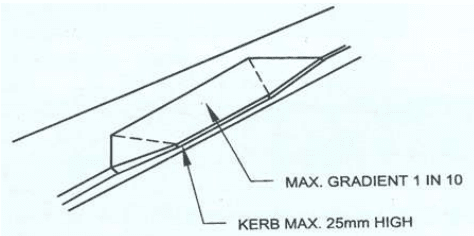
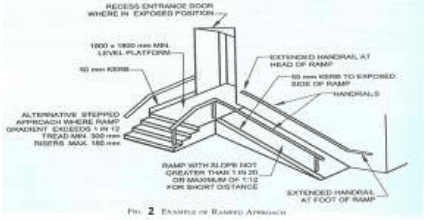
Ramps with gradients (gradual slope joining two level surfaces) that deviate from what would otherwise be considered the normal level. An exterior ramp, as distinguished from a ‘walk’, would be considered an appendage to a building leading to a level above or below the existing ground level.
(8) Walk-Walks
‘Walk’ and ‘walks’ defined as a predetermined prepared surface, exterior pathway leading to or from a building or facility, or from one exterior area to another, placed on the existing ground level and not deviating from the level of the existing ground immediately adjacent.