In theseBye-Laws, unless the context otherwise requires, the terms and expressions shall have the meaning indicated against each of them.The terms and expressions not defined in these Bye-Laws shall have the same meaning as in National Building Code of Indiaas amended from time to time.
2.1 Access: A clear approach from the entry into the building unit to building/buildings withinthe buildingunit.
2.2 Accessory Building: means a building separated from the main building on a building unit / plot which is putto use or is proposed to be put to use for one or more accessory uses.
2.3 Accessory use: means use of the building subordinate and customarily incidental to the principal use.
2.4 Additions and/or alterations: means: any change in the proposed or approved use or proposed or approved plan of the building.
2.5 Advertising Display Infrastructure/ Advertising Sign, billboards, and Hoarding: means any surface or structure with characters, letter or illustrations applied thereto and displayed in any manner whatsoeverfor the purpose of advertising or giving information regarding or to attract the public to any place, person, public performance, article or merchandise, and which surface or structure is attached to, forms part of or is connected, with any building, or is fixed to a tree or to the ground or to any pole, screen, fence or hoarding or displayed in space; or in or over any water body in the jurisdiction of the Competent Authority.
2.5A Advisor to the Administrator: means the Advisor appointed by the Government for the Union Territory of Lakshadweep Administration.
2.6 Air-conditioning: the process of treating air, so as to control its temperature, humidity orquality to meet the requirements of a conditioned space.
2.7 Amenities: means roads, streets, open spaces, parks, recreational grounds, playgrounds, gardens, water supply, electric supply, street lighting, drainage, sewerage, public works and other utilities, communication network, services and conveniences or any other amenity which may be notified by the authority from time to time.
2.8 Apartment / Flat: means multi storeyed residential buildings constructed in a detached or semi-detached manner designed as ground floor with more upper floors and constructed as separate dwelling units with common staircase.
2.9 Application: means an application made under these Bye-Laws in such form as may be prescribed by the Competent Authority from time to time.
2.10 Approved:As approved / sanctioned by the Competent Authority under applicable rules, laws or regulations etc.
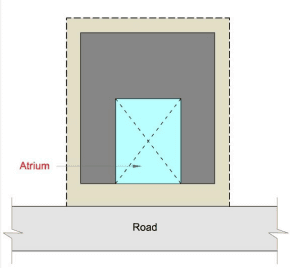
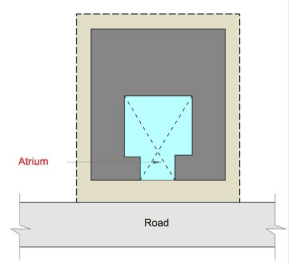
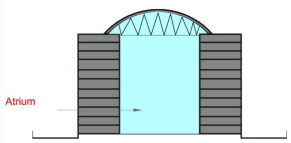
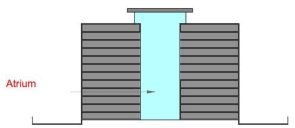
2.11 Atrium (Plural Atria):A large-volume space created by a floor opening or series of floor openings connecting two or more stories that is covered at the top of the series of openings with a light weight or glazed roof and is used for purposes other than an enclosed stairway; lifts hoist-way; an escalator opening; or as a utility shaft used for plumbing, electrical, air conditioning, or communications facilities.(Refer Figure No. 2.1).
Page No 19
Figure No.2.1: AtriumWithin a Building
2.12 Authorized Officer: means any person appointed by the Competent Authority for the any specific purpose underthese Bye-Laws.There can be different authorised officers for different purposes.
2.13 Appeal: meansan appeal filed by owner against the decision of the Authority I.
2.14 Appellate authority: means the Advisor to the Administrator of U.T. of Lakshadweep or any other authority so authorized to exercise the powers of appellate authority.
2.15 Authority:Authority means an officer of the Lakshadweep administration, who has been authorized by the Administrator to exercise powers under these Bye-Laws.
a. Authority I – Collector of Union Territory of Lakshadweep.
b. Authority II – Sub Divisional Officer (SDO) / Deputy Collector (DC) in concerned island of Union Territory of Lakshadweep.
c. Authority III – Superintending Engineer(SE), Lakshadweep Public Works Department of Union Territory of Lakshadweep.
d. Authority IV– Assistant Engineer (AE), Lakshadweep Public Works Department in concerned island of Union Territory of Lakshadweep.
e. Authority V – Assistant Engineer (AE), Electricity Department, in concerned island of Union Territory of Lakshadweep.
2.16 Balcony: means a horizontal projection, including a handrail or balustrade to serve as passage or sit out place.
2.17 Banquet Hall:means a room or an enclosed space or building for the purpose of hosting any social events or ceremonies like marriage, reception, party etc. accompanied with food and beverages.
2.18 Basement: means the lower storey of a building below the ground level.
Page No 20
2.19 Build to Line: means a means a line extending along the roadside margin and marks the location from which the vertical plane of the front building elevation must be erected; the build-to line is intended to create an even building façade line along a street. A certain percentage of the length of the roadside margin may be specified to which the building elevation must abut (Refer Figure No. 2.2).
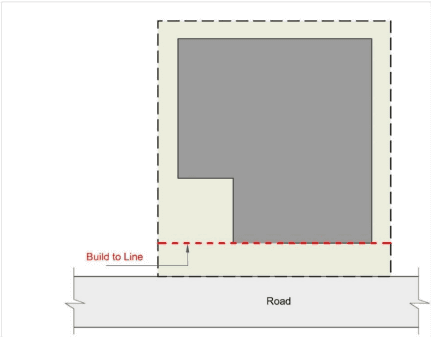
Figure No. 2.2: Built to Line for a Building
2.20 Building: means a structure constructed with any materials whatsoever for any purpose, whether used for human habitation or not, and includes:
i) Foundation, plinth, walls, floors, roofs, chimneys, plumbing and building services, fixed platforms etc.
ii) Verandahs, balconies, cornices, projections etc.
iii) Parts of a building or anything affixed thereto;
iv) Any wall enclosing or intended to enclose any land or space, sign, and outdoordisplay structures; etc.,
v) Tanks constructed or fixed for storage of chemicals or chemicals in liquid form andfor storage of water, effluent, swimming pool, ponds etc.,
vi) All types of buildings as defined in (a) to (k) below, except tents, shamianas andtarpaulin shelters erected temporarily for temporary purposes and ceremonialoccasions with the permission of Competent Authority, shall be considered to be "buildings".
Types of buildings based on design or typology:
a Detached Building means a building with walls and roofs independent of any other building and with open space on all sides.
b SemiDetached Building means a building detached on three sides with open space as specified in these Rules.
c Tenementmeans a residential dwelling unit constructed in a detached or semi-detached manner. Each dwelling unit in a tenement building is designed and constructed for separate entry with independent sanitary provisions.
d Multi-Storeyed Building – High Rise means a building exceeding 15 m or more in height (without stilt) and 17.5 m (including stilt).
e Multi-Storeyed Building–Low Rise means a building not exceeding 15 m or more in height (without stilt) and 17.5 m (including stilt).
f Dwelling1 means a detached building used for residential purpose.
g Dwelling 2 means semi-detached buildingused for residential purpose.
Page No 21
h Dwelling 3 means multi storey buildingused for habitation of multiple families and/or individuals such as apartments, flats, hostels, lodging and boarding or cottage industry or pre-school purpose.
SpecialBuilding means a building that houses large gatherings at a time such as theatres for drama, cinema, motion picture; drive-in-theatre; assembly hall; auditorium; town hall; lecture hall; exhibition hall; museum; stadium; community hall; marriage hall, banquet hall etc.
j Multi Level Car Parking: means a building primarily to be used for parking of cars, scooters, or any other type of light motorized vehicle.
Types of buildings based on safety / maintenance:
k Hazardous building means a building or part thereof used for:
1 Storage, handling, manufacture, or processing of radio-active substances or of highly combustible explosive materials or products which are liable to burn with extreme rapidity and/or producing poisonous fumes.
2 Storage, handling, manufacture, or processing of, which involves highly corrosive, toxic obnoxious alkalis, acids, or other liquids, gases or chemicals producing flame, fumes and explosive mixtures or which result in division of matter into fine particles and capable of spontaneous ignition.
3 Buildings or industries declared as hazardous by any act, rule, regulation or order of any authority.
Unsafe Building means a building which, is structurally unsafe; is insanitary; is not provided with adequate means of egress; constitutes a fire hazard; is dangerous to human life in relation to its existing uses; constitutes a hazard to safety or health or public welfare by reasons of inadequate maintenance, dilapidation, or abandonment.
2.21 Building Unit / Plot: means a land or plot or part of a land/ plot or combination of more than one land/plot enclosed by definite boundaries as approved by the Competent Authority. However, where an alignment has been fixed on any road by any Competent Authority, the Building Unit shall mean and refer to the land excluding the portion falling in alignment.
2.22 Building Unit / Plot Depth: means the mean horizontal distance between the front and rear plot boundaries.
2.23 Builtup Area: means the area covered by a building on all floors including all cantilevered portions and walls & columns, except areas that are excluded specifically under these Bye-Laws.(Refer Figure No. 2.3).
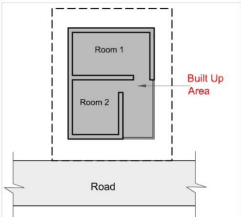
Built Up Area = Carpet Area + Walls
Figure No. 2.3: Built up Area, Building
2.24 Built up Area, Carpet: means the covered area of usable rooms of dwelling unit / building, excluding area covered by walls(Refer Figure No. 2.4).
Page No 22
Carpet Area
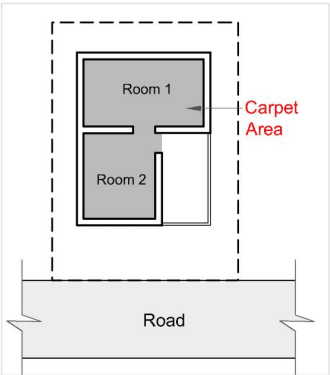
Figure No. 2.4: Carpet Area
2.25 Builtup Area, Dwelling Unit: means the areas covered by a dwelling unit within a building including all cantilevered portionsand walls & columns, excepting the areas excluded specifically under these Bye-Laws(Refer Figure No. 2.5).
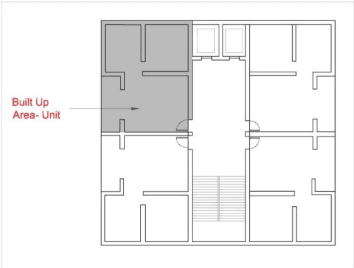
Fig No. 2.5: Built Up Area, Dwelling Unit
2.26 Cabin: means a non-residential enclosure.
2.27 Canopy: means cantilevered projection at lintel or slablevel provided that it shall not extend beyond the building unit boundary and there shall be no structure on it and the top shall remain open to sky.
2.28 Ceiling: means the internal roof lining of any room; in case there is no such lining the roof membrane shall constitute the ceiling.
2.29 Chhajja/ Weather Shed: means a structural overhang provided over opening on external walls for protection from weather.
2.30 Chimney: means a construction by means of which a flue is formed for the purpose of carrying products of combustion to open air and includes a chimney stack and a flue pipe.
Page No 23
2.31 Chowk: means a fully or partiallyenclosed space permanently open to sky within a building at any level.
2.32 Cold Storage: means a structure or room for the storage of edible or non-edible merchandise or commodities, which usually require special low temperatures and condition for storing or preservation, before their export or distribution for sale.
2.33 Collector: means the Collector appointed by the Government for the District.
2.34 Competent Authority: means authority empowered to grant Development Permission in any given area under any law for the time being in force or such other authority as may be notified by the Government or Prescribed Authority to perform any function under these Bye-Laws.
2.35 Common Plot: means a common open space exclusive of approaches at ground level or at higher levels not exceeding 15.0 mfrom the ground level of the buildingunit.
2.36 Community Hall: means a building and accompanying ground such as wadis used for social, civic, or recreational purposes, serving the area in which it is located and open to the general public. It is also a place where members of community tend to gather for group activities, social support, public information, and other purposes.
2.37 Construction: means erection of a structure whether permanent or temporary or a building, including any addition or extension thereto either vertically or horizontally, but does not include, any reconstruction, repair and renovation of an existing structure or building, or, construction, maintenance and cleansing of drains and drainage works and of public latrines, urinals and similar conveniences, or, the construction and maintenance of works meant for providing supply of water for public, or, the construction or maintenance, extension, management for supply and distribution of electricity to the public; or provision for similar facilities for publicity, all of which may also be in the ROW of roads/streets after obtaining due permissions of any authority.
2.38 Contiguous Holding: means a continuous parcel of land in one ownership irrespective of separate survey numbers or revenue maps of the holding(Refer Figure No. 2.6).
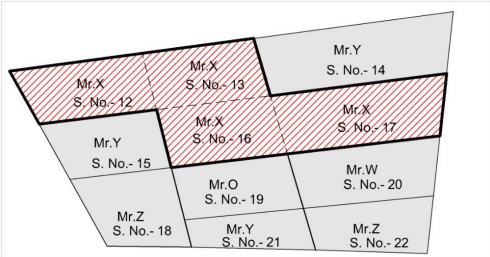
Fig No.2.6: Contiguous Holding
2.39 Conversion: The change from one occupancy to other occupancy or any change in building structure or part thereof resulting in a change of space and use requiring additional occupancy certificate.
2.40 Cornice:meansthe decorated projection at the top of a wall provided to protect the wall face or to ornament and finish the eaves. The term is used as well for any projecting element that crowns an architectural feature, such as a doorway.
2.41 Corridor: means a common passage or circulation space including a common entrance lobby(Refer Figure No. 2.7).
Page No 24
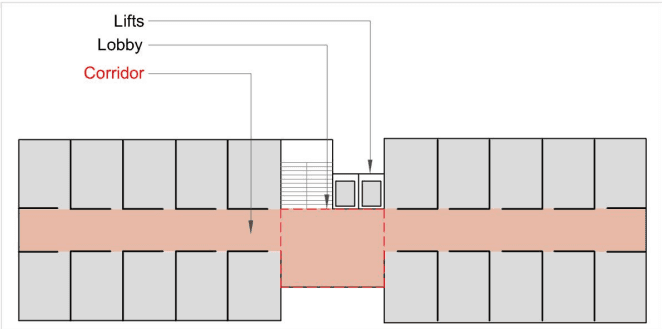
Figure No.2.7: Corridor
2.42 Courtyard: includes a chowk and also includes all spaces permanently open to the sky within a building.
2.43 Density: The residential density expressed in terms of the number of dwelling units per hectare.
2.44 Developer: means a person who has, by any law or contract, control over or would have had control over: 1) the appointment of registered professionals under these rules; 2) the design of the building; 3) the process of construction of the building and development, and; 4) financing of the construction and development. This control should be sufficient to ensure compliance of the various provisions related to development under these Rules.
2.45 Development Permission: means a permission granted by the Competent Authority to carry out any construction, reconstruction, erection, or re-erection permitted under these Rules.
2.46 Development of land:means any material change on the use of land intended for sale or construction of any structure brought about by a process or combination of processes of permanent nature, involving sub division/partition, layout of roads and footpaths, provision of water supply, sewerage drainage, electrification, landscaping, land assignment of any location parks and any social & community services in, over or under the said land in accordance with a lay out/development plan. Legal partitioning of land shall not be considered as development of land.
2.47 Dharamshala: means a building devoted to religious or charitable purposes offering lodging and/or dining facilitiesfor interested individuals or group of people at a nominal charge, or in some cases free ofcharge.
2.48 Domestic Wastewater: means either wastewater that is typically discharged from premises that are used solely for residential activities or wastewater of the same character discharged from any non-industrialand non- medical buildings.
2.49 Drain / Drainage System: means a system or a line of pipes or box or any other structure, with their fittings and accessories as manholes, inspection chambers, traps, gullies, floor traps used for drainage of buildings or yards appurtenant to the buildings within the same curtilage. A drain includes an enclosed or open channel for conveying surface water or a system for the removal of any liquid.
2.50 Dwelling Unit: means a shelter consisting of residential accommodation for one family and shall include a minimum of one room (with a carpet area of 9sq m and one side 2.4 m), one kitchen, bathroom and WC.
2.51 Enclosed staircase: means a staircase separated by walls and doors from the rest of the building.
Page No 25
2.52 Escalator: means a power driven, inclined, continuous stairway used for raising or lowering passengers.
2.53 Escape Route: means a route by which a person may reach an unenclosed space at ground level in the open air and in relation to:
i) any point on a storey of a building, means a route from that point
ii) any room, means a route from the doorway of that room
iii) any storey of a building, means a route from the exit from the storey
iv) any flat, means a route from the main entrance door of the flat
2.54 External Wall: means an outer wall of a building not being a party wall even though adjoining a wall ofanother building and also means a wall abutting on an interior open space of any building.
2.55 Existing Development / Building / Use: means development, building, structure or its use as sanctioned, approved, regularized, authorized by the Competent Authority, existing prior to the date of notification of these Bye-Laws.
2.56 Floor: means the lower surface in a storey on which one normally walks in a building. The general term, floor unless otherwise specifically mentioned shall not refer to a “mezzanine floor.
Note:- The sequential number of floor shall be determined by its relation to the determining entrance level. For floors at or wholly above ground level, the lowest floor in the building with direct entrance from road/street shall be termed as ground floor. The other floors above ground floor shall be called in sequence as first floor, second floor, third floor etc. with number increasing upwards;
2.57 Floor Area: means the net enclosed area of a floor in the building including walls, circulation spaces like lobby or corridors, service areas and semi-open spaces such as verandah or balcony.
2.58 Floor Space Index (FSI) or Floor Area Ratio (FAR): means the quotient of the ratio of the combined gross built-up area of all floors, to the total area of the building-unit (total plot area including common plot)
2.59 Footing: means a foundation unit constructed in brick work or stone masonry or concrete under the base of a wall or column for the purpose of distributing the load over a large area.
2.60 Foundation: means that part of the structure which is in direct contact with and transmitting load of the building to the ground.
2.61 Front: means the main frontage of a buildingunit on the roadside. For the building abutting two or more roads, front shall be chosen by the owner; however, the owner shall be required to leave road side margin on both the sides, as mentioned in 7.7.1.
Page No 26
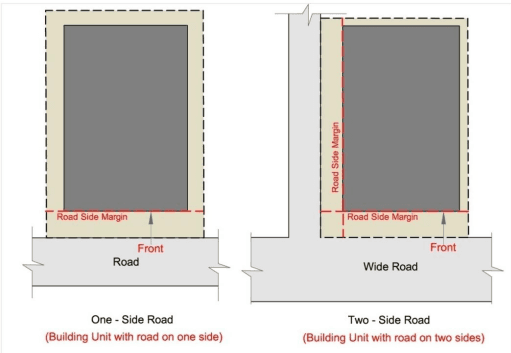
Figure No.2.8: Front
2.62 Gallery: means an intermediate floor or platform projecting from a wall of an auditorium or a hall providing extra floor area, additional seating accommodation etc.
2.63 Garage-Private: means a building or a portion thereof, designed and used for the parking of vehicles. It can be within a building or within a portion of a building unit but does not include an unenclosed or uncovered parking spacesuch as open parking area.
2.64 Garage-Public: means a building or a portion thereof, designed other than as a private garage, and operated for gain. It can be used for repairing, servicing, hiring, selling, storing, parking of vehicles.
2.65 Government: means The Administrator of Union Territory of Lakshadweep appointed by the President of India under Article 239 of Constitution of India.
2.66 Ground Coverage: means the ground area covered by a building including cantilevered portion on any floor, excluding margins, common plot, cut-out(open-to-sky) if any.
2.67 Ground Level: means the level of the crown of the existing adjacent constructed road or the existing ground level or the high flood level, whichever is higher as may be decided by Competent Authority.
2.68 Habitable Room: means a room occupied or designed for occupancy for human habitation and uses incidentalthereto, including a kitchen if used as a living room, but excluding a bathroom, water closetcompartment, laundry, serving and storing, pantry, corridor, cellar, attic, storeroom, poojaroomand spaces not frequently used.
2.69 Hazardous Material: means any of the following materials:
1 Radioactivesubstance.
2 Inflammable, combustible orexplosive materials that may produce poisonous fumes or explosions on storage, handling, processing or manufacturing.
3 Corrosive, toxic, obnoxious alkalis or acids, chemicals which mayproduce irritant, corrosive or poisonous gases on explosion or spontaneous combustion.
4 Material declared as hazardous by any act, rule, regulation or order of any Competent Authority
2.70 Height of a Room: means the vertical distance measured from the finished floor surface to the finished ceiling/ slab surface. The height of a room with a pitched roof means the average height between the finished floor surface and the bottom of the eaves and the bottom of the ridge(Refer Figure No. 2.9).
Page No 27
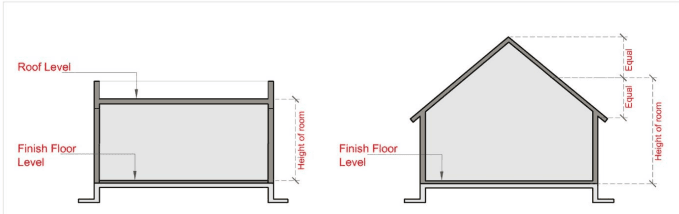
Figure No.2.9: Height of a Room
2.71 Height of Building: means the vertical distance measured from the average ground level and up to the top of the finished level of the topmost floor slab or in case of slopping roofs up to the midpoint of the height of the sloping roof.
The height of the sloping roof shall be taken as an average height of the relevant floor.
Provided that for purpose of other than the fire rules, the following shall be excluded for the computation of building height:
1 Lift cabin with machine room above.
2 Solar panel provided on roof top.
3 Chimney
4 Water Tanks
5 Mumty
6 Stilt Floor whether used for parking or otherwise.
2.72 High tide line: means high tide line as demarcated in Integrated Island Management Plan (IIMP) for Lakshadweep Islands.
2.73 Home Occupation: means such customary home occupation other than the conduct of an eating or a drinking place offering services to the general public, customarily carried out by a member of the family residing on the premises without employing hired labour, and for which there is no display to indicate from the exterior of the building that it is being utilised in whole or in part for any purpose other than a residential or dwelling use and in connection with no article or service is sold or exhibited for sale except that which is produced therein, which shall be non-hazardous and not affecting the safely of the inhabitants of the building and the neighbourhood, and provided that no mechanical equipment is used except that as is customarily used for purely domestic or household purposes and / or employing licensable goods, which are decided by the Competent Authority as Home Occupation from time to time. If motor power is used, the total electricity load should not exceed 0.75 KW. The area for such uses shall not exceed 25% of the total floor area of the dwelling; further, there shall be no public display of goods. Dwelling units used for home occupation shall not be considered as mercantile building or commercial operation.
2.74 Illuminated Exit Signs: A device for indicating the means of escape during normal circumstances and power failure.
2.75 Integrated Island Management Plan (IIMP):means Integrated Island Plan as approved the Ministry of Environment and Forest and Climate Change for U.T.of Lakshadweep.
2.76 Land:means the land on which construction is proposed by the owner / developer and shall include benefits to arise out of land, things attached to the earth or permanently fastened to anything attached to the earth and rights created by legislative enactment over any street. For avoidance of doubts, it is hereby clarified that land can include any contiguous holding.
2.77 Lift/Elevators: means a mechanically guided car platform or transport for persons and materials between two or more levels in a vertical or substantially vertical direction.
2.78 Lobby: means a hall at the entrance of a building or corridor/hall connected with a larger room or series of rooms and used as a passageway or waiting room.
Page No 28
2.79 Loft: means an intermediate nonhabitable slab between two floors which is constructed and used for storage purpose.
2.80 Margin: means the space adjacent to boundary of buildingunit, buildings, or common plot that should be kept fully opentosky. No builtup shall be permitted in marginal space except as specified in these Bye- Laws.(Refer Figure No. 2.10).
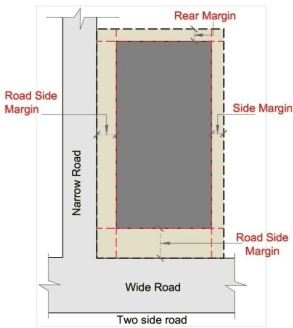
Figure No. 2.10: Margins
1 Roadside Margin: means the space provided from the roadside edge of the buildingunit.
2 Side Margin: means the space provided from the sides of the buildingunit.
3 Rear Margin: means the space provided from the rear edge of the buildingunit.
2.81 MezzanineFloor: means an intermediate floor between two floors overhanging or overlooking a floor beneath which is constructed in accordance with these Rules.
2.82 Natural Hazard: means a potentially damaging natural phenomenonlikehigh intensity earthquake, cyclonic storm, significant flood flow or inundation, landslides, mudflows, avalanches etc.
2.83 Natural Hazard Prone Areas: means areas with high probability of occurrence of natural hazard.
2.84 No Development Zone (NDZ): means area so defined in Integrated Island Management Plan (IIMP) for Lakshadweep Islands.
2.85 Non-Ambulatory Disabilities: means impairments which confine individuals to wheelchairs.
2.86 Non-Potable Water: means water for non-domestic consumption uses such as car washing, toilet flushing, gardening, construction, landscaping, irrigation etc and which is forbidden for domestic consumption as per drinking water standards set by Government/Appropriate Authority.
2.87 Occupant Load: means number of persons for which the means of egress of a building or portion thereof is designed.
2.88 Open Space: means an area forming an integral part of the plot, left permanently open to sky.
2.89 Operational construction: means a construction whether temporary or permanent which is necessary for the operation, maintenance, development or execution of any of the services essential to the life or the community as declared by the Administrator of U.T. of Lakshadweep from time to time.
2.90 Owner: means a person who receives rent for the use of the land or building or would be entitled to do so if it were let, and includes: -
1 An authorised agent or trustee who receives such rent on behalf of the owner.
2 A receiver, executor or administrator, or a manager appointed by any court of competent jurisdiction to have the charge of or to exercise the rights of the owner.
Page No 29
3 An agent or trustee who receives the rent or is entrusted with or is concerned with any building devoted to religious or -charitable purposes; and
4 A mortgage in possession.
2.91 Parapet: means a low wall or railing built along the edge of roof of a floor such as terrace, balcony, mezzanine, or staircase.
2.92 Parking Space: means an enclosed, semi-covered or open area including driveway and access aisles required to park vehicles, as per Rules related to parking. Parking spaces shall be served by a driveway connecting them with a street or alley and permitting ingress or egress of vehicles (Refer Figure No. 2.11).
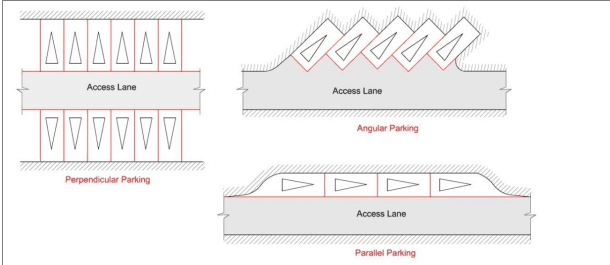
Figure No.2.11: Parking Space
1 Covered Parking Space: means an enclosed, semi-covered area including driveway and access aisles required to park vehicles, as per Rules related to parking but does not include the garage-private or public.
2 Open Parking Space: means a semi-covered or open area including driveway and access aisles required to park vehicles, as per Rules related to parking. Parking spaces shall be served by a driveway connecting them with a street or alley and permitting ingress or egress of vehicles.
2.93 Partition: means an interior nonload bearing divider one storey or part storey in height.
2.94 Persons on Record: Architect, Civil Engineer, Structural Designer, registered with the Competent Authority and undertaking the responsibility for the particular work as prescribed by the Competent Authority.
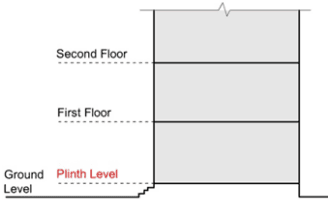
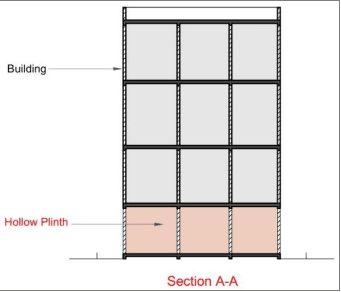
2.95 Plinth: means the solid or hollow volume below the floor which is immediately above the ground level. Also, Hollow Plinth means the space provided below the floor which is on stilts immediately above the ground level for the purpose of parking and other permissible uses (Refer Figure No. 2.12).
Page No 30
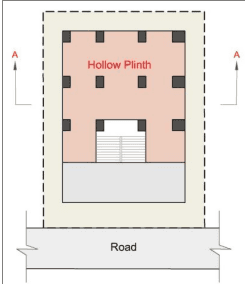
Figure No.2.12: Plinth
2.96 Pergola: means an architectural feature or elementofany material, which is used for aesthetic and elevation purpose and open on all sidesincluding top side. In any case it shall not be integral part of anyhabitable space.
2.97 Pollution control Board: means the Lakshadweep Board for prevention and control of pollution.
2.98 Porch: Means a covered surface supported on pillars or otherwise for the purpose of a pedestrian or vehicular approach to a building exclusive of marginal space (Refer Figure No. 2.13).
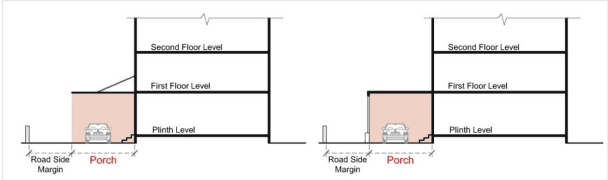
Figure No.2.13: Porch
2.99 Premises: means either:
1 A property which is held under a separate record title or for which a separate title record or certificate may be issued and in respect to which a building plan have been or may be issued or
2 A building which is in possession as an individual unit by a cross-lease, unit title or company lease and for which a certificate of title is available or
3 Land held in public ownership, for a particular purpose or
4 Separately assessed to local authority taxes, individual unit within building.
2.100 Prohibited Industrial Waste: means an industrial waste having physical and chemical characteristics in excess as decided by Appropriate Authority for the time being in force.
2.101 Pre-school: means a school for young children, also known as kindergarten or nursery.
2.102 Public Purpose: The expression of “Public Purpose” includes:
1 Provision of land to any end for common use of public.
Page No 31
2 Provision of village sites, or the extension, planned development or improvement of existing village sites.
3 Provision of land for town or rural planning.
4 Provision of land for planned development of land from public funds in pursuance of any scheme or policy of Government and subsequent disposal thereof in whole or in part by lease, assignment, or outright sale with the object of securing further development as planned.
5 Provision of land for a corporation owned or controlled by the Government.
6 Provision of land for residential purposes to the poor or landless or to persons residing in areas affected by natural calamities, or to persons displaced or affected due to implementation of any scheme undertaken by Government, any local Authority or a corporation owned or controlled by the Government.
7 Provision of land for carrying out any educational, infrastructure housing, health or slum clearance scheme sponsored by Government, local authority or any other authority or body established by or under any law for the time being in force.
8 Provision of land for any other scheme of development sponsored by Government or with the prior approval of appropriate Government, by a local Authority.
9 The provision of any premises or building for locating a public office, but NOT acquisition of land for companies.
10 The provision of land for a facility for physically challenged person.
2.103 Rainwater harvesting system: means a system to collect rainwater as may be prescribed by Authority-III
2.104 Renovation and Repair: means any work to an existing building or structure, which improves its condition without structural alterations or changes to the building or structure.
2.105 Rear: means that portion of a building unit which is on the opposite side of the front.
2.106 Registered Architect / Structural Engineer/ Civil Engineer: A person on record having prescribed qualifications registered by the Competent Authority.
2.107 Retrofitting: means upgrading the strength of an unsafe building by using suitable engineering techniques.
2.108 Road / Street:means any road, footway,pathway, passageway, square, court, alley, or passage, accessible whether permanently or temporarily to the public, whether a thoroughfare or not; and shall include every vacant space, notwithstanding that it may be private property and partly or wholly obstructed by any gate, post, chain or other barrier, if houses, shops or other buildings abut thereon and if it is used by any person as a means of access to or from any public place or thoroughfare, whether such person be occupier of such buildings or not, but shall not include any part of such space which the occupier of any such building has a right at all hours to prevent all other persons from using as aforesaid.
2.109 Road / Street – Public: means any street.
1 Over which the public have a right of way andor which is declared a public street in any notification by the Government.
2 heretofore levelled, paved, metalled, channelled, sewered or repaired out of panchayat or other public funds;
2.110 Road/Street Level or Grade: means the officially established elevation or grade of the centreline of the street upon which a plot fronts, and if there is no officially established grade, the existing grade of the street at its midpoint.
2.111 Road/Street line: means the line defining the side limits of a road/ street or the side limits of the proposed ROW of the road as notified by the Government and shall include regular line of street as defined by any Authority.
2.112 Road width or Width of road/street: Means the whole extent of space within the boundaries of a road when applied to a new road/street, as laid down in the survey, Outline DevelopmentPlan, Town Planning Scheme or prescribed road lines by any act or law, and measured at right angles to the course or intended course of direction of such road / street.
2.113 Row houses: means group of residential buildings, on adjacent plots with or without common walls, often of similar or identical design, situated side by side and joined by common walls and having only front and rear open spaces.
Page No 32
2.114 Service Apartment: means a type of furnished apartment including kitchen or cooking facility and amenities for daily use, available for shortterm or long-term stays.
2.115 Service Road: means a road/ lane provided at the front, rear, or side of a plot for service purpose.
2.116Setback Line: means the line from an adjoining a street that indicates an extension of a street or a future street that may lawfully extend. Roadside margin shall be considered from this imaginary plot boundary thus established. This additional land to be left is defined as setback. The setback line may change from time – to – time as decided by the Competent Authority (Refer Figure No. 2.14).
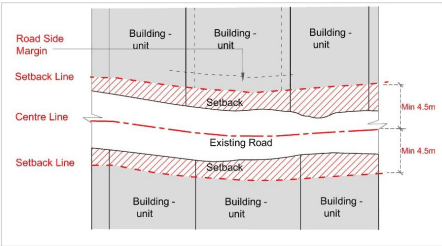
Figure No.2.14: Setback Linefrom an Existing
2.117 Solid Waste:means and includes solid or semi-solid domestic waste, sanitary waste, commercial waste, institutional waste, catering and market waste and other non-residential wastes, street sweepings, silt removed or collected from the surface drains, horticulture waste, agriculture, and dairy waste, treated bio-medical waste excluding industrial waste, biomedical waste and e-waste, battery waste, radio-active waste generated in the area.
2.118 Stair Cabin / Stair Cover /Mumty: means a structure with a covering roof over a staircase and its landing built to enclose only the stairs for the purpose of providing protection from the weather, and not to be used for human habitation (Refer Figure No. 2.15).
Page No 33
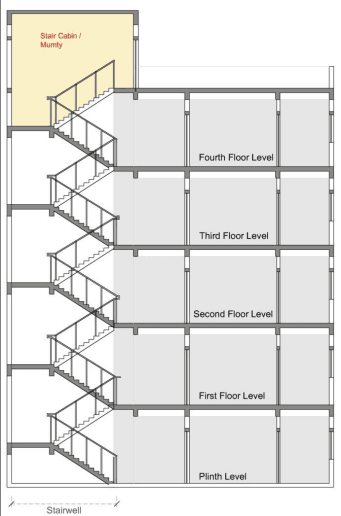
Figure No.2.15: Stair Cabin/ Mumty
2.119 Staircase: means a flight or series of flights of steps with the supporting framework, casing, and balusters, constructed to connect different floors or levels in a building.
2.120 Stairwell: means a vertical shaft around which a staircase has been built.
2.121 “Storey: means the portion of a building included between the surface of any floor and the surface of the floor above it, or if there is no floor above it, then the space between any floor and the ceiling next above it. No storey in a building shall be less that 2.9 m”
2.122 Temporary Structure: means structures such as tents, shamianas etc where roof or walls are not made of RCC, brick, masonry etc, and are erected for temporary or ceremonialpurposes.
2.123 To Erect: in relation to a building means:
1 To erect a new building on any site whether previously built upon or not.
2 To re-erect any building of which portions or entire building above the plinth level have been pulled down, burnt, or destroyed.
2.124 Unauthorised Construction: means any construction that is not approved bythe Authority.
2.125 Use / Occupancy: Occupancy or Use is either existing occupancy/use or authorised occupancy/use. Existing Occupancy/use means the principal occupancy ofa building for which the building or a part of it is used or intended to be used, including contingent subsidiary occupancies. Authorised Occupancy/use means the principal occupancy ofan approved building for which the building or a part of it is permitted to be used, including contingent subsidiary occupancies. Mixed / multiple occupancy / use buildings being those in which more than one occupancy/use are present in different portions of the building / intermingled.
Use – Agricultural: means use of land for horticulture, farming, raising of crops, fruits, vegetables, grass, fodder, trees or any other kind of cultivation, breeding and keeping of live-stock, including fish, poultry and bees, gaushalas and the use of land for any purpose
Page No 34
8
10
which is ancillary to its cultivation or to any other agricultural purpose but does not include the use of land as a garden which is an appendage to a building and then expression “agriculture” shall be constructed accordingly.
Use - Farm buildings: means a structure erected on land assessed or held for the purpose of agriculture for all or any of the following purposes connected with such land or any other and belonging to or cultivated by the holder thereof, namely:
-For the storage of agricultural implements, manure, or fodder.
-For the storage of agricultural produce.
-or sheltering cattle.
-For the residence of members of the family, servants, or tenants of the holder, or -For any other purpose which is an integral part of his cultivating arrangement.
Use – Assembly: means a building or place or part thereof that is used for congregation of people for the cultural, amusement, recreational, social, religious, patriotic, civil, travel and similar such purposes and this includes building/s of auditorium, city hall, town hall, theatre hall, cinema theatre, exhibition hall, museums, party plot, community hall, banquet hall, dance hall, multiplex, shopping mall, stadium, skating rinks, gymnasia, restaurants, eating or boarding houses, places of worship, dance halls, clubs, gymkhanas, road, railways, air, sea or other public transportation stations, and recreation areas.
Use – Business / Offices: means any building or place or part thereof used for transaction of business and / or keeping of books and records such as offices, banks, professional establishments, etc. Use for office includes work for the purpose of administration, clerical work, handling money, telephone, telegraph, publication, and computer operation.
Use – Commercial / Mercantile: means any building or place or part thereof used for mercantile and business use – shops, stores or markets for display and sale of wholesale / retail goods; offices and services.
Use – Educational: means a building or place or part thereof that is exclusively used for a preschool, school, college, polytechnic, recognised by the appropriate board or university, or any other Competent Authority involving assembly for instruction, education or recreation, incidental to educational use. Such use includes other incidental uses such as a library or a research institution, quarters for essential staff to reside in the premises, and a building used as a hostel for an educational institution whether situated in its campus or not.
7 Use – Health: meansa building or place or part thereof used for healthcare facilitysuch as medical or diagnostic or research centres, hospitals, nursing homes and care centres for elderly, destitute, orphans, abandoned women, children, and infants.
Use –Hospitality: means a commercial establishment in building or place or part there of providing lodging and usually meals, entertainment, and various personal services to public on a short-term basis except homestays registered under the law for the time being in force.
9 Use – Industrial: means a building or space or part thereof wherein products or material is fabricated, assembled, or processed, such as assembly plants, laboratories, power plants, refineries, gas plants, mills, dairies, and factories.
0 Use – Mercantile: means a building or place or part thereof used for display and sale of wholesale or retail goods / merchandise, including ancillary uses such as office, storage and service facilities in the same premise. This use includes shops, stores, markets, shopping centre, shopping mall, wholesale market.
11 Use – Public Utility: means a building or premise or part there of constructed forinfrastructure and safety facilities such as electrical sub-station, fire station, bus-station, bus terminals, fuelling station, multi-level parking, water purification facility, pumping station, postal networks, and communication networks etc.
12 Use – Public Offices: means office facilities in a building or premise or part thereof, constructed/operated by Government (Central / State), Local Bodies andPublic Sector Undertakings etc, used for or optedto be used as office / hospital / college / school / hall / exhibition, shops, commercial or for other public purpose activities. This includes
Page No 35
buildings such as- Courts, Police Station, Medical facility, Public Library, Civic Centre, Ward, and Zonal Offices for any Authority.
13 Use –Residential: means a building in which sleeping accommodation is provided for normal residential purposes with sanitation facilities and with or without cooking or dining facilities, and includes one or more family dwellings, hostels, dormitories, apartment units, flats etc.
14 Use – Religious: means a building or place dedicated to accommodation and service of Religion or other such objects of religious nature. It may have different nomenclature in different religions like temple, mosque, church, gurudwara, synagogue, upashraya, shantniwas, and may have ancillary facilities like ashram, bathing ghat, madrasa and gaushala.
15 Use – Storage: means a building or place or part there of used primarily for storage or shelter of goods and merchandise. Such use includes warehouse, cold storage, freight depot, transit shed, store house, public garage, hangar, grain elevator and barn.
2.126 Ventilation: means the supply of outside air into, or the removal of inside air from an enclosed space.
2.127 Warehouse: means a building or place or part thereof that is used or intended to be used for the storage of goods for stocking, sale, or similar purpose. It usually has loading docks to load and unload goods from trucks and often have cranes and forklifts for moving goods in and around the structure.
2.128 Waterbody: means a natural existing low-lying ground, forming a natural waterbody or wherein rainwater gets collected and/or plots designated as Talav / Lake / Pond under any legitimate records.
2.129 Water Closet (WC): means a privy with an arrangement for flushing the pan with water but does not include a bathroom.
2.130 Water Course: means a channel that is natural or artificial formed by training or diversionof a natural channel meant for carrying storm and wastewater.
2.131 Wayside Shop: means a shop that is situated at or near the side of a road, pathway.
2.132 Wholesale Establishment: means an establishment wholly or partly engaged in wholesale trade and manufacturing, wholesale outlets, including related storage facilities, warehouses and establishments engaged in truck transport, including truck transport booking warehouses.
2.133 Window: means an opening, other than a door, to the outside of a building, which provides all or part of the required natural light, ventilation, or both to an interior space.