Effective measures must be taken within each premise for conservation of rainwater, harvesting and recharging to the following standards. The same shall be shown in plans while applying for planning permission.
For all types of Buildings except Commercial and Residential Apartment Buildings
(a) Percolation Pits:
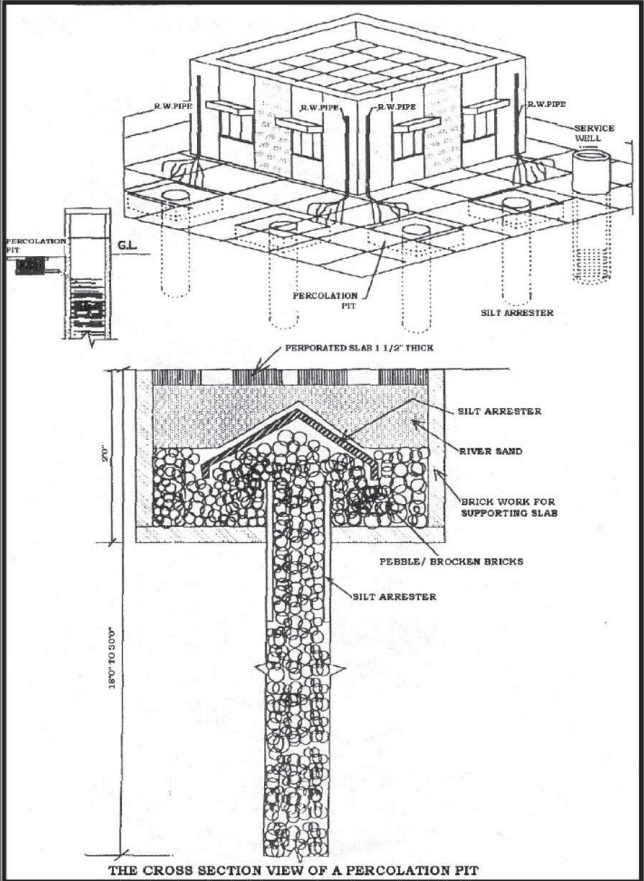
In areas around the buildings, percolation pits of size 1.2m x 1.2m x 1.5m shall be provided at the rate of 1 nos. such pit for every 100 sq.m. of Plot area . Such pits shall be filled with small pebbles or brick jelly or river sand and covered with perforated concrete slabs. All Rain water outlets/drains and waste water drains shall be connected to the roadside side through the percolation pit only.
(b) Storage and re-use : All buildings with plot area 134sq m and above shall have the provision of rain water harvesting storage and reuse.
For Commercial, Residential Apartment, Public Semi Public, Institutional, Industrial and all other categories of buildings
(a) Percolation Pits:
In areas around the buildings, percolation pits of size 1.2m x 1.2m x 1.5m shall be provided at the rate of 1 nos. such pit for every 100 sq.m. of Plot area . Such pits shall be filled with small pebbles or brick jelly or river sand after and covered with perforated concrete slabs. All Rain water outlets/drains and waste water drains shall be connected to the roadside side through the percolation pit only.
And
(b) Grass Paving
All paved areas shall be done in a type of perforated paving (in- situ or readymade) where 10-15% of the area is covered by grass. This is in addition to the mandatory green space that is to be provided as provisions of this Bye Law.
For Commercial, Residential Apartment, Public Semi Public, Institutional, Industrial and all other categories of buildings"
(a) Terrace Water Collection Sump:
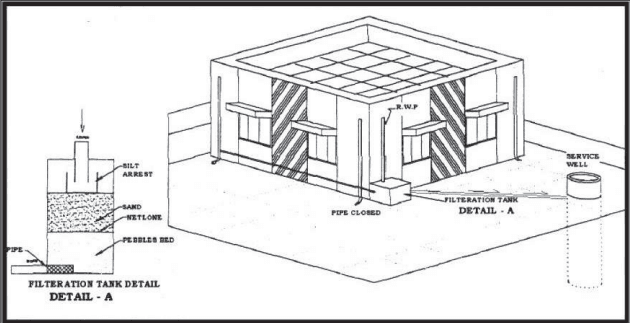
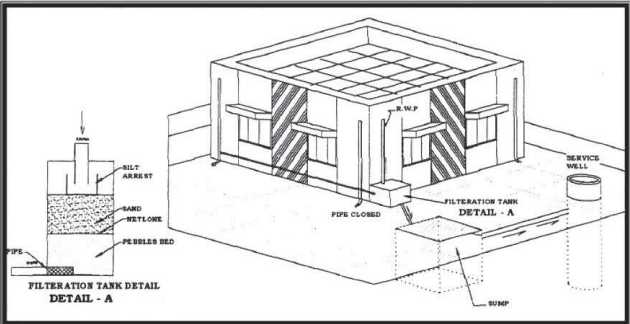
The terrace shall be connected to a sump or the well through a filtering tank by PVC pipe. A valve system shall be incorporated to enable the first part of the rain water collected to be discharged out to the soil if it is dirty.
The filtering tank measuring 0.6 m by 1.2 m square or larger can be constructed near the sump. A filtration tank can be divided by a perforated slab and onepart should be filled by small pebbles and other by brick jelly. The bottom portion of the tank should have slope to avoid stagnation of water. The capacity of the sump can vary as per the size of plot. The water so collected can be used for car washing and gardening etc only.
(b) Open Ground percolation: Whenever there is open ground a portion of top soil should be removed and replaced with river sand to allow slow percolation of rain water.
(c) Piped Recharge of Well:
Roof top water may also be collected and discharged directly to a well after filtration. Pipes for such purposes shall be minimum 75mm dia and provided for every 50 sq.m. of roof area
Rain Water Harvesting Methods
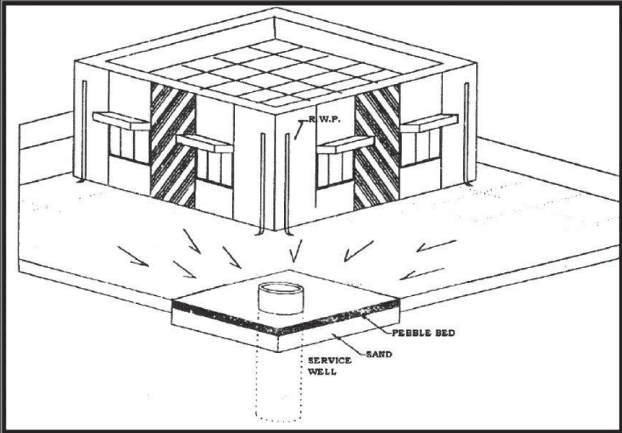
METHOD-I
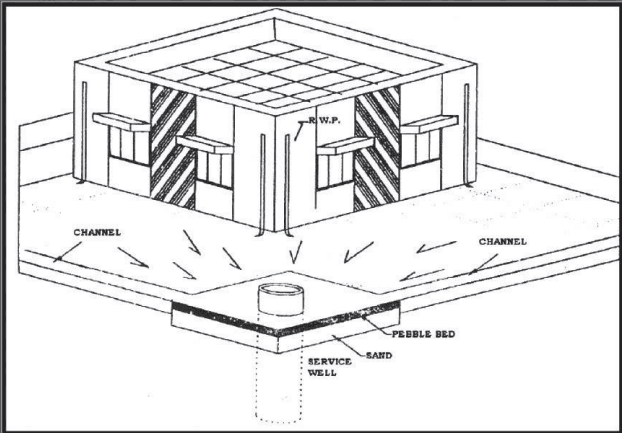
METHOD-II
METHOD-III
METHOD-IV
THE CROSS SECTION VIEW OF A PERCOLATION PIT
9813
METHOD-V
METHOD-VI
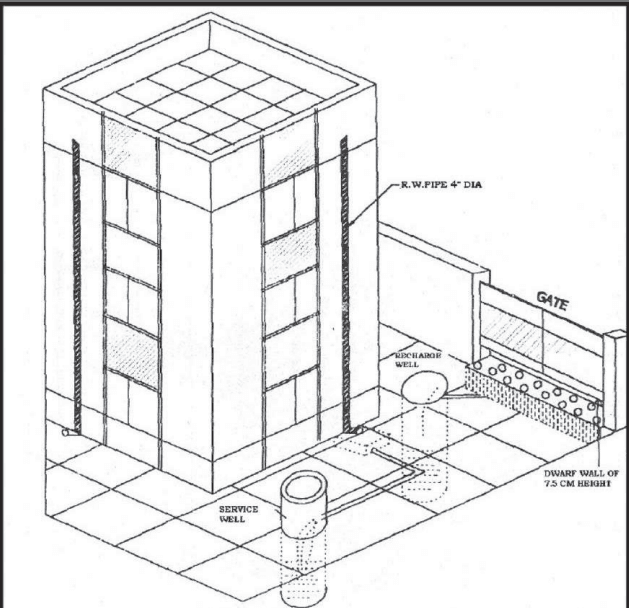
Provide a well of 1.2m for a depth of 10.0m and divert the rain water from the terrace into the well through rain water down-take pipes. Divert the rain waterfalling around the open space surrounding the building to the front gate wherein a gutter is provided for a depth of 1.0m and a width of 0.6m with perforated slabs. The rain water collected in the gutter in front of the entrance is discharged into another recharge well of 1.20m dia. with 10m depth provided near by through necessary piping arrangements.