Decentralized Wastewater Treatment Systems (DEWATS) are increasingly recognized as a viable alternative to traditional centralized sewerage systems, particularly in regions where the latter’s implementation is hindered by high costs, lengthy construction times, logistical disruptions, limited coverage, elevated maintenance expenses, and frequent operational failures. DEWATS offer a localized, cost-effective, and sustainable approach to wastewater management, treating wastewater near its source through smaller, modular systems. This eliminates the need for extensive pipeline networks and large-scale treatment plants, rendering them especially suitable for individual properties, small communities, industrial facilities, and institutions in both urban and remote settings.
The benefits of DEWATS are multifaceted. Economically, they lower infrastructure, operational, and maintenance costs. Environmentally, they minimize ecological impact through localized treatment, reducing pollution loads and the risk of spills. Furthermore, DEWATS facilitate water reuse for purposes such as construction works, irrigation and landscaping, enhance energy efficiency, and offer scalability and customization. Their suitability for remote areas ensures reliable sanitation, contributing to improved public health
Three case studies of decentralized Sewage Treatment Plants (STPs) and Faecal Sludge Management (FSM) Systems have been presented that offer valuable lessons on the merits on considering decentralized treatment systems.
Source: Decentralized Wastewater and Faecal Sludge Management: Case Studies from India, Asian Development Bank Institute
I.Decentralized Wastewater Treatment at Aravind Eye Hospital, Puducherry
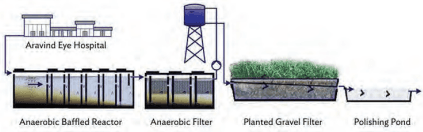
Aravind Eye Hospital (AEH) in Puducherry features an ecological wastewater treatment plant that effectively treats wastewater from the hospital and supplies water for irrigating the landscape. The treatment plant, built in 2002-2003, is based on the decentralized wastewater treatment system (DEWATS) and is designed to be easy and affordable to maintain, ecologically sensitive, and robust.
Source: Consortium for DEWATS Dissemination [CDD] Society
Figure 8.10: Schematic Overview of DEWATS Setup at Aravind Eye Hospital
The DEWATS at AEH comprises six major modules: a grease trap, settler, anaerobic baffled reactor, anaerobic filter, horizontal planted gravel filter, and polishing pond. The system effectively treats around 307 cubic meters of domestic wastewater per day, achieving a treatment efficiency of 90-95%. The treated wastewater is reused for gardening and toilet flushing, resulting in substantial water savings of over 100,000 cubic meters per year.
Source: Consortium for DEWATS Dissemination [CDD] Society
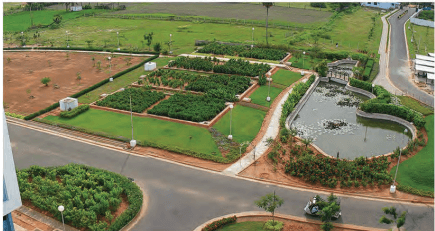
Figure 8.11: Planted gravel filter and polishing pond at Aravind Eye Hospital after construction
The DEWATS offers several benefits to AEH, including low life cycle costs, significant water savings, low-cost water, and substantial electricity savings. The system has been operating successfully for 13 years with no major difficulties. The success of DEWATS at AEH demonstrates the potential of decentralized wastewater treatment systems to provide a cost-effective, sustainable, and environmentally friendly solution for managing wastewater in India.
II. Faecal Sludge Management in Devanahalli, Bangalore and Karnataka
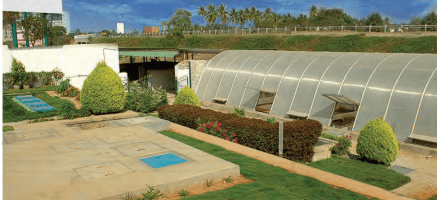
India’s first dedicated faecal sludge treatment plant was established in Devanahalli in 2015. The plant was designed to treat faecal sludge from septic tanks and soak pits, with a capacity of 6,000-8,000 Liters per day. The treated faecal sludge meets the required standards for reuse.
Source: Consortium for DEWATS Dissemination [CDD] Society
Figure 8.12: India’s first fecal sludge treatment plant in Devanahalli, Karnataka
The Devanahalli FSTP demonstrates an effective decentralized approach to faecal sludge management, offering a solution that can be replicated in other areas facing similar challenges.
I. Public–Private Partnership for Decentralized, Small-Scale Sewage Treatment Plants, New Delhi
The Delhi case study focuses on diverting sewage water from the city’s main sewer line to a decentralized sewage treatment plant (STP) for the purpose of water reuse. Delhi, which generates approximately 2,225 million litres of sewage daily, undertook a project to divert 3 MLD (Million Litres Per Day) of sewage to a newly established decentralized STP. The treatment system, a Continuous Aerobic Treatment system, was installed in the second basement of a hotel building to conserve space. The hotel reuses approximately 200 KLD of the treated water for various non-potable purposes, such as flushing, watering gardens, and filling decorative water bodies. Additionally, sludge from the treatment process is combined with treated organic waste and utilized as organic fertilizer.
By engaging private sector involvement and ensuring complete wastewater treatment and reuse, the New Delhi Municipal Council (NDMC) has made significant strides towards enhancing Delhi’s water security and mitigating environmental pollution. More recently, the Delhi Jal Board, the agency responsible for water supply in the city, has proposed the construction of 600 such STPs across Delhi.
Sludge Reuse
As one of the outputs of treated sewage, the wetcake sludge will undergo air-drying in sludge drying beds. This process eliminates enteric bacteria and pathogens, and the resulting sludge, rich in nitrates, phosphates, and other plant nutrients, is an excellent organic fertilizer for land application. Adequate drying, crucial for maximum bacterial reduction, will be ensured through a minimum 15- day period. The actual drying duration, varying seasonally, will be determined during operation. Properly dried sludge can serve as a soil conditioner. Periodic testing will confirm that heavy metal concentrations are within acceptable limits for food crop application. In the absence of specific sludge reuse standards, compost quality standards from the Solid Waste Management Rules, 2016, will be applied.