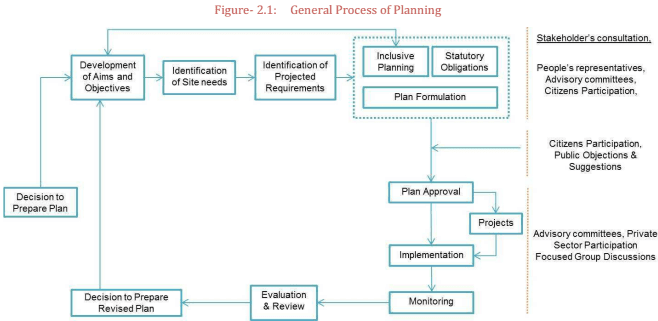
Assessment of projected requirements should be for a period of twenty to thirty years and it should further be classified under periods of 5 year in line with State five-year plans. Such classification would help in preparation of annual plans and budget.
1. Population
- Projected population: should be guided by environmental and infrastructure [especially drinking water], sustainability and holding capacity of the city. Dispersal of economic activity may also guide population projection
- Floating population, age sex composition, literates
2. Economic base and employment
■ Hierarchy of commercial areas, dispersal of commercial activity and related activities
■ Dispersal of industries, environmental restriction on industrial development
■ Urban poverty and its alleviation.
■ Work force, employment in different sectors of economy: formal and informal sectors
- Proposed hierarchy of trade and commerce area
3. Shelter
- Informal sector housing, slum up-gradation and resettlement strategy,
■ Housing need and requirement
4. Transportation
- Mass transportation system and its integration with activity nodes/facility centres and land use pattern
- Need for Airport, seaport (as the case may be)
■ Travel demand forecast, Road length, hierarchy of roads, transport terminals
■ Projection of parking requirements
■ Proposed network of city-level non-motorized routes and zones
5. Social Infrastructure
■ Education: schools, technical institutes, universities
Health care: Dispensary, health centres, hospitals
■ Recreational: Parks and open spaces, theme based parks
Religious
Socio-cultural: museum, cultural centres
■ Cremation/ Burial grounds
6. Physical Infrastructure
■ Water: projected water demand, water treatment plant
■ Sewerage: estimation of generation and treatment capacity
■ Power demand and supply gap
Drainage: estimation in case of change in jurisdiction, developable area or major change in land use share
- Gap assessment & projection of other utilities
7. Land use requirement for
■ Residential areas
■ Commercial areas
■ Manufacturing area
■ Public and semi-public
Parks, Playgrounds and Open Spaces
■ Transport and Communication
■ Special areas
Agriculture
■ Water-bodies
- Assessment of Disaster management infrastructure to meet the requirement of prescribed in the District Disaster Management Plan