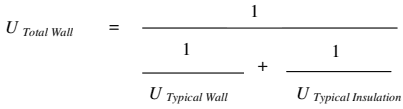
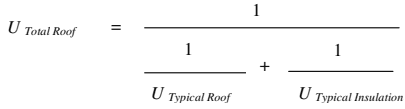
aValues are for a mean temperature of 2 4 ° C , . Representative values for dry materials are intended as design (not specification) values for materials in normal use. Thermal values of insulating materials may differ from design values depending on their properties (e.g., density and moisture content, orientation, etc.) and variability experienced during manufacture. For properties of a particular product, use the value supplied by the manufacturer or by unbiased tests.
b The symbol λ is also used to represent thermal conductivity.
c Resistance values are the reciprocals of C before rounding off C to two decimal places.
dLewis (1967).
e U.S. Department of Agriculture (1974).
fDoes not include paper backing and facing, if any. Where insulation forms a boundary (reflective or otherwise) of an airspace, see Tables 2 and 3 for the insulating value of an airspace with the appropriate effective emittance and temperature conditions of the space. Conductivity varies with fiber diameter. (See Chapter 23, Factors Affecting Thermal Performance). Batt, blanket, and loose-fill mineral fiber insulations are manufactured to achieve specified Rvalues, the most common of which are listed in the table. Due to differences in manufacturing processes and materials, the product thicknesses, densities, and thermal conductivities vary over considerable ranges for a specified R-value. hThis material is relatively new and data are based on limited testing.
iFor additional information, see Society of Plastics Engineers (SPI) Bulletin U108. Values are for aged, unfaced board stock. For change in conductivity with age of expanded polyurethane/ polyisocyanurate, see Chapter 23, Factors Affecting Thermal Performance.
j Values are for aged products with gas-impermeable facers on the two major surfaces. An aluminium foil facer of 25 µm thickness or greater is generally considered impermeable to gases. For change in conductivity with age of expanded polyisocyanurate, see Chapter 23, Factors Affecting Thermal Performance, and SPI Bulletin U108.
kCellular phenolic insulation may no longer be manufactured. The thermal conductivity and resistance values do not represent aged insulation, which may have a higher thermal conductivity and lower thermal resistance. lnsulating values of acoustical tile vary, depending on density of the board and on type, size, and depth of perforations.
m Cavity is framed with 20mm wood furring strips. Caution should be used in applying this value for other framing materials. The reported value was derived from tests and applies to the reflective path only. The effect of studs or furring strips must be included in determining the overall performance of the wall.
nValues for fully grouted block may be approximated using values for concrete with a similar unit density.
oValues for concrete block and concrete are at moisture contents representative of normal use.
pValues for metal or vinyl siding applied over flat surfaces vary widely, depending on amount of ventilation of airspace beneath the siding; whether airspace is reflective or non reflective; and on thickness, type, and application of insulating backing-board used. Values are averages for use as design guides, and were obtained from several guarded hot box tests (ASTM C 236) or calibrated hot box (ASTM C 976) on hollow-backed types and types made using backing of wood fiber, foamed plastic, and glass fiber. Departures of +50% or more from these values may occur.
q Vinyl specific heat= 1.0 kJ/(kg.K)
rSee Adams (1971), MacLean (1941), and Wilkes (1979). The conductivity values listed are for heat transfer across the grain. The thermal conductivity of wood varies linearly with the density, and the density ranges listed are those normally found for the wood species given. If the density of the wood species is not known, use the mean conductivity value. For extrapolation to other moisture contents, the following empirical equation developed by Wilkes (1979) may be used:
k = 0. 7 4 9 4 +
Where p is density of the moist wood in k g / m 3 , , and M is the moisture content in percent.
sFrom Wilkes (1979), an empirical equation for the specific heat of moist wood at 2 4 ° C is as follows:
Where Dcp accounts for the heat of absorption and is denoted by DCp = M(0.008037 - 1.325 × 10⁻⁴ M)
Where M is the moisture content in percent by mass.
Assuming parallel heat flow only, the calculated resistance is higher than that calculated on the assumption of isothermal planes. The actual resistance generally is some value between the two calculated values. In the absence of test values, examination of the construction usually reveals whether a value closer to the higher or lower calculated R-value should be used. Generally, if the construction contains a layer in which lateral conduction is high compared with transmittance through the construction, the calculation with isothermal planes should be used.
If the construction has no layer of high lateral conductance, the parallel heat flow calculation should be used. Hot box tests of insulated and uninsulated masonry walls constructed with block of conventional configuration show that thermal resistances calculated using the isothermal planes heat flow method agree well with measured values (Van Greem 1985, Valore 1980, Shu et al. 1979). Neglecting horizontal motor joints in conventional block can result in thermal transmittance values up to 16% lower than actual, depending on the density and thermal properties of the masonry, and 1 to 6% lower, depending on the core insulation material (Van Greem 1985, McIntyre 1984). For aerated concrete block walls, other solid masonry, and multicore block walls with full mortar joints, neglecting mortar joints can cause errors in R-values up to 40% (Valore 1988). Horizontal motor joints usually found in concrete block wall construction are neglected in Example 2.