Thermal storage may be used for limiting maximum demand, by controlling peak electricity load through reduction of chiller capacity, and by taking advantage of high system efficiency during low ambient conditions. Thermal storage would also help in reducing operating cost by using differential time-of-the day power tariff, where applicable.
The storage media can be ice or water. Water need stratified storage tanks and is mostly viable with large storage capacity and has an advantage of plant operation at higher efficiencies but requires larger storage volumes. In case of central plant, designed with thermal energy storage, its location shall be decided in consultation with the air conditioning engineer. For roof top installations, structural provision shall take into account load coming on the building/structure due to the same. For open area surface installation, horizontal or vertical system options shall be considered and approach ladders for manholes provided. Buried installation shall take into account loads due to movement of vehicles above the area.
Improved Air Cooling
Bureau of Energy Efficiency
Smart Home
Annex E-Smart Home
E
The concept of smart home is in existence for many decades; however, it has gained further importance in present scenario due to increase in demand for comfort and convenience (with growth of disposal income), increased dependence on appliances, increase in per capita electricity consumption and availability of rooftop solar PV and EV for potential onsite generation and storage respectively.
Alongside these drivers at consumer end; technology advancement in the form of availability of high speed computing devices (smart phones) and affordable internet data, reduction in size of IoT devices / sensors and by shifting sophisticated computing functions to cloud and development of complex algorithms to control systems as per user requirement and preference (using Artificial Intelligence) has provided fresh push to demand of smart home product and services.
The need of utility-based demand response program to match the variable consumer demand (due to use of diverse appliances) with dynamic electricity supply (due to penetration of renewable energy in grid) is gradually making the smart home solutions a must have product/service in every home, to make it demand response ready.
To manage the energy use in a home in order to make optimum use of these opportunities and for minimizing the demand supply gap, there is need of Smart Home Energy Management System (SHEMS). SHEMS can be defined20 as the combination of a service and devices that are designed to work together to deliver occupancy-based optimization of energy use. SHEMS21 consist of hardware and software, which are linked and integrated to, monitor energy usage, provide feedback on energy consumption, enhance control and provide remote access and automation provisions over appliances and devices that use energy in the home. SHEMS can deliver a range of services and benefits to households, which includes:
Energy management (energy efficiency)
Demand response (contribute to regulating energy demand)
Electricity generation, storage and delivery to the grid
Comfort and convenience
The functionality of SHEMS can be broadly categorized in five areas that include monitoring, control, user interface, data sharing and grid connectivity. Schematics indicating the functionality of SHEMS and purpose of each functionality is given below:
20 Source: ENERGY STAR® Program Requirements, Product Specification for Smart Home Energy Management Systems, https://www.energystar.gov/sites/default/files/ENERGY%20STAR%20SHEMS%20Version%201.0%20Program%20Requirements\_0.pdf
21 Source: Sustainable Now, https://sustainable-now.eu/guide-to-home-energy-management-systems/
Bureau of Energy Efficiency
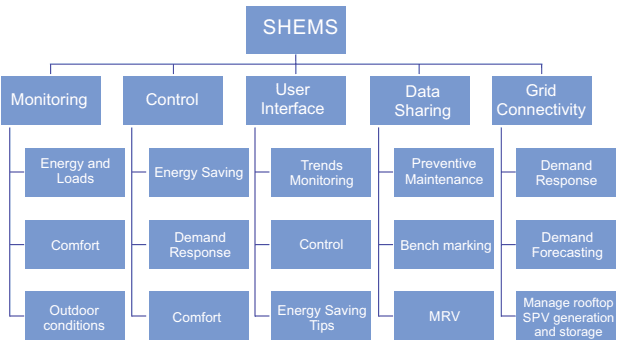
The above-mentioned functionalities of SHEMS22 can be operationalized with the support of:
Physical sensors and devices
Communication network for data transfer across smart devices, computation and data storage systems
Data processing, decision making and relay commands as per defined logic or preference
Smart appliances, devices and actuators to align the physical parameters to required level
C User interface to enable user to monitor, interact with smart home components and convey preferences
Smart meter to monitor, record the energy consumption, load variation and to facilitate implementation of demand response program
In smart home, energy and cost savings is achieved by:
) Preventing idle running of energy consuming system
) Optimization of adjustable building envelope elements to minimize energy demand
) Optimization of operating parameters to match user preference
Shifting the operation of non-essential energy consuming systems to off peak time
Making use of renewable energy generation source, whenever available to meet the energy demand
Optimization of charging and discharging of storage for cost saving
Smart home have significant potential for saving energy, however, the net energy savings depends on a range of factors, which include:
Smart Home
22 Source: Based on the analysis conducted as part of BEE-GIZ study on Smart Home: Technology Assessment Study and Pilot Design through technical support of Deloitte Touche Tohmatsu India LLP and Prof. Vishal Garg (IIIT Hyderabad, India)
Bureau of Energy Efficiency
Smart Home
The rationale behind automation (comfort or energy saving)
Level and type of automation used (i.e. occupancy based on/off control or fine tuning of operating parameters based on user preference and weather conditions)
User behaviour (whether the user just looks at energy monitoring information or uses this information to change settings or change behaviour)
O Power consumption by monitoring and control devices
Additional power consumption by appliances in standby mode due to inclusion of smart communication features.
Several studies have been undertaken at international level by various public and private agencies, including manufacturer associations, to estimate the energy savings from smart home solutions (product and services). Based on one of them, conducted by the Connected Device Alliance (CDA)23, energy savings potential in a dwelling enabled with smart home devices and services could be in the range of 20-30% of the present household energy use, subject to the factors mentioned above.
As technologies are optimised, developed and linked with the implementation of further energy efficiency opportunities in homes, the energy savings potential may increase. Smart Home requirement can be added to code along with other benchmarks in the ENS code after suitable characterisation, study, analysis of best practices, and benchmarking.
Notes