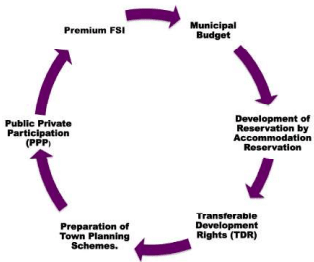
The urban land needs to be considered as an asset and should be utilized for generating the required resources for its development. The planning commission is also of the view that the plans for the development of cities must be on a self-financing basis.
As seen from the earlier paragraphs, Govt. has made various enabling provisions in the Town Planning Act for implementation of various proposals in Development Plan. Besides, there are various schemes introduced by the Govt. to help the municipal corporation to take initiative in implementing the Dev. Plan proposals. Following are the details of such provisions / schemes.
There are different ways of implementation of the Development Plan by Resource Mobilisation. They are as follows:
A) Municipal Finance
As per the latest budget of the Pune Municipal Corporation, for the financial year 2010-2011, the annual income is about Rs.2031.64 crores while the amount of expenditure is Rs. 2190.85 crores.
Following are the observations after an analytical study of the income and expenditure figures:
Octroi and property tax are observed to be the main sources of receipts. The income from octroi has increased from Rs. 646.17 crores in 2009-2010 to about Rs.912 crores in 2010-2011 during the last seven years which indicates an increase of 41.14 %. This is indicative of the increasing turnover in trade and commerce. The income from property tax was Rs 469.75 crores in 2010-11.
B) Levy of Development Charges as per MR&TP Act 1966
Since August 1992, the Corporation is empowered to collect the development charge and premium against various development
permissions given under the provisions of the Maharashtra Regional and Town Planning Act, 1966. Development charge is leviable in respect of the sub-divisions, layout of the land and the construction of residential, commercial and industrial buildings in the city. These development charges are collected under an independent head of account viz. “Development fund”. This fund is expected to be utilized for providing public amenities and maintenance and improvement of the area under the jurisdiction of the planning authority. This fund can be applied for the implementation of Development Plan proposals.
The receipts on account of the development fund, has increased from Rs. 50.69 crores in 2002-2003 to Rs. 335.2 crores in 2010-2011. With reference to the Government notification dt. 27 Dec 2010, an amendment is made in the MR&TP Act 1966 clause no 124B section 3 Second schedule says that the development charges shall be paid at 2% of the rates of developed land mentioned in the Stamp Duty Ready Recknor and land development shall be paid at 0.5 % of the rates of developed land mentioned in the Stamp Duty Ready Recknor.
On the “Expenditure” side, one of the major items is the execution of obligatory functions of the Municipal Corporation and other is repayment of loans taken for various development works.
It is observed that, so far, Corporation has not made any specific provision in the budget for implementation of the proposals of the development plan, which is implicitly contemplated in the provision of section 42 of MRTP Act 1966. Moreover the provisions in the Maharashtra Regional & Town Planning Act regarding “Development Charge” and creation and utilization of “Development Fund” makes it imperative on the part of the Corporation to make separate provision annually for this purpose,in the budget.
The increase on the income side is observed to be gradual. The Corporation will have to make special efforts for the same as described in subsequent paragraphs
C) Funding under Government Grants and JNNURM Projects
The central government as well as the state government have special projects budget allocated to various cities in the country for infrastructure upgradation under the JNNURM. All the cities are set to experience a complete over-haul in its infrastructural facilities. As far as Pune city is concerned, funding under JnNurm has been approved by the central government for projects related to roads, water supply, sewage, river improvement, etc.
D) Development of reservation under Accommodation Reservation
The burden of acquisition would be considerably reduced, if the Corporation succeeds in encouraging participation of the public and the semi-government / public institutions in the implementation process through the concept of Accommodation Reservation, provision to allow F.S.I. in lieu of compensation etc. as incorporated in the development control regulations.
This concept has been included in the development control regulations, that would enable the Corporation to have public participation in the implementation process, whereby the financial burden on the Corporation can be reduced.
E) Transferable Development Rights (TDR)
With rising land-values, especially in Metropolitan Towns and big cities, it has not been possible for the Planning Authority to keep up the pace \ of implementation at the desired level. To overcome this problem of paying monetary compensation to the concerned landowners, the Maharashtra\Government has formulated the concept of TDR, which has been included in the Development Control Rules of the Pune Municipal Corporation. Section 126 of the M.R. & T.P Act, 1966 has also been amended for enabling compulsory acquisition of lands, reserved for public purposes, by granting TDR, in lieu of monetary compensation.
Chapter No. VII of the Maharashtra Regional and Town Planning Act, 1966 contains provisions regarding land acquisition in respect of the lands reserved in the development plan. The provisions regarding compensation in section 126(1) enable the Corporation to acquire the lands in lieu of / Transferable Development Rights. This provision is supplementary to the above mentioned provisions of the development control regulations.
Under this concept, the owner whose land is reserved in the development plan, is awarded a Transferrable Development right in the form of Development Right Certificate, in lieu of the land under the reservation. The development right certificate holder can utilize the FSI in respect of the reserved land up to the prescribed limit and in the prescribed manner, after handing over the land under the reservations, free of cost to the municipal corporation. Alternatively, he can sell this right to any other person with the permission of the Commissioner. This concept has been incorporated in the development control regulations. The effective implementation of this provision will reduce the financial burden on the Corporation. Also to implement the development Plan more efficiently and speedly a new concept has been introduced whereby if any person/landowner hands over this reserved land within 1 to 5 years from the sanction of the development plan, he will be entitled for additional 50% to 10% incentive TDR in addition to the basic TDR.
F) Developmental TDR
It is essential that the corporation should get reserved sites developed in a cost effective and time bound manner. Over a period of time, it was realized that due to financial inability, the corporation was unable to do so. Hence a provision was made in the development control rules which permits the owners of lands, to hand over the developed site to the corporation. In consideration of this, developmental TDR would be made available to such land owners.
G) Levy of premium for additional benefit as per dc rules
The development control regulations of this development plan contains a provision to empower the Commissioner to charge a premium in respect of the cases, in which additional benefit is accruable to the land owner, due to the newly introduced provisions in the development control regulations e.g. Additional FSI for schools, hospitals, starred category hotels, Stair-case, passage free of FSI etc. This would help in increasing the income of the Corporation.
G-1) Premium FSI
To achieve the vision of an efficient and sustainable public transport it is proposed to densify the public transport corridor to a distance of about 500m on both sides of the metro corridor. This can be achived by availing an additional FSI above the basic FSI in lieu of premium. The charges collected can be used for augumentation of the infrastructure required in future.
H) Preparation of Town Planning Schemes
Another effective tool for implementation of the development plan is the preparation of town planning schemes for developing areas. In a town planning scheme, burden of acquisition cost is recouped by way of betterment contribution from the residents of the scheme area. The municipal corporation has good experience in implementing eight town planning schemes in the past. Some of the proposals of the development plan can be implemented by undertaking few schemes in the areas having development potential. A well thought out phasing programme for implementation is essential.
Town Planning Scheme is rightly called "land acquisition without tears". Town Planning schemes if proposed, especially in the areas which were earlier in agricultural Zone; can relieve a big burden of PMC as regards acquisition of reservation and roads earmarked in these areas. .
I) Public private participation in implementation (PPP)
Urban planning is the main function and duty of the local government. For any urban planning effort to be successful, partnership between the planning function of the government and the local community is a must. The collective wisdom of the planning agency must converge to produce a desirable city. In Democratic sense,”Planning is for the people and by the people.”
Public private participation in implementation of DP is meant to be self financing, so as to reduce the burden of payment of compensation by the Planning Authority, for land acquisition etc. The main aim is to secure land by incurring minimum expenditure on the cost of acquisition. Public participation is necessary in both plan formulation and implementation stage. PPP can be initiated at different levels, starting with public hearing and encouraging individual citizens, civic clubs, neighbourhood associations, business professionals to participate in planning committees and advisory committees.
PPP can be achieved by development of buildable and even non-buildable reservations earmarked in development plan, like primary and secondary schools, parking spaces, gardens, parks playgrounds, community halls, shopping center, flyovers, major district roads on Build operate and Transfer (BOT) and Build, Operate, Transfer and Maintain basis.
J) Development of Road by Private Parties in lieu of Credit Notes :-
It is necessary to device policies to ensure that the load on the Municipal corporation exchequer is minimized. The introduction of the policy of issue of credit notes in lieu of the development of roads needs consideration. If a developer takes the work of execution of a stretch of a DP road of considerable length (as decided by the Municipal Commissioner ) and as per the specifications decided earlier he may be issued a credit note stating the total cost incurred in the development of the road. Such amount may be adjusted against the premium charged to
the developers against his construction project any where within PMC limits. The amount may also be adjusted against the premium to be paid by any other developer in any of his projects in the city if the original developer authorises the other developer.