17.10.1. Land use zoning and social facility proposals: - The Existing Land Use map was taken as a basis for this purpose. Since 1987, policy of reduction in Industrial acreage in city limits has been adopted. No additional industrial acreage has been therefore proposed and industrial zones therefore largely remain stable except for marginal changes. Promotional policies for non polluting industries such as IT, BT, R & D Activities etc have been introduced. Also the trend shows that, the industrial pockets are getting conversed to converting in residential area; due to housing demand. It may, be necessary to examine and decide as to whether substantial area would be needed to be zoned for ITandBT, Software park, hardware park, animation park, Knowledge Processing, Out sourcing, R&D activities and Genetics.
Sites reserved for public purposes which are vacant and not acquired, will be continued or re-designated under this Development Plan. Some of these sites are reserved since 1966, and due to this, land owners have unnecessarily suffered. So in order to acquire reservations speedily in future, incentive policies have been introduced.
There are agriculture pockets shown in earlier development plan and many of them are vacant and surrounded by residential developments. A policy decision is needed to be taken with regards to the development of these areas considering the need of housing sector and other social and recreational amenities.
17.10.2 Slum redevelopment, rehabilitation: -
Housing for slum dwellers has always posed serious problems before authorities. Separate Slum Rehabilitation Authority (SRA) has been formed by the government for PMC and PCMC area in 2005. It is supposed to plan for slum redevelopment and rehabilitation. Policies have been framed for redevelopment and rehabilitation of slums located on reserved sites, either insitu or in the nearby vicinity. Proposals regarding this have been included in the Revised Development Plan. Such projects have been undertaken at some locations under the Basic services to urban poor (BSUP), funded by JNNURM.
Also, policies will have to be framed to rehabilitate slums through public private partnership, with along SRA, RAY etc.
17.10.3 Hill Top Hill Slope Area: -
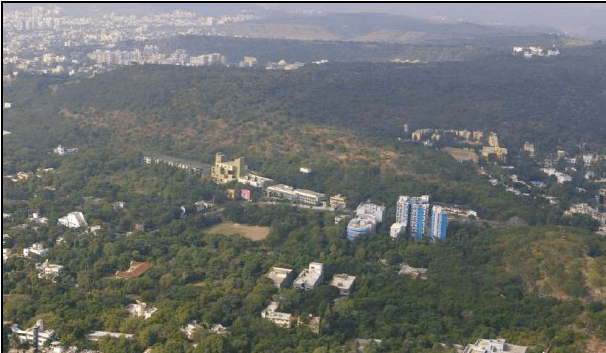
In the sanctioned Development Plan of 1987, hill tops and hill slopes zones are shown. According to the present development regulations in old limit area, 4% construction is allowed for particular uses. The same policy has been continued in this D.P with some additional users.
17.10.4 Area Development Approach:-
Some PMC lands have been allotted for rehabilitation of slum dwellers, project affected peoples on lease basis. Also some lands have been allotted by the Government to flood affected people. The dilapidated wadas, gunthewari type development on EWS and other reservations sites, etc are the other high density pockets seen in the city. The social amenity and recreational facility within these pockets is not up to the mark. Policies need to be framed for proper planning of these areas with a view to provide better housing, quality of life and for creation of affordable public housing stock.
17.10.5 Manner of dealing with encumbrances on designated sites: -
During the exercise of evaluation of sanctioned Development Plan in respect of designated sites, it was observed that many designated sites are encumbered either with hutments or otherwise. It was also observed that sites are not always fully encumbered; and that in some cases. It would be possible to obtain area required for the public purposes, if the occupants of encumbered area are re-habilitated in one corner of the designated site, leaving the remaining area which could be used for the public purpose for which the site has been designated. If the occupants of the encumbered area could be rehabilitated on the same site or site adjacent to the designated site, it is expected that opposition which is normally met with in case of such operation, would not be encountered.
17.10.6 Integrated plan proposals for PMC, PCMC and 3 Cantonments: -
The development plan for the 23 fringe villages for the year 2011-21 has been prepared and submitted to the State government for sanction. Pune Cantonment and Khadki Cantonments form pockets within the PMC area. Obviously, there is a direct co-relation between the activities in cantonment areas and PMC limits. For example, the High Explosives Factory in Khadki has many of its employees residing in PMC area, thereby causing problems of commutation and congestion. Similarly, residents of Pune Cantonment also depend to a considerable extent on the social facilities available within the PMC area. There does not seem to be any development control rules as such operating in the cantonment areas; and therefore there is great imbalance in the building development between the cantonments and PMC area. For all these reasons, it is necessary to plan for the entire urban mass, consisting of the PMC and the two cantonments, in a comprehensive and integrated manner. Co-ordination in respect of the following issues is essential:
-
Traffic and Transportation.
-
Integrated land use.
-
Full and proper use of urban land.
-
Services and Social facilities.
-
Regulation for controlling developments.
17.10.7 Proposals for Aesthetics, tourism, maintenance of Heritage structures etc.: -
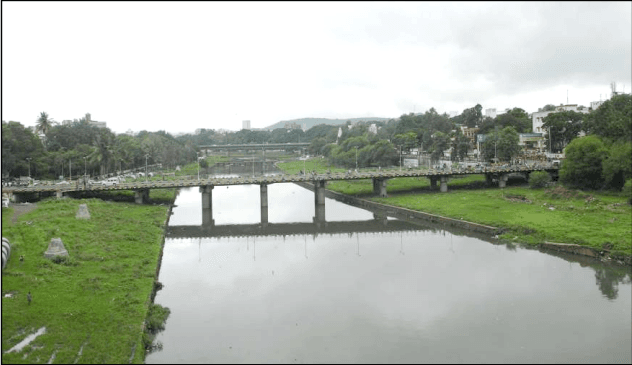
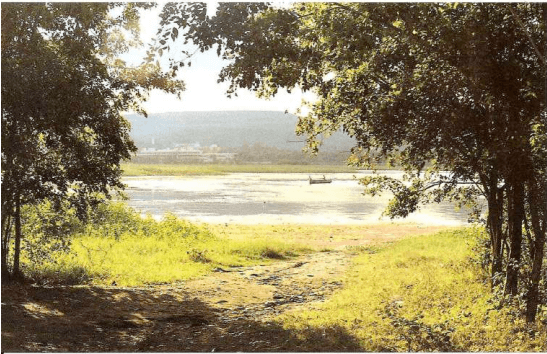
Pune is a city of historic importance and a number of sites need to be preserved. Proposals for establishing Zoos, bird sanctuaries, amusement parks, river front development, etc. have been included in the revised Development Plan with a view to promote tourism in the City. Such sites are not only tourist attractions, but they will serve as important recreational spaces within the otherwise drab and dull jungle of concrete buildings. Special efforts to make proposals in this respect have been considered. To promote architecturally marvelous building designs, incentive schemes will be designed by PMC. Conservation policies for heritage buildings and precincts have been framed.
17.10.8 Rationalized and Standardized Development Control Rules and Regulations: -
Municipal Bye-Laws are framed under the provision of the B.P.M.C. Act; while the Development Control Rules are under the M. R. and T.P. Act. Since 1987, many modifications have been approved and several directives have been issued at the Government level, which have been incorporated in the revised Plan. Some minor changes to suit local conditions of Pune have been made in the standard rules and bye-laws.
17.10.9 Phasing, programming, financial implications and resources:-
The implementation of the development plan includes two actions viz. 1) Development control and 2) Development plan for the social Amenities and Facilities and the proposed circulation pattern.
Land is the governing factor in the physical planning process. The rising land-values in the cities and the resulting heavy compensation liabilities pose severe constraints to the Planning Authority's efforts relating to town improvement and town development. Implementation of the Development Plan proposals requires procurement of land either by private negotiations or through Land Acquisition Acts.
Land procurement through such means, naturally requires huge investment. Due to lack of adequate financial support, acquisition of sites for public purposes is normally not achieved satisfactorily and the plan, more or less, remains a paper plan.
17.10.10. Financial Implications and different modes of effective implementation of plan
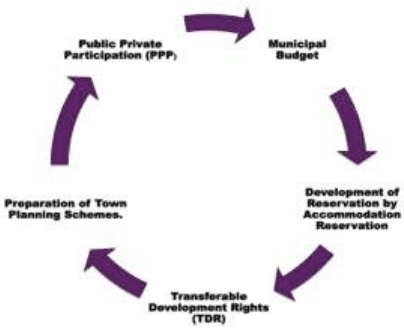
Sites have been designated for various purposes in the sanctioned Development Plan. However, the circumstances have since then changed; and it is likely that the purpose for which a site was designated originally is required to be changed under the revised Development Plan.
Decision about possibility to inter-change purposes in the above circumstances is proposed to be taken; and inter change of proposals made under the revised Development Plan accordingly. The proposals would be categorized as long term and short term as per their needs of development of city.