Access Aisle - An accessible pedestrian space between elements, such as parking spaces, seating and desks that provides clearances appropriate for use of the elements.
Accessible - A site, building, facility, or portion thereof that complies with these Guidelines and that can be approached, entered, and used by all people.
Accessible Route - A continuous unobstructed path connecting all accessible elements and spaces in a building or facility that can be negotiated by a severely disabled person using a wheelchair and that is also safe for and usable by people with other disabilities. Exterior accessible routes may include parking, access aisles, kerb ramps, walkways, and ramps. Interior accessible routes may include corridors, ramps, elevators, lifts, and clear floor space in front of fixtures.
Accessible Signage - Any visual way finding system incorporates architecture, landscape design, lighting, landmarks, and orientation points. Signage is one key element of an effective way finding system and should be accessible to all users including people with disabilities.
Ambulatory Disabled - A person who is able, either with or without personal assistance, and who may depend on prostheses (artificial limbs), orthotics (calipers), sticks, crutches or walking aids to walk on level or negotiate suitably graded steps provided that convenient handrails are available.
Automatic Door - A door equipped with a power operated mechanism and controls that open and close the door automatically upon receipt of a momentary signal. The switch that begins the automatic cycle may be photoelectrical device, floor mat, sensing device, or manual switch mounted on or near the door itself.
Beveled - Smooth, slanted angle between two surfaces; for example, a slant or inclination between two uneven surfaces to allow easier passage of a wheelchair.
Braille Signage - Is a specialist way finding device that incorporates Braille as a primary source of information for people who are vision impaired and maybe aided with raised tactile lettering, maps, or pictorial images.
Braille - The Braille system is a method that is widely used by blind people to read and write.
Circulation Path - An exterior or interior way of passage from one place to another for pedestrians, including walkways, hallways, courtyards, stairways, and stair landings. Clear - Unobstructed
Colour Contrast - The basic guidelines for making effective colour choices are based on the hue value of the colours. The most commonly used methods of achieving colour contrast is to incorporate either “harmonising” or “contrasting” colour combinations.
Chapter 9: Appendix
Cross Slope - Cross slope or camber is a geometric feature of pavement surfaces: the transverse slope with respect to the horizon. It is a very important safety factor. Cross slope is provides a drainage gradient so that water will run off the surface to a drainage system such as a street gutter or ditch.
Disability - is an umbrella term for impairments, activity limitations, and participation restrictions, denoting the negative aspects of the interaction between an individual (with a health condition) and that individual’s contextual factors (environmental and personal factors). Disability is neither simply a biological nor a social phenomenon but arises from the relationship between health condition and context.
Grab Bars - A bar used to give a steadying or stabilizing assistance to a person engaged in a particular function.
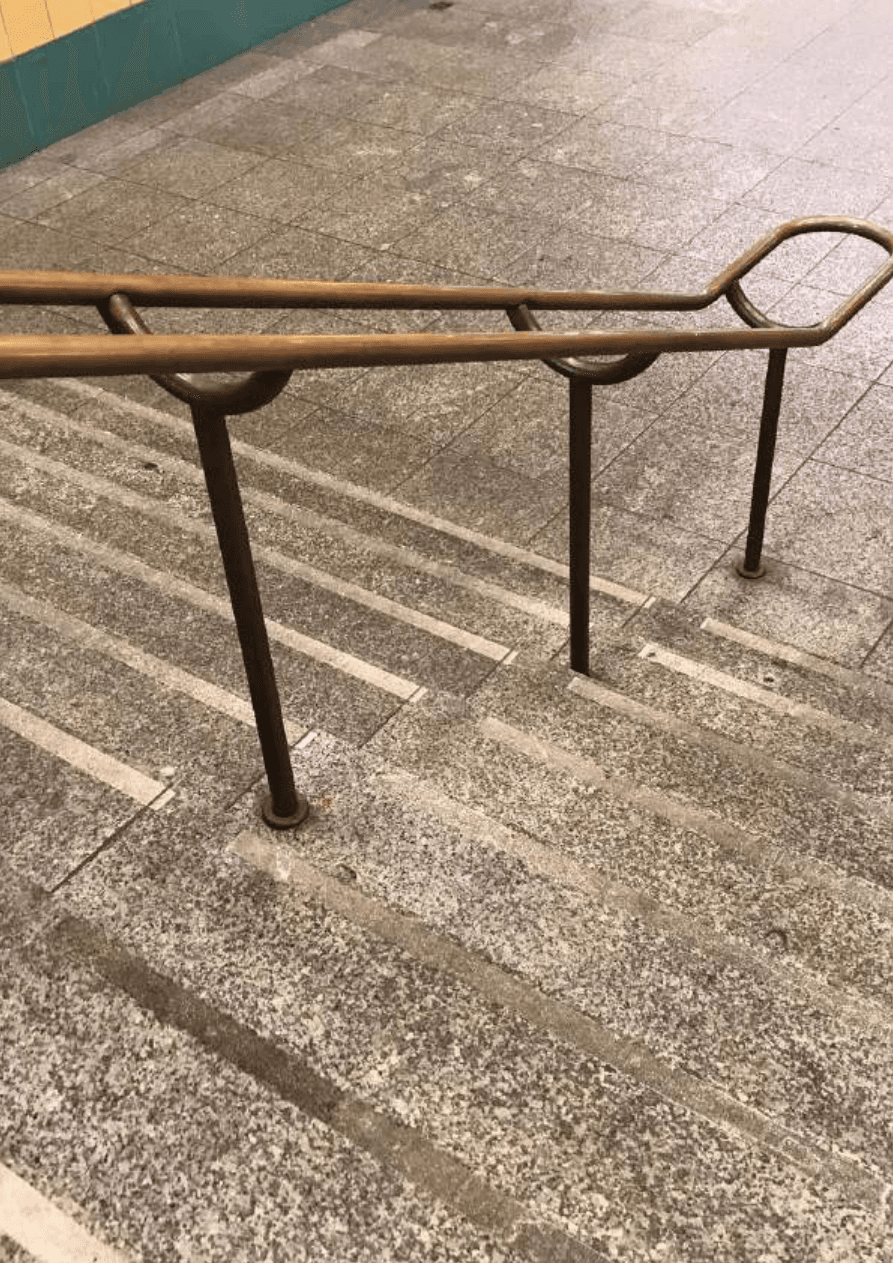
Handrails - A rail used in circulation areas such as corridors, passageways, ramps, and stairways to assist in continuous movement.
Hue - Hue is the perceptual attribute associated with elementary colour names. Hue enables us to identify basic colour categories such as blue, green, yellow, red and purple. People with normal colour vision report that hues follow a natural sequence based on their similarity to one another. With most colour deficits, the ability to discriminate between colours based on hue is diminished.
Individual Washrooms - A compartment having the basic requirements of a water closet compartment, washbasin and other essential washroom accessories as required by people with disabilities.
Induction loop - An induction or inductive loop is an electromagnetic communication or detection system which uses a moving magnet to induce an electric current in a nearby wire. Induction loops are used for transmission and reception of communication signals, or for detection of metal objects in metal detectors or vehicle presence indicators. A common modern use for induction loops is to provide hearing assistance to hearing-aid users.
International Symbol of Access - Also known as the (International) Wheelchair Symbol, the International Symbol of Access consists of a square overlaid with a stylized image of a person using a wheelchair. The symbol is often seen where access has been improved, particularly for wheelchair users and other mobility impaired persons. The symbol denotes a barrier free environment, such as steps, to also help older people, parents with prams, and travelers with luggage. The wheelchair symbol is "International" and therefore not accompanied by Braille in any language.
Kerb - A side barrier to a trafficable surface or is the edge where a raised sidewalk/footpath, road median, or road shoulder meets an unraised street or other roadway.
Kerb Ramp- A short ramp cutting through a curb or built up to it or a Kerb is a drop, with walkway, at a gradient no greater than 1:10 on both sides of necessary and convenient crossing points. Width should not be less than 1200mm. If width (X) is less than 1200mm, then slope of the flared side shall not exceed 1:12.
Knurled Surface- Roughened area, often in a crisscross pattern; used on either doorknobs
or grab bars. On doorknobs, it is used to provide tactile clues to visually impaired persons to indicate that passage leads to an area of danger. On grab bars it is used to improve grasp and to prevent slipping.
LRV- Light reflectance value (LRV) is the total quantity of visible light reflected by a surface at all wavelengths and directions when illuminated by a light source.
Luminosity Contrast- Also known as tonal contrast, it is the most important element that assists people with vision impairments to distinguish between two different surfaces. A minimum difference of 30 points in the Light Reflectance Value of colours of two architectural surfaces produces an adequate luminosity contrast that is perceivable by persons with vision impairments.
•Marking a parking space reserved for vehicles used by Persons with Disabilities
•Marking a public lavatory with facilities designed for wheelchair users
Lux - Is the standard unit of illumination. It is used as a measure of perceived intensity of light.
Operable Parts - A part of a piece of equipment or appliance used to insert or withdraw objects, or to activate, deactivate, or adjust the equipment or appliance (for example coin slot, pushbutton, handle).
Passing places - a space on the footpath, single track road or one lane road that permits two ways travels when it is not wide enough to allow wheelchairs/vehicles to pass one another.
Persons with Disabilities - A Person with Disability is a person with any physical, mental, intellectual, or sensory impairment which in interaction with various barriers may hinder full and effective participation in society on an equal basis with others. The term “Persons with Disabilities”, consistent with the terminology used in the UNCRPD, is used throughout these Guidelines.
Public Areas - Interior and exterior rooms or spaces that are made available to the public. Public use may be provided at a building or facility that is privately or publicly owned.
Public Use- Describes interior and exterior rooms or spaces that are made available to the public. Public use may be provided at a building or facility that is privately or publicly owned.
Ramp- An inclined way connecting one level with another.
Signage- Any room number, name tag, building directory, or similar object containing a printed message and/or symbol. Signage and signs are used synonymously in this document.
Space- A definable area (for example, toilet room, hall, assembly area, entrance, storage, room alcove, courtyard, or lobby).
Tabletop - Road raised to footpath/footway level at crossing or with leveled.
Tactile - Tactile means information and interpretations derived from the sense of touch. This involves sensory transfer through physical contact of the hands or feet with other surfaces, as well as sensory transfers received by contact with non-physical elements such as pressure, wind, and temperature.
Chapter 9: Appendix
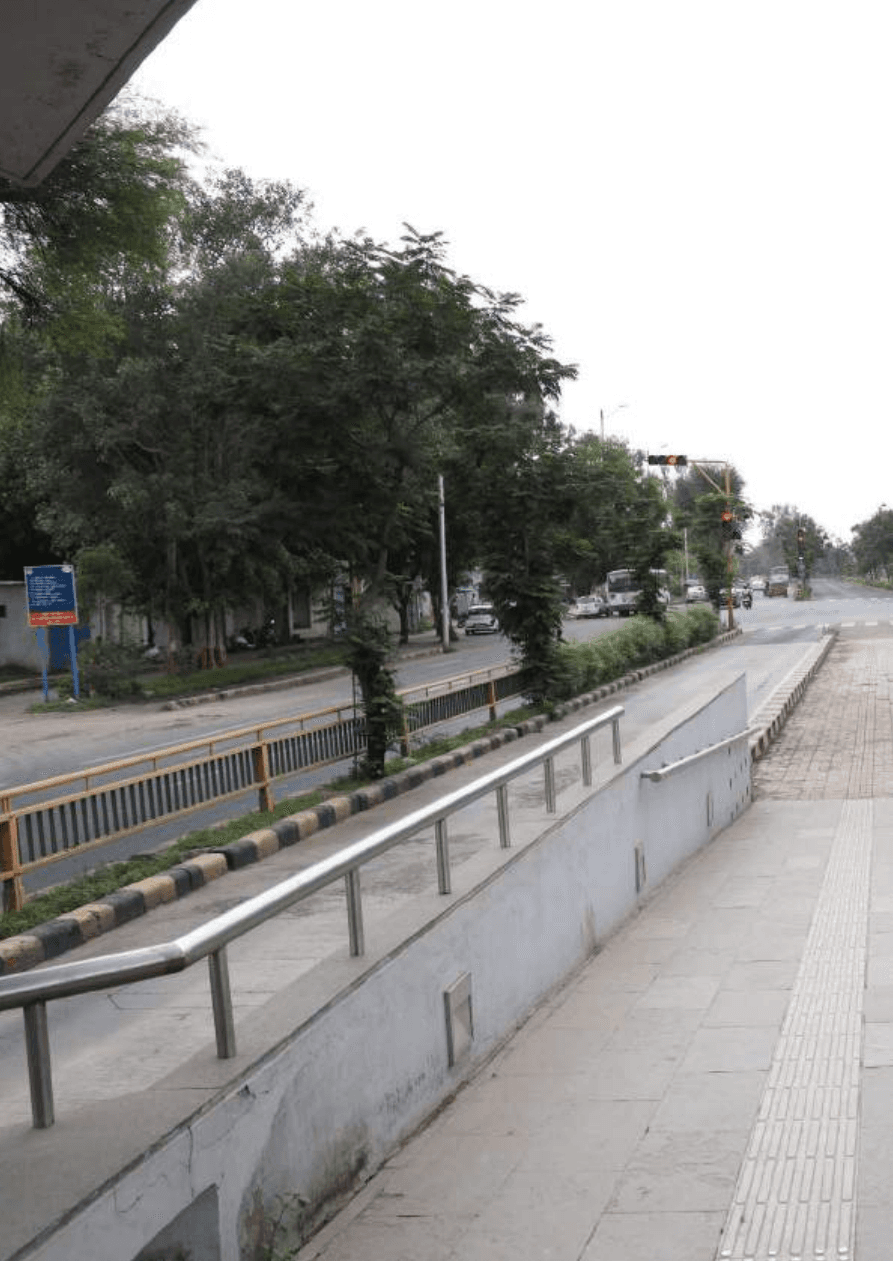
Tactile Ground Surface Indicators – Also known as Tactile paving/tiles, provide a distinctive surface pattern of “strips” and "truncated domes" or cones (which are small domes or cones that have had their tops cut off, or truncated) detectable by long cane or underfoot which are used to guide/alert persons with vision impairments of their approach to facilities, streets, and hazardous drop-offs. People who are blind or visually impaired are alerted of impending danger from vehicle impact or a grade change.
Tactile signs (Refer also to Braille Signage) -Tactile signage incorporates raised text or symbols to enable touch reading by people who are blind, and touch enhancement of visual perception for people who are vision impaired.
Tactile Guiding Blocks - These are 300 x 300 mm tiles that incorporate bars that are 5mm (± 0.5mm) high, 20mm wide and spaced 50mm from the centre of one bar to the centre of the next. These flat-topped bars that are easily detectable underfoot by people with visual impairments. They are used externally to guide people with visual impairments along the circulation path. They may also be used internally in large busy areas such as railway stations and airports.
Tactile Warning Blocks - To warn persons with visual impairments of the approaching danger, it is recommended to incorporate Tactile Ground Surface Indicators (TGSI) along the approach path to unavoidable obstacles and hazards. TGSI, also commonly known as, Tactile Warning Blocks, are 300 mm x 300 mm tiles that incorporate rows of 5 mm (± 0.5 mm) high flat-topped blister like domes that are easily detectable underfoot by persons with visual impairments. These tactile warning blocks are recognized internationally as a sign of approaching hazards.
Traffic island - can be a median strip, a strip in the middle of a road. It can also be a narrow strip between roads that intersect at an acute angle. Some traffic islands may serve as refuge islands for pedestrians.
Universal Design - Defined as “the design of products and environments to be usable by all people, to the greatest extent possible, without the need for adaptation or specialized design”.
Vision impairment - Vision impairment is any significant loss of sight.
Water Closet Compartment/Toilet Cubicle - A compartment having a water closet with grab bars installed to assist people with physical disabilities
Wheelchair User - A person who depends on a wheelchair for mobility
White Cane - A white cane is a long rod-like device used by blind or visually impaired travelers to give them information about the environment they are traveling through.

Nine waves
Harmonised Guidelines & Standards for Universal Accessibility in Indi
Ministry of ttoujng and Urhuan tol
waves with distinct
curved profiles
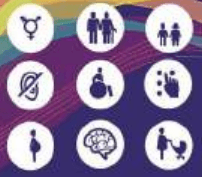
Nine icons
Nine colours
Cover Design Concept
Waves of Diversity and Pluralism
colours and nine icons representing diversity The graphic composition represents nine waves, nine colours and nine icons representing diversity pluralism as a foundation of universally colours and nine icons representing diversity andpluralism as a foundation of universally ssible and inclusive India. pluralism as a foundation of universally accessible ssible and inclusive India. and inclusive India.
The waves with distinct curved profiles represent an life span with ability and disability as an a human life span with ability and disability as an usive experience for all. inclusive experience for all.
p g y g ,The nine icons representing the diversity of age, der and abilities provides a framework for p gender and abilities provide a framework for ding all. Semantically, the number ‘nine’ g . y, including all. Semantically, the number ‘nine’ also represents the cosmic universe in Indian represen s e cosm c un verse n n anrepresents the cosmic universe in Indian mythology. hology.
The cover design reinforces a positive image of cover design reinforces a positive image of cover design reinforces a positive image of inclusion with diversity and dignity to all humansion with diversity and dignity to all human sion with diversity and dignity to all human lives. It celebrates the idea of difference amidst the . It celebrates the idea of difference amidst. t ce e rates tpursuit of equity.pursuit of equity.
2021 Harmonised Guidelines & Standards for Universal Accessibility in India
Ministry of Housing and Urban Affairs Government of India