Accessibility needs in the context of built environments for diverse user groups provide a specific yet generic perspective towards creating enabling built environments for all. While the following chapters specify details of various elements of built environments, this section provides a broad perspective on the various attributes of accessibility for persons with disabilities.
2.4.1 Physical Disabilities
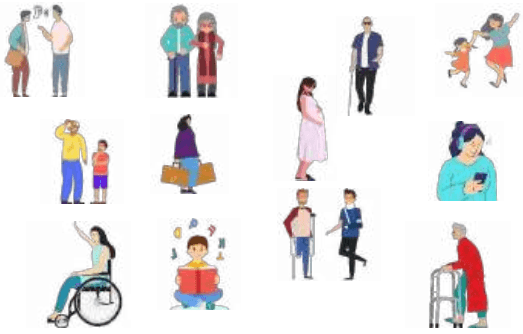
Persons with disabilities too exist in diverse forms and with varying degrees of disabilities. Certain disabilities of physical nature may be visible through body structures while several disabilities impair the invisible body functions which may require adaptation at various levels in built environments. Some of the common accessibility needs for diverse disability types in built environments are stated below.
a. Ambulant Disabilities
This includes persons with lower limb difficulties which may be temporary or permanent in nature leading to requirements for body support, slow movement, etc. Persons with ambulant disabilities may use assistive devices like crutches, cane, walking frames, rollators, etc. while some may move without assistive devices. Built environments need to accommodate their needs, through some of the following features:
• Adequate Parking spaces for adapted scooters, tricycles or other assistive devices
• Grab rail support in circulation spaces for movement.
• Nonslip surfaces alongwith periodic maintenance of walking spaces.
• Low kerb heights and level crossings in street environments
• Provision of resting spaces in public spaces, side walks, etc.
• Providing adaptive or accessible washroom facilities with support features like grab rails, hooks, space to keep assistive devices like cane, crutches, etc.
b. Non ambulant disabilities / Wheelchair users
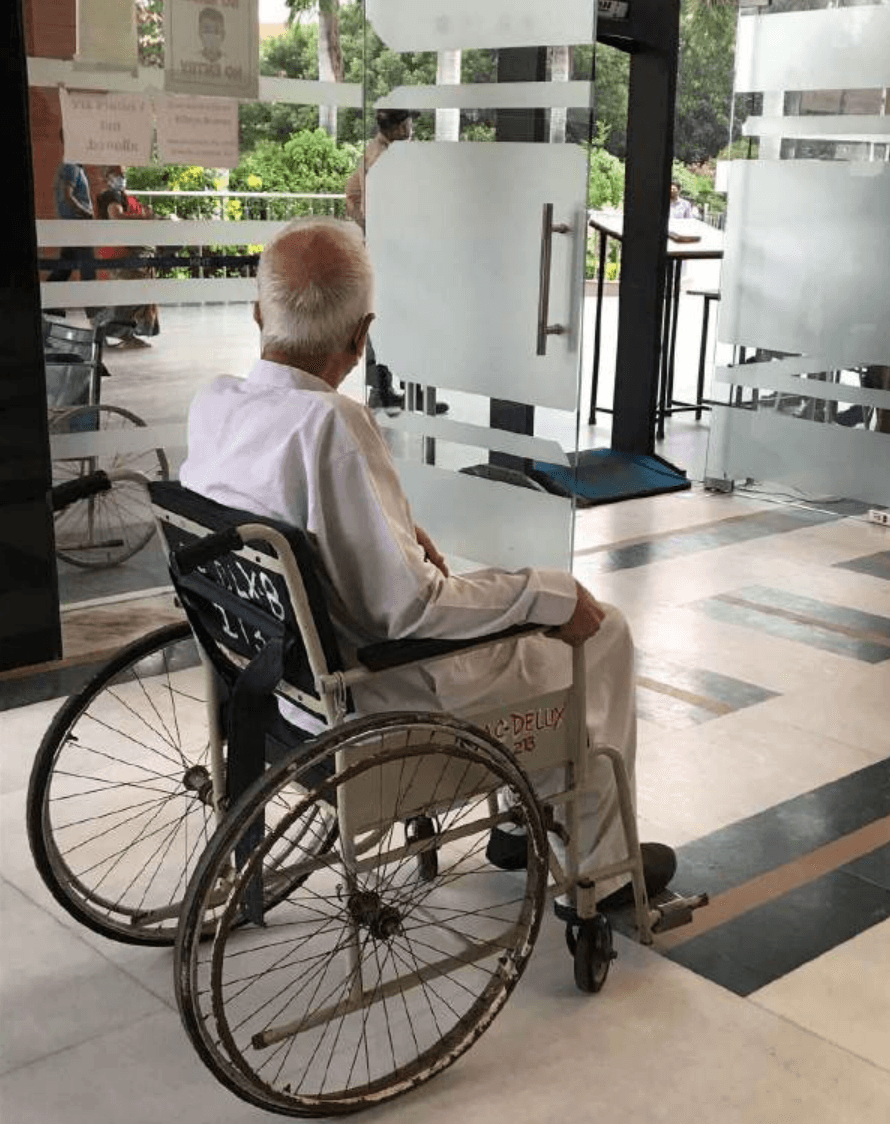
Non ambulant disabilities may occur as a result of various reasons, either naturally or due to an accident. Persons with non ambulant disabilities may use wheeling devices like wheelchairs (manual, powered, etc.) or tricycles or ground mobility devices as assistive technologies for their mobility needs. Negotiating levels in built environments remains a critical challenge to their accessibility and safety needs. The following features may enhance accessibility:
• Parking spaces with wider access and circulation
• Step free and wider entrances with adequate landing spaces for wheelchair or powered chair maneuvering, etc.
• Adaptive spaces for wheelchair users in outdoor and indoor environments.
• Provision of ramps with gentle gradient, maneuvering spaces, edge protections, grab rails and non slippery surfaces.
• Accessible elevator with maneuvring spaces and appropriate level differences.
• Clear space of 900 mm minimum for all circulation areas like corridors, doors, street bollards, etc. to accommodate a wheelchair user.
• Low height controls for easy reach in room interiors, elevators, etc.
• Knee space clearances below counters, lavatories, etc. in washrooms, reception counters, etc.
• Providing accessible washrooms and other accessible facilities like parking.
• Sturdy and non slippery flooring material allowing easy maneuverability of the wheelchair and other mobility devices.
• Emergency alarms and evacuation services with access to public assembly areas
c. Upper Limb Extremities
Upper limb extremities may result from consequence of various health conditions or life situations. This may pose challenges to performing activities involving lifting, reaching, gripping, etc. Built environments could sensitively respond to their accessibility needs through the following accessibility approaches or support:
• Easy to operate doors or other interior features
• Provision of lever type handles in openable systems (doors, cabinets, etc.)
• Grab rail supports in circulation spaces
• Foot operated controls like latches, switches etc. in doors or windows
• Avoiding sharp corners and edges wherever shoulder or body push features are required
• Flexible furniture systems for ease in body adjustments in absence of upper limb limitations
• Provision of support surfaces at various heights to keep belongings
• Non slip surfaces, especially in wet areas like washrooms, etc.
2.4.2 Visual Impairments
Visual impairments include various forms of sight related disorders ranging from low vision to peripheral loss of vision to partial or complete blindness, etc.
a. Low Vision
People with partial loss of vision can usually find it very difficult to navigate in and around the built environment, especially in unfamiliar settings. While excessive contrast can create problems of glare, inadequate contrast can make it difficult for persons with low vision to discern objects or details in the environment.2
• Adequate visual contrast in level changes and surfaces
• Adequate illumination
• Larger Font size in signage
• Effective colour combinations keeping in mind the needs of the colour blind
• Glare free light
• High resolution (readable characters) for example with LCD
• Use of assistive technologies like screen magnifiers, screen readers, text to speech or voice recognition software, etc.
• Obstruction and Protrusion free paths for movement
• Avoid slippery surfaces
b. Blindness
• High contrast environments
• Provision of Tactile Pavers guides people with visual impairment to move independently.
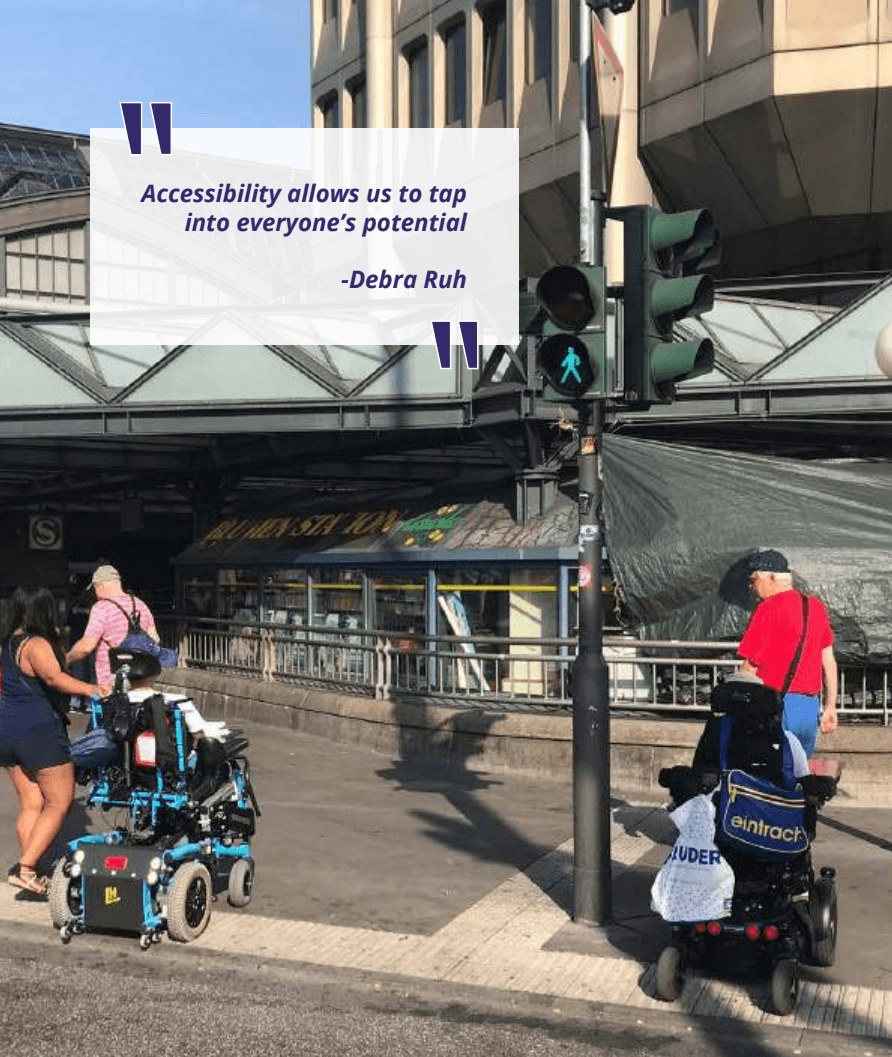
• Provision of safe and level pedestrian crossings in street environments
• High contrast color markings at the edges wherever there are level
Chapter 2: Understanding Accessibility
changes.
• Braille plates as information systems to be integrated with elements like handrails in staircase / ramps or grab rails in circulation spaces.
• Provision of Multi-lingual signage alongwith Braille.
• Tactile floor plan or tactile models with consistency to be provided for in built environments especially public buildings, transportation hubs, etc.
• Use of Digital Signage system with Audio-Video public announcements.
• Good acoustic treatment indoors which does not distort sound.
• Radio Frequency Identification systems and new state of the art technologies for enhanced sensory communication may be employed to enhance accessibility in mobility and other functional spaces of built environments.
• Use of sensory landscapes, micro climate features, soundscapes using water, etc. as features in built environment for ease in navigation.
• The handrails at staircase / ramps should have information of Floor Number in Braille.
2.4.3 Hearing Impairment
Hearing quality is crucial for communication of information or detection of hazards while moving through a range of built environments especially in high traffic zones or environments with high background noise. Hearing loss (HL) is classified as Mild for HL in range 26 to 40 db, Moderate for HL range 41 to 55, moderately severe from 56 to 70 db, Severe for 71 to 90 db and profound HL for range 91 db or more. Considering a range of HL across individuals with hearing impairments, built environments
need to reinforce their visual order, communication systems especially for emergency services and evacuation to ensure that persons with hearing impairments are not neglected. Built environment spaces and infrastructure needs to facilitate oral -aural or sign language communication through its operations and services to be inclusive to persons with hearing impairments. A few of the accessibility needs in this context are stated below:
• Audio alerts can be substituted with visual alerts.
• Users should be able to configure the frequency and volume of audible cues wherever made available.
• Use of efficient wayfinding system which allows a user to reach a destination independently.
• Use of Digital Signage system with Audio-Video public announcements.
• Good acoustic treatment indoors which does not distort sound and enhances its quality.
• Minimising Background noise especially in transportation systems, street environments and public spaces.
• Assistive technology supports like Headphones, Hearing aids, Ear implants (Cochlear implants) for individuals
• Devices like Induction Loop Systems, Infrared transmission systems (IR), Radio transmission systems (FM) may be employed as Assistive Technologies in built environment.
2.4.4 Speech Impairment
• Facilitation of two way communication to minimize barriers to hearing low and indistinct speech.
• Use of appropriate wayfinding,
signage systems.
• Use of efficient wayfinding system which allows a user to reach a destination independently.
• Use of visual icons or pictograms in addition to text characters.
• Use of Digital Signage system with Audio-Video public announcements.
2.4.5 Cognitive Impairments
• Provision of physical and sensory cues such as touch, sound, smell and tactile or audible information.
• Simplified designs, layouts for ease in mind mapping.
2.4.6 Neurodiversity
Neurodiversity refers to the wide range of differences in the manner in which the human brain processes information. It refers to alternative thinking styles, such as Dyslexia, Autism spectrum condition, Attention Deficit Hyperactivity Disorder (ADHD), Dyspraxia, Dyscalculia, etc.
• Wider aisle widths with legible and neat visual order in built spaces.
• Visual comfort through adequate lighting.
• Different light intensities have an impact on how every person handles a task. It can have a greater impact when neurodiversity is a factor, sometimes making it extremely difficult to complete tasks unless a suitable degree of visual comfort is provided.
• For neurodiverse building occupants, excessive noise - or even certain types of noises - can elevate stress levels and disrupt (or even halt) productivity. Flooring can be used to manage excessive noise.
• Soft landscapes around level changes to prevent injury in case of slips or falls.
• Grab rail support in circulation spaces.
• Avoiding sharp corners in built environment or its internal furniture.
• People with neurodiversity may process navigational information in a non-traditional way, so standard wayfinding may not be sufficient. Additional measures may include lighting and flooring effects.
2.4.7 Multiple Disabilities
Persons with multiple disabilities may reflect a combination of the above mentioned needs in built environments in addition to specific support for their functioning and performing activities of daily living.