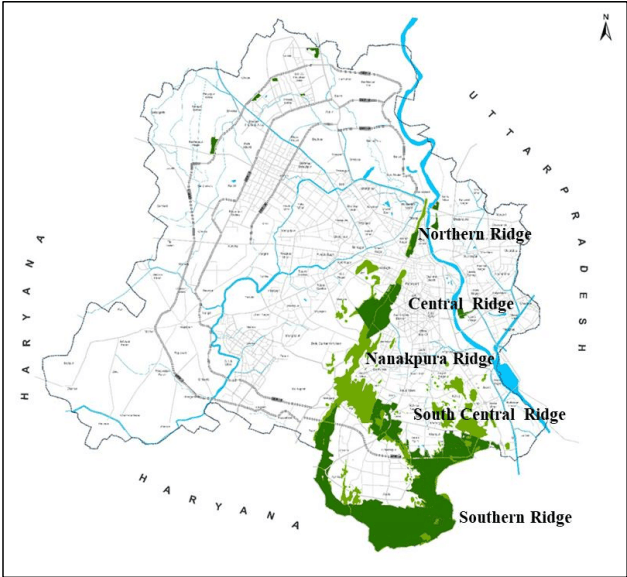
a. Invasive and alien species that cause land degradation or disturb ecology to be replaced with indigenous flora that require less water and/or are effective for pollution control.
b. Afforestation with indigenous species and tree transplantation may be taken up in identified areas as per feasibility.
c. Environmental assets shall be monitored regularly and necessary steps shall be taken by concerned agencies to keep these assets free from pollution and address any other issues.
d. Enhancing biodiversity for conserving and preserving the ecosystems of the River Yamuna and the Aravalli Ridge. Suitable aquatic species may be introduced to restore health of water bodies.
e. DJB, I&FC and other concerned agencies shall implement rejuvenation of the river and lakes in the city. Treated wastewater shall also be made available for lake/water body rejuvenation projects.
(b) Enhancing people’s connection with nature: Environmentally Sensitive Areas to be identified as ‘interactive zones’, where regulated public access shall be considered for activities such as active/passive recreation, exercise/yoga, nature classes, environmental research, picnics, camping, biodiversity tours, etc. by concerned agencies, taking into consideration universal access of such facilities. Amenities like
toilets, drinking water, resting places, visitor information centres, kiosks etc., may be provided as per norms.
(c) Special initiatives for the rejuvenation of River Yamuna and its floodplains: Delhi is a river city and its history and cultural ethos is closely linked with the River Yamuna and its floodplains. The following strategies have been adopted for rejuvenation of the river and floodplains:
i. River Yamuna and its floodplains shall be identified based on the prevailing records and technical assessment of Irrigation & Flood Control Department, GNCTD and other Competent Authority as applicable.
ii. Active floodplain shall be a ‘no construction zone’ and only recreational uses shall be permitted. All unauthorised construction including religious structures shall be demolished by the concerned agency on priority. Essential government utilities, socio-cultural and recreational activities, public infrastructure development; promoting conservation of floodplains shall be permitted only with approval/NOC of the competent authority/statutory body.
iii. Area outside Active flood plain shall have restricted development. Existing authorised and planned constructions as well as essential government utilities shall be allowed to continue as per permissible norms and approval/NOC from statutory body. Further developments in the zone shall be restricted to socio-cultural and recreational uses, essential utilities and public infrastructure with approval/NOC of the competent authority/statutory body.
iv. Measures for rejuvenation of the River Yamuna and its floodplains:
a. Rejuvenation and Ecological restoration of the River Yamuna along the 22 km stretch between Wazirabad Barrage and Okhla Barrage
b. Implementation of 13 major restoration projects for the rejuvenation of approximately 1,700 hectares of the Yamuna floodplain, focusing on restoring wetlands, natural depressions, floodplain ecosystems, and biodiversity while enhancing climate resilience and groundwater recharge.
c. Ecosystem restoration shall be carried out by de-silting of existing wetlands and restoring them for catchment of floodwaters and creating new wetlands by developing and deepening the existing depressions into storage basins. These would complement floodplain forest and grasslands that have been planted with species of riverine nature as both would serve as habitats for bio-diversity.
d. Green buffer shall be maintained along the edge of the river, wherever possible, and planted with species of riverine nature to protect the river edge.
e. Development of Ridge–Yamuna Park Connector as an integrated 200 km cycling network, including a 52 km stretch along the Yamuna floodplain, to
promote connectivity and strengthen the Ridge–Yamuna continuum. A 75–100 m wide public greenway may be developed along the embankments, wherever feasible, with cycling and walking trails and spaces for passive activities to enhance public access to parks and the river and encourage a stronger river– people connect.
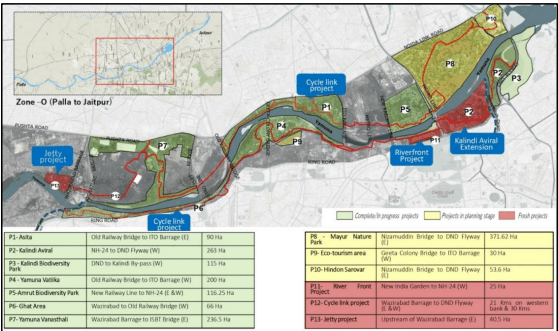
Illustration 2: River Yamuna floodplain Projects (For illustrative purpose only)
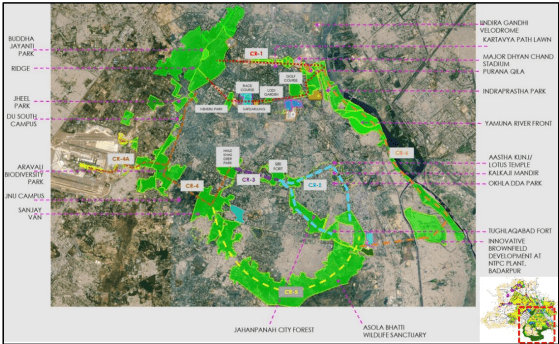
Illustration 3: Park Connectors (For illustrative purpose only)
f. Improve the water quality of the River Yamuna by intercepting and treating all 22 drains discharging into the river through sewage treatment, constructed wetlands, and bio-remediation. The intercepted drain corridors shall be restored
and seamlessly integrated with the green spaces and floodplains to create continuous ecological corridors. Discharge of untreated or unregulated sewage, wastewater, industrial effluents, and solid waste into the river and other water bodies shall be strictly prohibited.
g. Areas such as Ghats etc., shall be utilised for socio-cultural activities in a sustainable manner and activities such as disposal of pooja material, immersion of idols etc. during festivals shall be regulated.
h. Manual security and CCTV surveillance shall be deployed and installed to check the dumping of malba, garbage or any other such illegal activities and construction in the floodplains.
(d) Preservation of eco-cultural assets: Delhi has a number of historical monuments located within or in close proximity to green and blue assets. Archaeological Parks are an example of such eco-cultural assets. Cultural Resource Management Plans (CRMPs) shall be prepared to preserve and develop such eco-cultural assets. Historical gardens, water structures (baolis, wells, tanks) etc., shall be taken up for rejuvenation by concerned agencies. Delhi's historic baolis shall be taken up for restoration and integrated into the city's groundwater recharge strategy by reviving their traditional water-harvesting functions, wherever feasible. Efforts shall be made to re-establish lost connections with water systems and aquifers, wherever feasible, to enhance ecological sustainability and water security.