1.1 History of Town
Nashik has a personality of its own, due to its mythological, historical, social and cultural importance. The city is situated on the banks of Godavari River, making it one of the holiest place for Hindus all over the world. Nashik has a rich historical past, as the mythology has it that, Lord Rama, the King of Ayodhya, made Nashik his abode during his 14 years in exile. At the same place, Lord Laxman, by the wish of Lord Rama, cut the nose of ‘Shurpnakha’ and thus city was named as ‘Nasik
In ‘Kritayuga’, Nashik was ‘Trikantak’, ‘Janasthana’ in ‘Dwaparyuga’ and latter in ‘Kuliyuga it became ‘Navashikh’ or Nashik. Renowned poets like Valmiki, Kalidas, and Bhavabhooti have paid rich tributes here. Nashik in 150 B.C. was believed to be the Country’s largest market place. From 1487 A.D., this province came under the rule of Mughals and was known as ‘Gulshanabad’. It was also home of Emperor Akbar and he has written at length about Nashik in ‘Ein-e-Akabari’. It was also known as the ‘Land of the brave’ during the regime of Chhatrapati Shivaji Maharaj.
Apart from this mythological legends, the fact remains that Nashik, since ages, is a Pilgrimage Centre to the people not only from Maharashtra, but also from all over the Country.
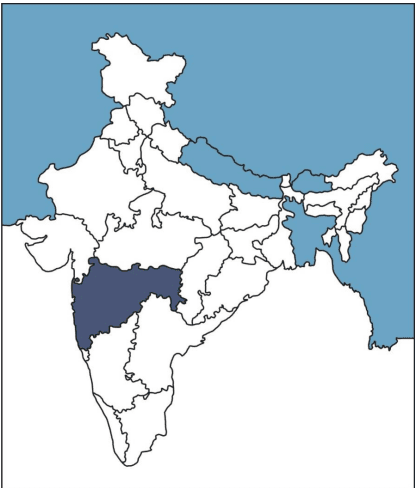
MAP OF INDIA
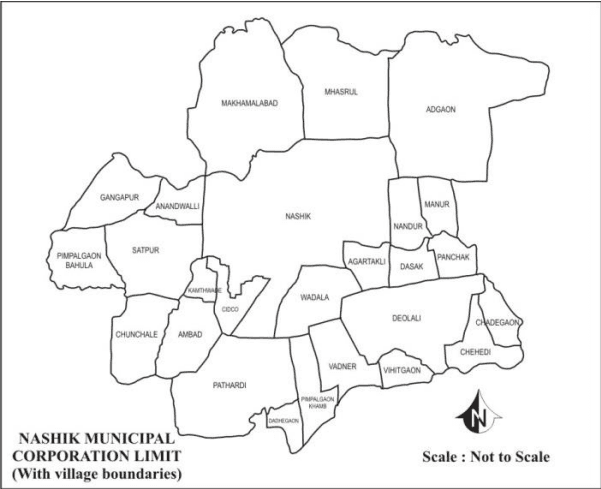
MAP SHOWING CORPORATION LIMIT
Round about 1216, Nashik was under Yadavas of Devagiri, who built most of the temples, known as ‘Hemadpanthi’. Devagiri rule continued till Muslims conquered them by the end of 13th Century. In 1637, on the overthrow of Nizamshahi Dynasty, Nashik territory was merged with Mughal Province of Aurangabad. In 1679, Shivaji Maharaj crossed Bheema and plundered fort Galana (near Malegaon). On his return, he was blocked near Sangamner, but could avoid the enemy due to superior knowledge of his guides. Shivaji Maharaj’s death in 1680, brought revival of Mughal Power and by 1818, Holkar’s possession over Nashik had all passed to the British. During 1857, Nashik was witnessing considerable disturbances and also during “Free India” movement. During first half of 20th Century, noteworthy revolutionaries operated from Nashik. Jackson Garden (now Shivaji Udyan) in Nashik witnessed the Patriotic aspirations of such revolutionaries. With the starting of “Mitra Mela” activity, Nashik stood prominently on the political horizon of the Country and became a strong centre of revolutionary activities headed by Late Shri. Vinayakarao Savarkar. Still, it is politically very important place since prominent politicians belong to this place.
Nashik and its adjoining areas are having very good fertile agriculture land and known for production of good quality of grapes. These grapes are exported to other countries. There are so many wineries in the area and is famous through-out India for good quality of wine. Therefore, this city is also known as Grape City or Wine City.
1.2 CIVIC Administration
Nashik is the Divisional Headquarter having 5 Districts within the Division. It is located on the Mumbai – Bhusawal – Nagpur route of the Central Railways.
The erstwhile Nashik Municipal Council was established in May 1864 and raised to the status of a City Municipal Council in 1874. Thereafter, it was a “A” Class Municipal Council, as per the provisions of the Maharashtra Municipalities Act, 1965; and had population of 2,62,428 souls according to 1981 Census. The Nashik road - Deolali Municipal Council was established in 1952. It was a “B” Class Municipal Council and had population of 77,666 souls, as per 1981 Census. Following establishment of Industrial Estate at Satpur by Maharashtra Industrial Development Corporation, the Government considered it necessary to have Municipal Council at Satpur to manage the fast growing civic demands. Accordingly, the Satpur New Township Municipal Council was established on 1 March 1972. It was a “C” class Municipal Council and had population of 19,952 souls, as per 1981 Census. The 20 villages around Nashik city, having aggregate population of 58,183 souls as per 1981 Census used to manage their affairs through the respective Grampanchayats.
The Nashik Municipal Corporation has been established vide Government in Urban Development Department’s Resolution No. NCC/ 1082/ 211(i) /UD – 21, dated 22-10-1982 to take effect from 7-11-1982. The Corporation limit included the areas of 3 erstwhile Municipal Councils, viz. 1) Nashik Municipal Council, 2) Nashik-road-Deolali Municipal Council & 3) Satpur Municipal Council. The entire area of Corporation consists of 25 villages out of which Vihitgaon, Vadner and Pimpalgaon Khamb are partly included. The Nashik Municipal Corporation is recently upgraded to a “B” class Municipal Corporation, vide Govt. Notification No. MCO-2014/CR-153/UD-14, dated 1/9/2014.
The Civic Administration, at present, is being managed by Nashik Municipal Corporation with the help of Municipal staff. The Main office of the Municipal Corporation is located in its own building at Rajiv Gandhi Bhavan, Sharanpur Road, Nashik. Another six ward offices are also in operation at main road (Nashik east), Pandit colony (Nashik West), Panchavati, Satpur, Cidco, Nashik Road to control the civic administration and provide facilities to the residents of Nashik City.
1.3 The Sinhastha Kumbhamela
The most spectacular of all the events, the ‘Kumbhamela’ is a religious festival which occurs every 3 years and is celebrated in four major pilgrim centres around the country by rotation. Thus Kumbh Mela is held at each of the four places every twelfth year. In Maharashtra, the festival is held in Trimbakeshwar and Nashik. The Nashik Kumbhmela is generally acknowledged to be the most sacred of all the festivals. It is a mammoth fair where saints and devotees gather for the festival.