2.3.1 Professional Services and Responsibilities
The responsibility of professionals with regard to planning designing and supervision of building construction work, etc and that of the owner shall be in accordance with Part 2 ‘Administration’. All applications for permits and issuance of certificates, etc shall be as given in Part 2 ‘Administration’. Employment of trained workers shall be encouraged for building construction activity.
2.3.2 Construction of all Elements
Construction of all elements of a building shall be in accordance with good practice [7(1)]. Constructional aspects using bamboo shall be as given in 2.3.3. It shall also be ensured that the elements of structure satisfy the appropriate fire resistance requirements as specified in Part 4 ‘Fire and Life Safety’, and quality of building materials/components used shall be in accordance with Part 5 ‘Building Materials’.
2.3.3 Construction Using Bamboo
2.3.3.1 Bamboo being a versatile resource characterized by high strength, low mass and ease of working with simple tools, it is desirable to increasingly make appropriate use of this material. Design of structures using bamboo shall be done in accordance with Part 6 ‘Structural Design, Section 3 Timber and Bamboo, 3B Bamboo’. For construction using bamboo, some of the important constructional provisions given in 2.3.3.2 to 2.3.3.6 shall be followed.
2.3.3.2 Working finishing
2.3.3.2.1 Bamboo can be cut and split easily with very simple hand tools. Immature bamboos are soft, pliable and can be moulded to desired shape. It takes polish and paint well.
2.3.3.2.2 While it is possible to walk with bamboo simply using a machete, a few basic tools, such as,
machete, hack saw, axe, hatchet, sharpening tools, adze, chisel (20 mm), drill, wood rasps, steel rod, and pliers, will greatly increase the effectiveness of the construction process.
2.3.3.2.3 For providing safety to the structure against fire, bamboo may be given fire retardant treatment using following chemicals; a few drops of concentrated HCl shall be added to the solution to dissolve the precipitated salts:
| Ammonium phosphate | 3 parts |
|---|---|
| Boric acid | 3 parts |
| Copper sulphate | 1 part |
| Zinc chloride | 5 parts |
| Sodium dichromate | 3 parts |
| Water | 100 parts |
2.3.3.2.4 Foundations
Bamboo in direct contact with ground, bamboo on rock or preformed concrete footing, bamboo incorporated into concrete or bamboo piles may form the foundation structure (see Fig. 1).
2.3.3.2.5 Floors
The floor of bamboo may be at ground level with covering of bamboo matting, etc. In elevated floors, bamboo members become an integral part of structural framework of building. The floor will comprise structural bamboo elements and bamboo decking.
2.3.3.2.6 Jointing Techniques
The jointing techniques in construction using bamboo shall be in accordance with Part 6 ‘Structural Design, Section 3 Timber and Bamboo, 3B Bamboo’.
2.3.4 Low Income Housing
For low income housing, appropriate planning and selection of building materials and techniques of construction have to be judiciously done and applied in practice. Requirements of low income housing specified in Part 3 ‘Development Control Rules and General Building Requirements’, shall be followed. However, all requirements regarding structural safety, health safety and fire safety shall be in accordance with this Code.
2.3.5 Site Preparation
While preparing the site for construction, bush and other wood, debris, etc, shall be removed and promptly disposed of so as to minimize the attendant hazards.
Temporary buildings for construction offices and storage shall be so located as to cause the minimum fire hazards and shall be constructed from non-combustible materials as far as possible.
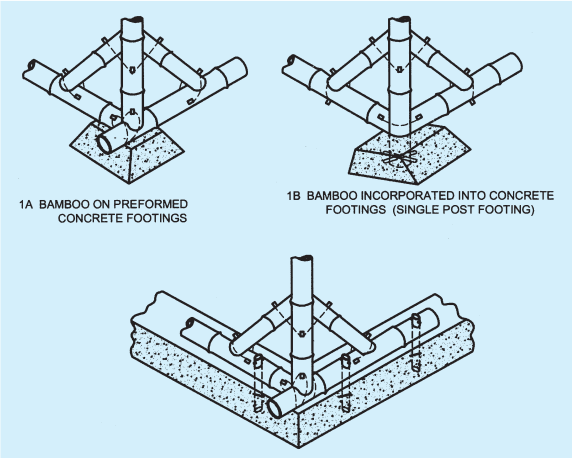
1C BAMBOO OUT OF GROUND CONTACT ON STRIP FOOTINGS OF CONCRETE (LARGE DIAMETER THICK WALLED BAMBOO WITH CLOSELY SPACED NODES TO BE USED)
FIG. 1 BAMBOO FOUNDATIONS
2.3.6 Use of New/Alternative Construction Techniques
The provisions of this part are not intended to prevent use of any construction techniques including any alternative materials, not specifically prescribed by the Code, provided any such alternative has been approved. The Authority may approve any such alternative such as ferrocement construction, row-lock (rat trap) bond in masonry, stretcher bond in filler slab and filler slab provided it is found that the proposed alternative is satisfactory and conforms to the provisions of relevant parts regarding material, design and construction and that material, method, or work offered is, for the purpose intended, at least equivalent to that prescribed in the Code in quality, strength, compatibility, effectiveness, fire and water resistance, durability and safety.