The increasing need of urbanisation further aggravated by the rural push factors is directly affecting the quality of life and environment. Such areas shall not be merely left to the factors of natural growth and can be identified for Regional
planning. A region is a flexible concept and can be referred to as a continuous and localised area intermediate between National and Urban levels.
The District Planning Committees is to be the single decision making committee, which can address to the issues of planning in the District. In many States, DPC's are not constituted, however, in some of them, the Town and Country Planning Acts provides a legal framework for constitution of Regional Development Authorities. For example, the Bombay Metropolitan Region Development Authority Act, 1974 makes it mandatory to constitute the Metropolitan Regional Development Authority for the planning and development of Mumbai metropolitan city.
Whenever functional areas cut across different State boundaries there may be problems of co-ordination in administration. Ideally in such cases, a unified RDA (for this specified region) may be instituted with representation from each of the State.
In the present scenario, Indian metropolitan cities have planned development, which partially satisfies the aim of the 73rd & 74th CAA, however, incomplete adherence of the Act has resulted into lack of holistic planning. Thus, it is required that state governments amend respective State Town and Country Planning Acts and provide a structure of regional planning with appropriate administrative structure to carry out its preparation and implementation.
Such regions are holistic from administrative point of view and there are little chances of conflict when there is a single administrative unit. The present planning system for only urban settlements has developed islands of growth centres, creating vast disparity. Planning for district as a region is the approach in which country as whole can be covered in planning exercise leaving no intermediate space. Thus, for convenience of administration of regions and entire coverage of country under planned development the structure of regional planning should be followed.
The 12 th Five Year Plan has emphasised on regional development particularly DPC composition to control and regulate unplanned development beyond the urban areas i.e. urban sprawl/ scatter. The State T&CP Acts provide statutory setup for urban and regional planning and development. In many States Special Area Planning Acts, similar to Regional Planning, are also in place.
Transport linkages play an integral role in the growth of urban nodes. As movement of goods, services and alignment of infrastructure follow the transport network while the human settlement and economic activities generally follow the transport lines. Lately, Government of India has recognised the potential of transport corridors as instrument of imparting economic push to
large region and thus has been implementing programmes, which are spread across a large region like, Delhi Mumbai Industrial Corridor (DMIC) Programme. The objective of DMIC project is to expand India's manufacturing and service base and develop DMIC as a "Global Manufacturing and Trading Hub". The project will provide a major impetus to planned urbanization in India with manufacturing as the key driver.1.
The National Highway Development Programme (NHDP) was launched in 2000 to upgrade and strengthen National Highways and one of the advantages identified under the NHDP is all round development of areas. Other transport oriented regional corridors conceptualised are the Eastern and Western Freight Corridors. Keeping these developments in mind, Transit Oriented Development (TOD) approach to plan and develop regions can be adopted.
There are other types of regions as well, which have homogeneity and linkages in terms of investment, tourism and natural environment. In India, owing to its vast stretch and heterogeneity, multiple/different typologies of regions could be adopted for planned development. The regional planning approach is suggested in these guidelines for planned and sustainable development of the human settlements.
http://www.dmicdc.com
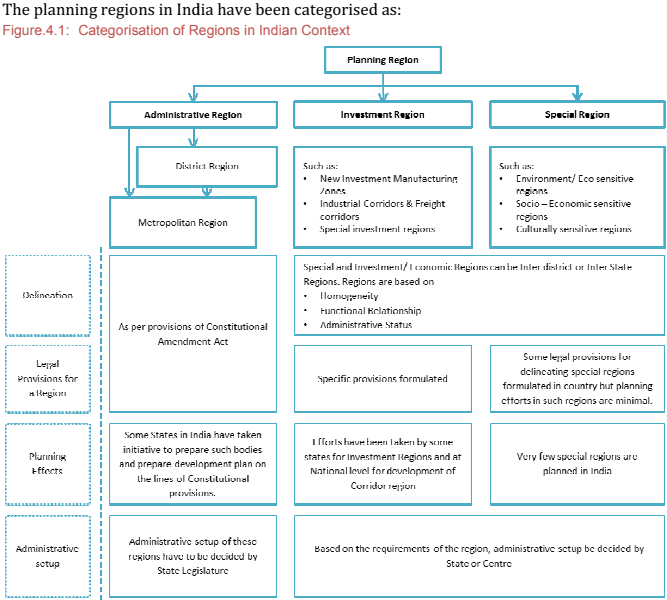
Source: Compilation from 73 rd & 74 th CAA, State Administrative set-ups and regional planning cases in India