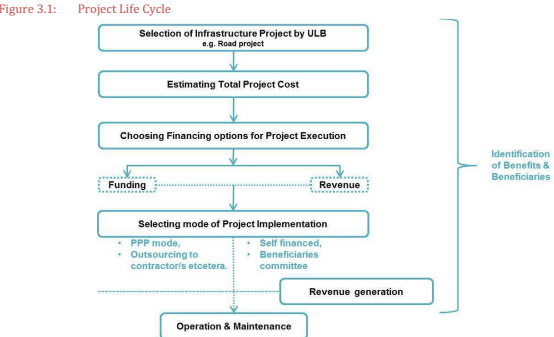
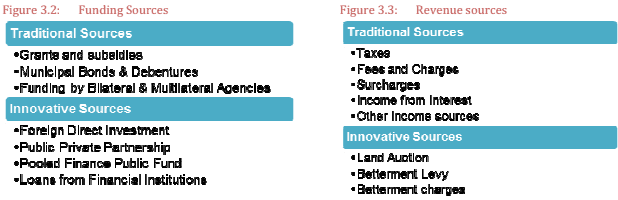
Land assembly and development mechanism are undertaken for achieving optimum social use of urban land and to ensure adequate availability of land to public authority and individuals. Public private participation is achieved in land development through various techniques. Mainly, land assembly techniques prevent concentration of land in few hands and promote its efficient social and economic allocation. Some of the land assembly techniques also promote flexibility in land utilization in response to changes resulting from growing city. The various mechanisms to assemble and/or develop land are enlisted below:
■ Land Acquisition: bulk land acquisition by State and by private initiatives.
- Land Pooling: land pooling approach and redistribution scheme, popularly known as Town Planning schemes.
- Land Reservations: the concept of Accommodation Reservation which allows the land owner to develop the sites reserved for an amenity.
2 Appendix B of Volume II B provides definition for land and associated terms.
■ Transferable Development Rights: a technique of land development which separates the development potential of a land parcel for use elsewhere.
Guided Land Development: this model uses the provision of infrastructure as an instrument to guide urban development in partnership with landowners without pooling any land.
3.2.3.1 Land acquisition
“Land Acquisition” popularly means the acquisition of land for defined public purpose by a government agency from individual landowners, as authorized by the law, after paying a government-fixed compensation to cover losses incurred by landowners from surrendering their land. The land acquisition process can be undertaken by the State or through private initiatives. As of now, most of the land acquisition is to be processed as per the RFCTLARR, 2013. Some models of land acquisition are as follows:
Bulk land acquisition method as a State Initiative:
In this method, Master Plan is prepared for the entire area encompassing different land uses and involving various activities. Land is developed in accordance to the planning norms for various uses/activities. Bulk land is acquired from farmers by the development agency and compensation is paid to farmers/owners based on the provision of prevailing act.
Bulk land acquisition method with Private Initiative:
To defray the cost of land acquisition some state governments and ULBs have developed models in which private sector acquire land by directly paying compensation to the affected families. A variety of models are in existence per which land is acquired for planned development with private partnership.
Haryana Guided Land Development Model: In this model, the private developer can acquire land directly from farmers at market price and at the same time, it permits a land owner to assume the role of a colonizer. This model provides fixed time period of 5 years to utilize that land acquired (initially 2 years, then extension of 3 years, if required) and the developer is expected to complete the projects within this period. Major highlights of this model are that the difficulties and delays inland acquisition are avoided and pressure on government to pay compensation is reduced, overall enhancing investments.
Ghaziabad Joint Venture Model: As per approach followed by Ghaziabad Development Authority (GDA), a joint venture (JV) is formed between the GDA and the builders/developers/co-operative societies through open bid (based on technical and financial capabilities). Twenty per cent of the plots developed are to be reserved for EWS/LIG and the costing and allotting of social facility by developer has to be done as per the government regulations. The balance of the land is to be sold by the developer at profit. For the entire process, the
development authority acts only as a facilitator. Project duration is specified in the JV agreement and penalty is imposed if developer requires time extension, thus making sure that land is utilized within the stipulated time period.
Hyderabad Differential Compensation Models: In Hyderabad, the land acquisition technique has been modified into two different models, in which while acquiring land for public and private projects, different level of compensations are arrived at, these are-
Model I: When land is acquired for projects mainly for public purpose such as roads, power generation and distribution, irrigation, schools, welfare housing, environmental projects etc., appropriate compensation is paid to landowners by consulting them.
Model II: When land is acquired for projects such as SEZ, Industrial Estates, Satellite townships and others where value addition enhances the land prices substantially, mainly for third party use, compensation is normally worked out on profit sharing basis, which is in two parts, namely-
• Basic Value (Government Rate) of Land
- % Equity Sharing in SPV / % of Net Developed Area / Built Space
CIDCO Model of Land Development in Navi Mumbai follows the technique of land banking for land assembly. The compensation to land owners is done by the way of monetary and land compensation. But in Vasai Virar sub-region, CIDCO undertook the land assembly by obtaining power of attorney from landowners or outright purchase of freehold lands located close to each other by private developers or builder. The promoter is solely responsible for providing and maintaining infrastructure for consolidated land parcel.
3.2.3.2 Land pooling
In Town Planning or Plot Reconstitution Scheme, the land is pooled and its development is financed with the involvement of landowners without compulsorily acquiring land. This land assembly technique helps to provide plots for basic services in a planned layout from the original haphazard arrangement. Costs incurred by the developmental authority for development and for infrastructure are recovered from the sale of few of the final land plots reserved by the authority and betterment charges levied on land owners. The reconstituted plots are allotted to the landowners in proportion to their original land holdings.
The scheme was first introduced in the Maharashtra Regional and Town Planning Act, 1966 and later in Gujarat Town Planning & Urban Development Act, 1976 and is now widely appreciated model of land assembly. Another deviation of the land pooling mechanism has been recently introduced by the Delhi Development Authority (DDA), wherein DDA facilitated developers and landowners to pool land for development.
The town planning scheme is referred as ‘land acquisition without tears’ and has the following key advantages:
■ Infrastructure is provided in coordinated way.
■ Partial cost is recovered through betterment charges.
- Land for public and community purposes including green & open spaces is acquired without direct expanses.
■ Community benefits through unified planning.
■ Landowner shares the project cost and benefits by increased property prices.
However, the Land Pooling Scheme suffers from certain difficulties, such as:
- Delay in process of preparation, approval, arbitration and implementation, mainly due to litigations.
There are issues related to cost recovery.
There is also inadequate public participation in such schemes. To overcome the drawbacks of TP scheme, some suggestions are enlisted below:
■ Division of scheme into planning and financial part, which has been done in the Gujarat model.
- Appointment of an arbitrator and a project planner by local authority to modify the plan after initial preparation, who would undertake active consultation with original stakeholders pre and post plan preparation.
The contribution, which is based upon the estimated value of land assuming full development as per the scheme, should be replaced by estimated cost of the scheme.
■ Provision of Transferable Development Rights in lieu of compensation to original plot holders can be considered.
- Land pooling schemes to be prepared only for the areas included in current development plan.
Land development for Schedule-6 areas: Some North-east states have areas covered under the Schedule 6 of the Constitution. In such areas, land development and planning are not directly under the control of the State government but vests with the Autonomous District Councils and mainly under community ownership. Therefore, communities can be involved in development process of the settlements as it may be viable and easier approach.
3.2.3.3 Land reservations
The concept of Accommodation Reservation allows the land owners to develop the sites reserved for an amenity in the development plan using full permissible Floor Space Index (FSI)/ Floor Area Ration (FAR) on the plot, subject to agreeing to entrust and hand over the built-up area of such amenity to the local authority free of all encumbrances and accept full FAR/FSI as compensation in lieu thereof. The area utilized for the amenity would not form part of FAR/FSI calculation.
Reservations such as retail markets, dispensaries, etc. can be implemented in this way wherein local authority is not required to acquire the land by incurring expenditure on payment of compensation. In case of reservations like shopping centres etc., the owner can be allowed to develop these on agreeing to give at least upto 25% of the shops to the local authority for the purpose of rehabilitation of the displaced persons on payment of cost of construction.
In case of road widening/ new construction, the local authority can grant additional FSI on 100% of the area required for the purpose, provided the owner surrenders the land for widening or construction of new roads to the local authority free of all encumbrances and accept the additional FAR/FSI as the compensation in lieu thereof. This mechanism has considerably relieved local authorities from incurring huge expenses for the purpose of acquisition of such lands. The model can be explored for other non-economic activities such as open spaces, public utilities among others.
The concept of accommodation reservation has been incorporated in the Development Control Rules of the Mumbai Municipal Corporation.
3.2.3.4 Transferable Development Rights (TDR)
TDR is a technique of land development, which separates the development potential of a particular parcel of land from it and allows its use elsewhere within the defined zones of the city. It allows the owner to sell the development rights of a particular parcel of land to another. This entitlement is over and above the usual FSI available for receiving plot in accordance with the prevailing laws and regulations, which entitles a landowner to construct additional built-up area on his existing building or vacant land.
TDR is taken away from the zone and it is tradable which makes it different from Accommodation reservation. This is also generally used for redevelopment of inner city zones and for reconstruction/ re-development and has been tried out in numerous cities/ States including Bengaluru, Chennai, Mumbai and Rajasthan. However it has its prospects and consequences as experienced from the implementation in various cities. For instance, unbridled pooling of TDRs could damage the urban form! Hence it should be used carefully. States like Karnataka and Rajasthan have made provisions to mitigate such effects.
3.2.3.5 Guided Land Development
Guided land development model uses the provision of infrastructure as instrument to guide urban development. This is done in partnership with landowners who pay for the cost of providing services to their land and in return donate land for public infrastructure and a payment as betterment levy. This model, also proposed by the United Nations Economic & Social Commission for
Asia & Pacific (UNESCAP), has been for guiding the conversion of privately owned land in the urban periphery. It uses a combination of traditional government role of providing infrastructure and the enforcement of land subdivision regulations. The key advantage of the approach is that it is less costly than outright land acquisition and more equitable than land banking.
The principle behind guided land subdivision is that the government agency proactively selects the direction where it feels urban development should take place and provides infrastructure in those areas. This acts as an incentive to encourage developer to invest in the planned area selected by the government agency. The cost effectiveness of guided land development approach results from the fact that land development is planned, designed and implemented with the landowners of the designated area, who donate land for roads and right of way for infrastructure and public spaces, as well as pay a betterment levy to meet the costs of the project. To finance the scheme, a loan is initially taken to build the infrastructure, which is paid from betterment levies provided by landowners either on annual installments or in lump sum upon sale of land. The infrastructure is provided by the government agency upto the site. Individual landowners are supposed to subdivide their land for various developments and lay the on-site services.
But Guided land is often fraught with difficulties on the ground. First, as the model depends on the consent of the landowners it cannot be applied in areas with fragmented landownership, lack of owners' will and consensus. Second, collection of betterment levies may not be feasible by small landholders and lead to default of payment.