Service: the equipment for delivering energy from the supply or distribution system to the premises served.
Service water heating equipment: equipment for heating water for domestic or commercial purposes other than space heating and process requirements.
Set point: the desired temperature (°C) of the heated or cooled space that must be maintained by mechanical heating or cooling equipment.
Shading Coefficient (SC): measure of thermal performance of glazing. It is the ratio of solar heat gain through glazing due to solar radiation at normal incidence to that occurring through 3 mm thick clear, double-strength glass. Shading coefficient, as used herein, does not include interior, exterior, or integral shading devices.
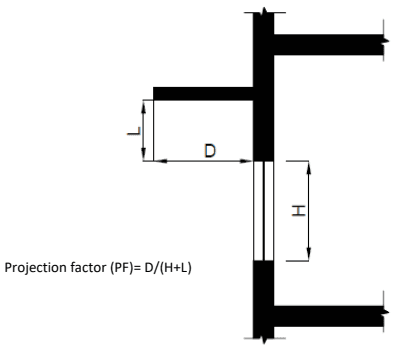
Shading Equivalent Factor: coefficient for calculating effective SHGC of fenestrations shaded by overhangs or side fins.
Shopping Mall (Shopping Complex): a large retail complex containing a variety of stores and often restaurants and other business establishments housed in a series of connected or adjacent buildings or in a single large building. The circulation area and atrium of the mall is an enclosed space covered completely by a permanent or temporary structure.
Simulation program: software in which virtual building models can be developed to simulate the energy performance of building systems and daylighting analysis
Single-zone system: an HVAC system serving a single HVAC zone.
Site-recovered energy: waste energy recovered at the building site that is used to offset consumption of purchased fuel or electrical energy supplies.
Slab-on-grade floor: floor slab of the building that is in contact with ground and that is either
DEFINITIONS
DEFINITIONS
above grade or is less than or equal to 300 mm below the final elevation of the nearest exterior grade.
Solar energy source: source of thermal, chemical, or electrical energy derived from direction conversion of incident solar radiation at the building site.
Solar Heat Gain Coefficient (SHGC): the ratio of the solar heat gain entering the space through the fenestration area to the incident solar radiation. Solar heat gain includes directly transmitted solar heat and absorbed solar radiation, which is then reradiated, conducted, or convected into the space.
Solar Reflectance: ratio of the solar radiation reflected by a surface to the solar radiation incident upon it.
Space: an enclosed area within a building. The classifications of spaces are as follows for purpose of determining building envelope requirements:
(a) Conditioned space: a cooled space, heated space, or directly conditioned space.
(b) Semi-heated space: an enclosed space within a building that is heated by a heating system whose output capacity is greater or equal to 10.7 W/m2 but is not a conditioned space.
(c) Non-conditioned space: an enclosed space within a building that is not conditioned space or a semi-heated space. Crawlspaces, attics, and parking garages with natural or mechanical ventilation are not considered enclosed spaces.
Star Hotels/motels (Star Hotel): any building or group of buildings under single management and accredited as a starred hotel by the Hotel and Restaurant Approval and Classification Committee, Ministry of Tourism, in which sleeping accommodation, with or without dining facilities is provided.
Stand-alone Retail (Shopping Complex): a large retail store owned or sublet to a single management which may offer customers a variety of products under self-branding or products of different brands. The single management shall have a complete ownership of all the spaces of the building and no space within the building is further sold or sublet to a different management.
Standard Building: a building that minimally complies with all the mandatory and prescriptive requirements of Energy Conservation Building Code and has same floor area, gross wall area, and gross roof area of the Proposed Building.
Standard Design: a computer model of a hypothetical building, based on actual building design, that fulfils all the mandatory requirements and minimally complies with the prescriptive requirements of ECBC, as described in the Whole Building Performance method.
Story: portion of a building that is between one finished floor level and the next higher finished floor level or building roof. Basement and cellar shall not be considered a story.
Summer Solar Insolation: measure of solar radiation energy received on a given surface area from the month of March to October within the same calendar year. Units of measurement are watts per square meter (W/m²) or kilowatt-hours per square meter per day (kW•h/(m²•day)) (or hours/day).
Super ECBC Building: a building that complies with the mandatory requirements of §4 to §7 and also complies either with the prescriptive requirements stated under the Super ECBC Building categories of §4 to §7, or, with the whole building performance compliance method of §9. This is a voluntary level of compliance with ECBC.
Super Market (Shopping Complex): supermarkets are large self-service grocery stores that offer customers a variety of foods and household supplies. The merchandise is organized into an organized aisle format, where each aisle has only similar goods placed together.
System: a combination of equipment and auxiliary devices (e.g., controls, accessories, interconnecting means, and terminal elements) by which energy is transformed so it performs a specific function such as HVAC, service water heating, or lighting.
System Efficiency: the system efficiency is the ratio of annual kWh electricity consumption of equipment of water cooled chilled water plant (i.e. chillers, chilled and condenser water pumps, cooling tower) to chiller thermal kWh used in a building.
System, existing: a system or systems previously installed in an existing building.