To achieve a sustainable society. It is important to achieve these measures:
- Use of energy, water and other natural resources efficiently and carefully
- Minimise waste, recycling, composting or energy recovery and finally dispose of what is left.
- Limit pollution to levels which do not damage natural systems
• Value and protect the diversity of nature
- Protect human health and amenity through safe, clean, pleasant environments
• Emphasis health service, prevention action as well as care
- Maximise everyone's access to the skills and knowledge needed to play a full part in society
- Ensure access to good food, water, housing and fuel at a reasonable cost
- Encourage necessary access to facilities, services, goods and other people in ways which make less use of the car and minimise impacts on the environment
• Make opportunities for culture, leisure and recreation readily available to all
- Meet local needs locally wherever possible Create or enhance places, spaces and buildings that work well, wear well and look well
• Make settlements 'human' in scale and form
- Value and protect diversity and local distinctiveness and strengthen local community and cultural identity
- Empower all sections of the community to participate in decision making and consider the social and community impacts of decisions.
- Create a vibrant local economy that gives access to satisfying and rewarding work without damaging the local, national or global environment
• Value unpaid work
3.2Environmental Considerations
The green areas in and around region shall be developed as a fertile zone in the sector of food production, forestry, soil conservation, village development and other essential for sustainable development. Forest cover shall be increased by forestation activates.
Various cities around the world are already setting targets and introducing polices for promoting renewable energy and reducing GHG emissions and on the lines JDA also planning to take various measures to reduce GHG emission.
3.2.1 Afforestation
The Forest area in Jaipur region shown by census do not include areas of reserved forests and protected forests in surrounding hills that amount to approximately 75 km2. From another perspective, overall, it is necessary regenerate at least 1 medium sized mature tree as desirable number per person in Jaipur, to increase forest cover
There are large chunks of land in forest area which is lying bare owing to deforestation and forest degradation activities. There is an urgent need to identify these areas and to find out technologies for afforestation of these areas, so that deforestation can be stopped to reduce GHG emission and generate a healthy environment.
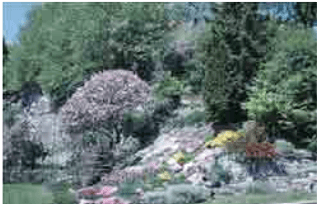
MDP 2025 attends to develop Rock cut area in Jaipur region. These Rock cut areas in Eco sensitive zone are lying unused which can be developed and landscaped as rock garden, botanical garden for both educational and entertainment purposes.
Landscaping on Rock cut/hilly areas
A hill can be landscaped in various ways and can be converted in to a beautiful garden that has colorful flowering plants. but it is necessary to take measure to prevent soil erosion and land slides while designing.
Before landscaping on
Hilly/Rock cut areas it is necessary to ensure that the soil does not get eroded in the long term. A heavy layer of mulch can be used to prevent erosion. Grass grows efficiently to prevent.
While landscaping a rocky area small retaining wall at stretches can also be constructed as it prevents landslides and also ensure the soil is not eroded. They are designed specifically to offset slopes while enhancing the curb appeal for landscape. A retaining wall maintains water level in the plants and adds to the beauty significantly.
The above measures are needed to bring beauty to the rock cut areas.
Landscaping can also be done by cutting the gentle slope to make terrace gardens. A hill can be landscaped by creating a rock garden. A rock garden could be constructed to hold the shape of a hill. A rock garden would help to redirect the water coming down the slopes of the hill landscape to a sump to be recycled later or to the vegetation on level ground below the hill.
3.2.2 Water Harvesting
To recharge ground water and increase water table JDA has made various efforts which are on going, viz:
- Mandatory provision of Rain water harvesting in plots more than 300 sqm area
- 21 institutes are registered as "JALDOOT" for providing information on rain water harvesting to general public.
- Financial assistance for Construction of Storm water and roof top water harvesting structure in public buildings
- All big parks will have treatment plant for recycling of waste water for horticulture use.
- Provision of drip irrigation in all big parks to reduce water consumption and reduce grass cover by planting more trees.
The artificial recharge of groundwater shall be practised to augment natural replenishment of groundwater reserves. JDA has identified various injection lines in Jaipur region for recharging of water. It is necessary to protect these points and create water bodies around these points for easy recharge of ground water. These injection lines should be treated for underground water recharge so the recreational areas can be proposed at these places.
3.2.3 Water Shed Management
Since water is a key resource and we can never create more water, therefore, water management deserves priority in the development and preservation of any area. All the old water bodies which are dried up due to lack of maintenance shall be regenerated. The institutions like 'water parliament' shall be encouraged. Watershed management shall be improved and general public shall be educated about watershed problems and their remedies. It must be an integrated programme, with the involvement of people right from demarcation of watershed to implementation.
3.2.4 Environment effect of Urban Transport
The comprehensive mobility plan for Jaipur Proposes various transport projects for Jaipur which can help in reducing Green house gases emission level. These projects when implemented have positive impact on the environment. The element of emission from vehicles such as carbon-monooxide, Hydrocarbons and particulate matter may significantly reduced in the year 2031, but if no projects are implemented, it can result in High emission of GHG gases as indicated:
SI
Elements
2031 (Tons/day)
2031 (Tons/day)
Do Nothing
With Projects
1
Carbon Mono oxide
26.17
20.84
2
Hydro Carbons
11.44
9.3
3
Particulate matter
0.75
0.63
"Hence efforts have to make to reduce the effect of air and noise pollution due to urban transport and to protect the environment for a sustainable development".
3.3Master Development plan-2025
A Master plan, prepared for urban areas, serves as an instrument and policy framework to guide the process of urban development. over the years it has emerged as an important approach to urban planning in the country.
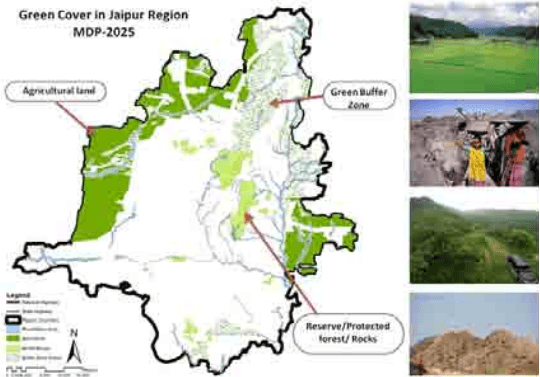
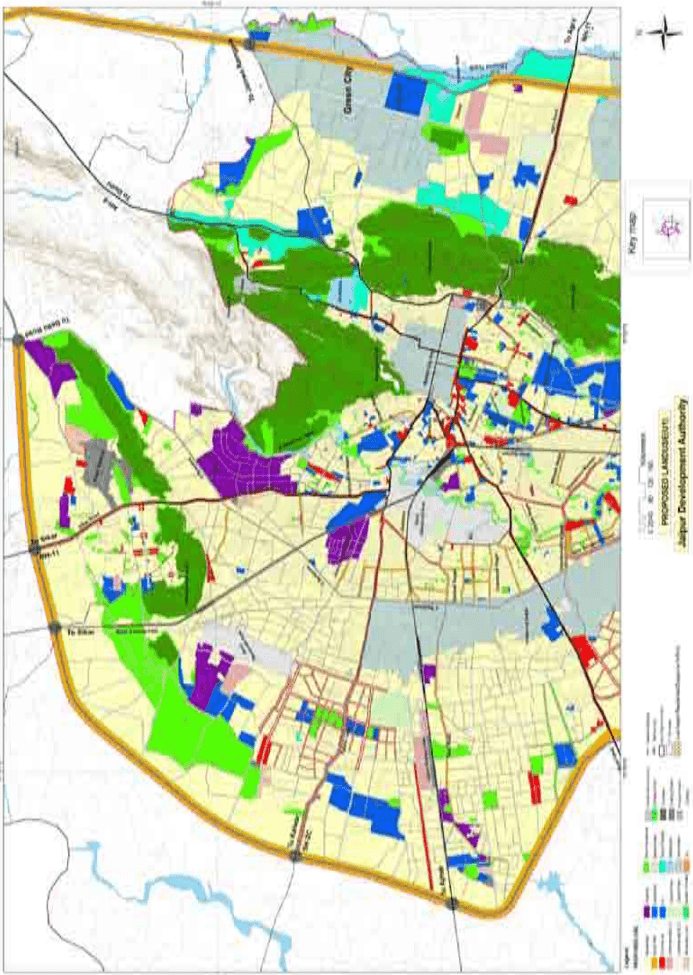
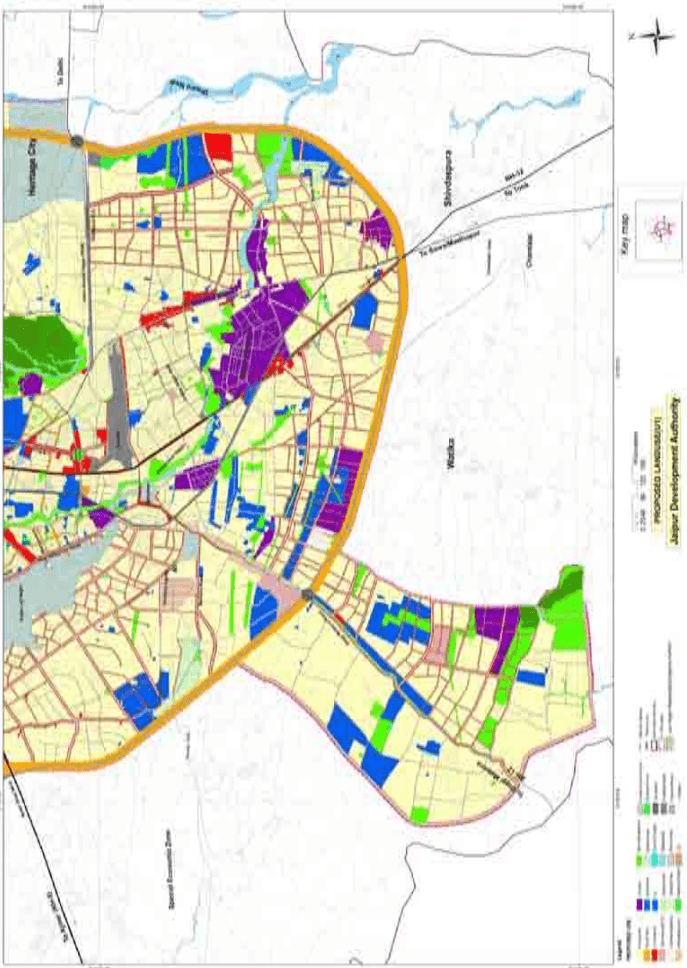
The land use plan of Jaipur is proposed, keeping in view the basic ideals of a developing city and the innovative approach being developed. The land use is based on the following premises; the built-up area, consisting of buildings and developments for residential, commercial, institutional, industrial and utility area along with circulation. the largely unbuilt part consist of agricultural uses, reserve/protected forest, hills, river/nallah/water bodies and a number of green activities.
A world class green spaces including various ecological areas/nature surrounds residential and commercial areas, making life on the greens a reality. The green activities are linked to the promotion of sustainable development, surrounding the built up area and acting as interface between the city and its bio region with Development Promotion and Control Regulations One.
(GSI) geological survey of India, has defined the Land capability of the Jaipur region for various uses based on various geo-factors such as geology, hydrology, ground water conditions, soil conditions and environmental geo hazards. As per these suitability units MDP there are three types of green spaces in MDP-2025 Jaipur region, namely, Agriculture area, Eco sensitive area (Hills/Reserve/protected forest) and Buffer zone adjoining G1. These green spaces cover about 30% of region area. The Master Development Plan 2025, proposed to enhance the per capita of open space for the population projected to grow to 6.50 million by the year 2025, besides this State-of-the-art infrastructure, excellent institutional and healthcare facilities, lush greens, everything is attended planned to excel even under the most discerning eye. The Master plan has considered the each and every aspect of development to fulfil the purpose of the infrastructure.
The master plan takes into account local living and work practices together with an analysis of the current state of the region's infrastructure. It also visions an intense and close relationship between the city area and the rural areas including the green belt which will be synergic nature, thus reducing the urban and rural divide that has crept in to planning so far and encouraging a rural-urban continuum. The approach of master plan is to establish that economic and human intellectual resources which, normally gravitate to urban areas, can be effectively used to plan development more evenly and to create an equitable and economical sound society.
One of the most useful strategies for enhancing the urban green spaces in Jaipur would be to protect and develop adjoining forest lands in accordance with Forest (Conservation) Act, 1980, and after carrying out appropriate Environmental Impact Assessment by investing in sequential restoration and enrichment of local biodiversity. Urban green spaces serve important social, psychological, health, aesthetic, ecological and economic functions. In the face of rapid urbanization of Jaipur city, developing forest lands as urban green spaces and botanical gardens would be a prudent conservation strategy. Indeed, this could be a vital tool to solve the challenge of forest land encroachments in urban proximity.
3.4Downstream Projects for Energy efficiency
Taking measures to reduce the GHG emission and Global warming, will not only increase energy efficiency and promote sustainable development in Jaipur region but also it can earn CER by selling carbon credits under KYOTO protocol. As per the brief research following projects have potential to be undertaken in Jaipur region.
• Reducing Emissions from Deforestation in and Forest Degradation in Developing Countries (REDD)
• Reducing Emissions from human-induced land-use change and forestry activities, limited to afforestation and reforestation
• Avoiding emission from Solid waste through alternative waste treatment processes
• Mitigation of greenhouse gas emissions from treatment of industrial wastewater
- “Mitigation of greenhouse gases emissions with treatment of wastewater in aerobic wastewater treatment plants”.
• Solar thermal domestic water heating systems.
• Installation of zero energy water purifier for safe drinking water application.
- “Avoidance of landfill gas emissions by in-situ aeration of landfills”.
• Rail/Bus based Urban Mass Rapid Transit Projects.
• Grid-connected electricity generation from renewable sources.
Chapter 3Power Distribution
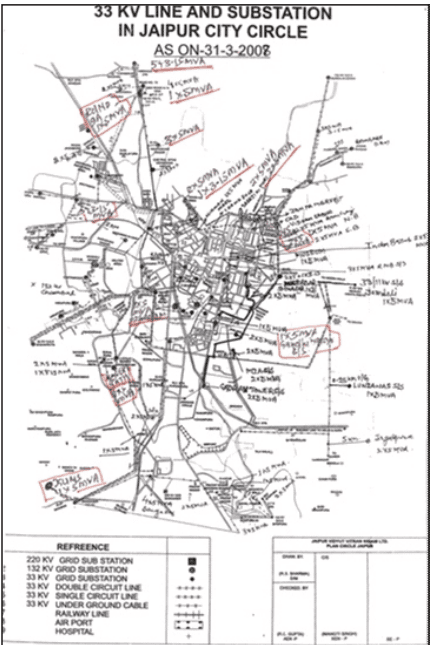
Power distribution of Jaipur City and it is environs by Jaipur Vidhyut Vitran Nigam Ltd. The existing city is having 220 KV, 132 kv and 33 kv grid substations and 33 kv double circuit line, single circuit line & underground cable.
In the entire city (the map enclosed) enumerate the distribution system in the existing city. Further, it is also proposed that as per the requirement looking into the future growth of the Zonal Development plans as and when prepared the the sites may be suggested for suitable locations after technical inputs from RVVNL for the Sub-stations. More reservation of facility area at scheme level present effective distribution system.
Map 2-20 Power Distribution in Jaipur city
2.13
Land uses in
Master plan
2025
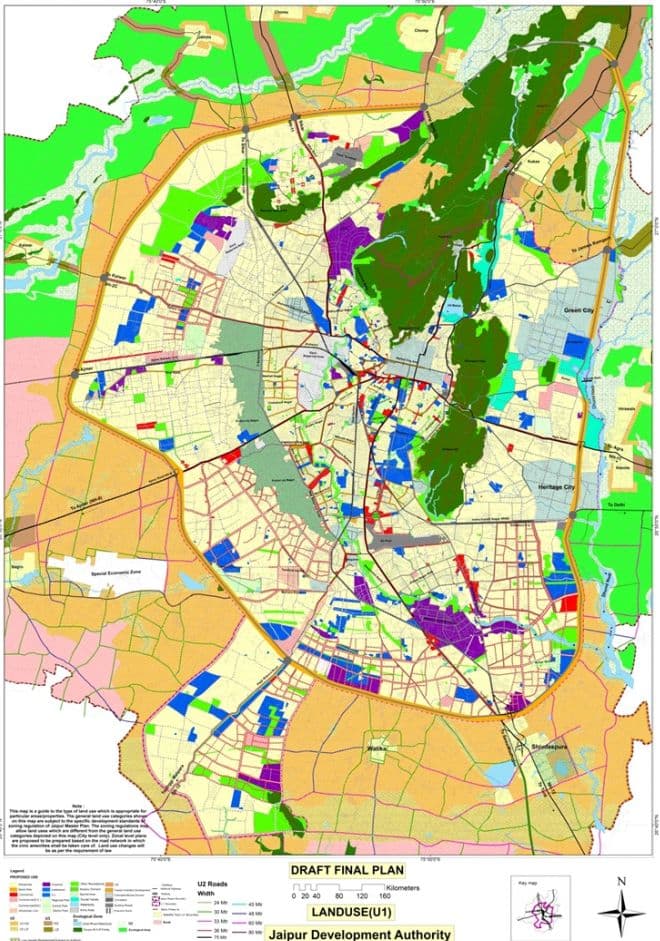
In order to reorient and redefining the system of change in land use the basic frame work of the urbanisable area is categorized with minimum number of major heads while defining the land use zoning in the urbanisable area. These are further supported by development controls and proposed development plans in reading the sub-heads use premises. The land use zoning was provided with major heads as mentioned below for the horizon Year 2025.
The following table enumerate the land use under each head provided for Jaipur
Table 2-17Land use for Urban Area-I (2025)
Land use for U1 -2025
S. No.
Use
Area (sq km)
Percentage
1
Residential
457.46
48.39
2
Commercial
72.22
7.64
2.1
Retail
31.57
3.34
2.2
DC
6.22
0.66
2.3
SCC
0.50
0.05
2.4
WC
4.01
0.42
2.5
Mixed
29.58
3.13
2.6
TOD
0.33
0.03
3
Public Semi Public
52.00
5.50
4
Govt Use
0.44
0.05
5
Army Area
10.42
1.10
6
Tourist Facility
10.32
1.09
7
Industry
26.38
2.79
8
Special Area
70.36
7.44
9
Circulation
100.30
10.61
10
Recreational
62.99
6.66
11
Nursery & Orchards
0.33
0.03
11
Water Bodies & Drain
7.99
0.85
12
Open Forest
70.97
7.51
13
Open Space
0.35
0.04
14
Ecological
0.48
0.05
15
U3 Area
2.33
0.25
Total
945.34
100.00
Map 2-21 land use plan-2025 for U1 area
CHAPTER
Quality of Life
Thought the level and quality of Infrastructure has been upgraded considerably, yet keeping the Importance of the Jaipur city, it is obligatory that the quality of life be brought at par with International standards.